Wraps & Liners
Edible Gold Leaf Sheet
Whisper-thin sheets of pure edible gold used to gild desserts, chocolates, and special dishes.
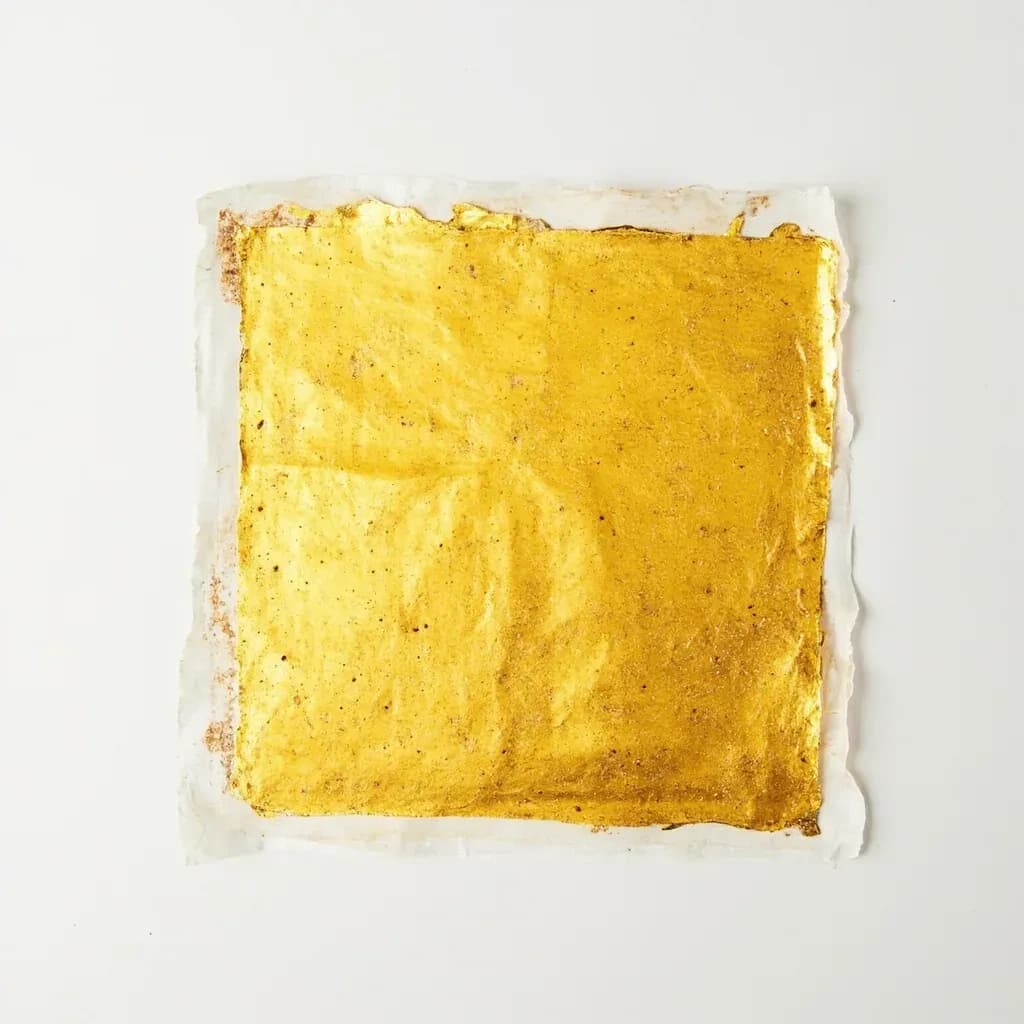
An edible gold leaf sheet is an extremely thin layer of pure, food-grade gold pressed onto transfer paper. Pastry chefs apply it with a dry brush or tweezers to gild chocolates, cakes, and plated dishes for a luxurious finish. It is flavorless and inert, valued purely for the shimmering decorative effect.
Edible gold leaf is what you get when a jeweler's craft meets a pastry finish: a sheet of nearly pure gold beaten so thin — roughly 0.1 to 0.125 microns — that it becomes a gossamer membrane you can pick up with a brush. It has no flavor, no aroma, no calories, and is biologically inert; it passes through the body unchanged, which is precisely why food regulators in both the EU (E175) and the US (FDA GRAS) permit it as a decorative additive. In the kitchen it is a finishing material, not an ingredient: it does not cook, melt, or infuse, and it contributes nothing to taste or texture beyond a faint, almost imperceptible silkiness when applied thickly.
For cooks, its real value is visual. Laid over dark chocolate, a mirror glaze, espresso buttercream, or black sesame cream, the leaf catches and reflects light in a way no other garnish can replicate. Because a single gram of gold beats out to roughly a square meter of leaf, even a precious 24-karat sheet goes surprisingly far — one transfer sheet will gild 20 to 30 standard bonbons or a full entremet. The craft of beating gold into leaf is ancient, refined in medieval Italy and perfected in Edo-period Kanazawa, Japan, where most of the world's edible leaf is still produced today.
Alternatives
Types & varieties
Free-floating sheets pressed between layers of tissue; the traditional form, lightest and most fragile, lifted with a brush.
Leaf pressed onto a waxed paper carrier so it can be rubbed off onto a surface; the kitchen workhorse and the easiest to handle.
Pre-torn fragments in small jars or shakers; scattered for an unstudied, broken effect on desserts and drinks.
Granulated gold brushed on for shimmer; also sold pre-mixed with gum arabic as edible liquid gold paint.
Standard warm-yellow edible leaf; the most widely available.
Pale, champagne-toned leaf alloyed with a small amount of silver.
Japanese product from Kanazawa, the traditional center of gold-beating; typically sold as loose leaf in books of 25 or 100 pieces.
Small pre-cut shapes (hearts, squares) popular for pastry and cocktail decoration.
Edible vs. Non-Edible Gold Leaf
The single most important distinction in this entire category. Edible gold leaf sold for culinary use is 22- or 24-karat pure gold, sometimes with a small silver alloy for moon gold. It is biologically inert and is not absorbed by the body. Decorative 'composition leaf' sold in hardware stores, art suppliers, and frame shops is an alloy of copper and zinc — sometimes brass or aluminum — made to look like gold for picture-framing and gilding furniture. It is genuinely toxic and must never be used on food. The imitation products go by several names, all of which should be treated as inedible. Always buy from a pastry-supply or cake-decorating retailer, and check that the package explicitly states 'edible' and lists the karat.
- Edible: 22k, 23k, 24k pure gold — passes through the body unchanged
- NOT edible: composition leaf, Dutch metal, variegated leaf, schlagmetal (copper-zinc alloys)
- NOT edible: silver leaf, copper leaf, aluminum leaf, and any 'imitation gold' from craft or hardware stores
- If the price is unusually low, the package is very small, or the label does not state a karat, assume it is not edible
Common uses
Tips & pitfalls
- Verify the label explicitly says 'edible' and lists 22–24k pure gold — imitation composition leaf (gold-colored copper, brass, or aluminum) is sold at art-supply and craft stores and is genuinely toxic.
- Work in a still, draft-free room; the leaf is so thin that breathing, fans, or air-conditioning can send it airborne in an instant.
- Handle only with tweezers, a soft sable or gilder's mop brush, or by manipulating the transfer paper itself — bare fingers leave oily marks that discolor the leaf and prevent it from adhering cleanly.
- Apply to a slightly tacky surface so the leaf grips without tearing; brush a thin coat of piping gel, clear alcohol, or sugar syrup over fondant before gilding.
- Burnish gently with a soft dry brush after laying the sheet to push the leaf into embossed details and shed loose flakes.
- Cut with a fresh, dry razor blade on a hard surface rather than scissors, which crush the leaf and waste material.
- Lay a sheet of black paper beneath your work area so any drifting leaf is visible and can be recovered — nothing should go in the bin.
- Save all scraps, trimmings, and dust from cutting; they are perfectly good for rimming glasses or dusting pastries.
- Store unused sheets flat between their original tissue in a rigid, dry tin; humidity causes black spotting and ruins the leaf.
- Don't refrigerate gilded items once dry; condensation will spot the leaf.
Good to know
- Material
- Pure gold, 22–24 karat (≥99.9% Au); never alloyed with copper, zinc, or nickel for culinary use
- Thickness
- Approximately 0.1–0.125 μm
- Yield
- ~1 g of gold beats out to roughly 1 m² of leaf
- Standard sheet size
- Transfer leaf is typically 83 × 83 mm (3¼ × 3¼ in)
- Flavor
- None — gold is inert, tasteless, and odorless
- Food safety
- EU E175; US FDA classifies pure gold as GRAS; passes through the digestive tract unabsorbed
- Storage
- Flat, dry, room temperature, between original tissue in a sealed tin; effectively indefinite shelf life
- Cost (approximate)
- $5–25 per transfer sheet for 24k; higher for moon gold or branded Kanazawa leaf
Also called
Edible Gold Leaf · Gold Leaf · Food-Grade Gold Leaf
Related

Aluminum Foil
Wraps, covers, and tents food for the oven and grill

Parchment Paper
Nonstick liner for clean, even baking and easy release

Wax Paper
Moisture-resistant sheet for wrapping and counter prep

Plastic Wrap
Clings tight to cover bowls and wrap leftovers

Silicone Baking Mat
Reusable nonstick liner that replaces parchment

Cheesecloth
Loose-woven cloth for straining stock and bundling herbs

Beeswax Food Wrap
Reusable wax wrap that molds around bowls and produce

Piping Tips
Shaped nozzles that turn frosting into stars and rosettes