Wraps & Liners
Guitar Sheet
Smooth food-grade acetate sheet for glossy chocolate, mousse, and dessert work.
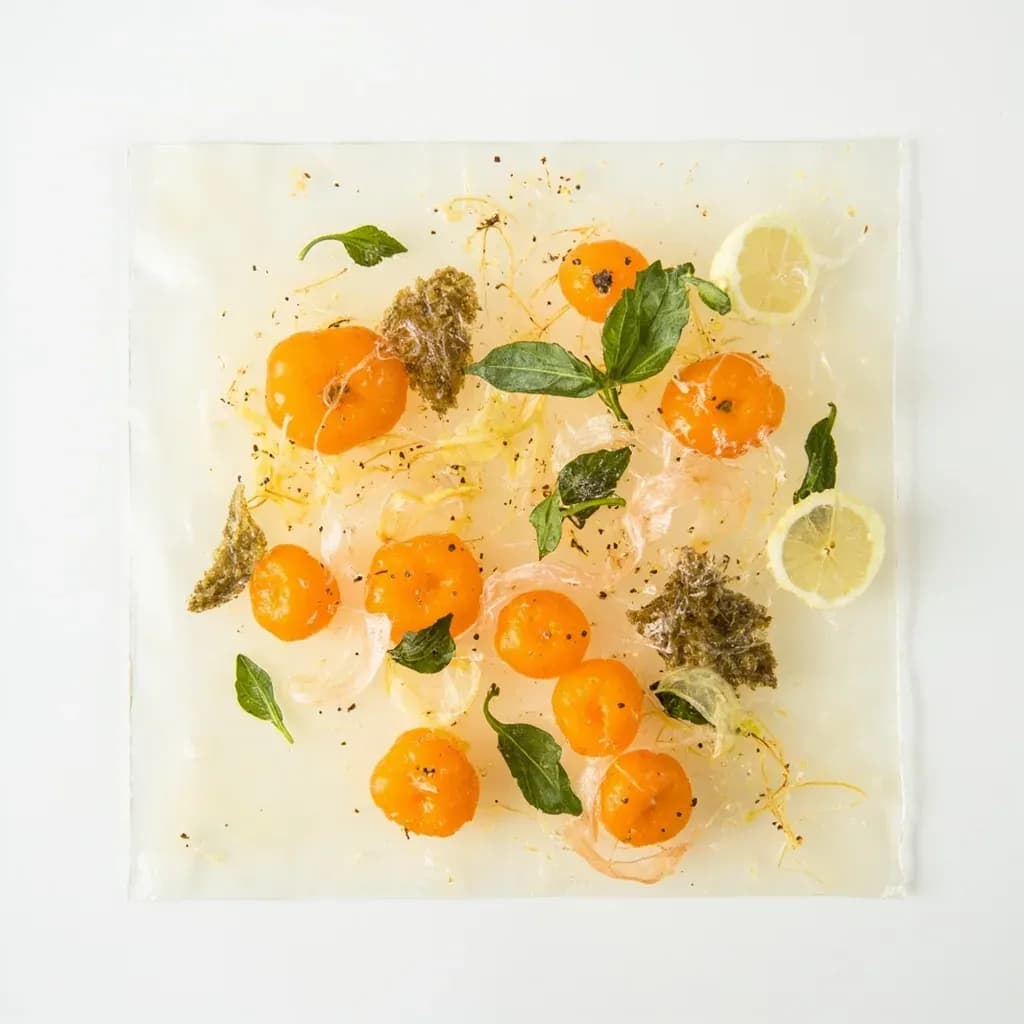
A thin, ultra-smooth food-grade acetate (PET) sheet, named for the chocolatier's guitar cutter, used to give chocolate and desserts a high-gloss finish. Pastry cooks spread tempered chocolate on it for shiny garnishes, line ring molds for clean-sided entremets, and set mousses against it. Peeling away the sheet leaves a mirror-smooth surface.
The guitar sheet — feuille guitare to the French patissiers who named it — is the thin, semi-rigid cellulose-acetate sheet behind every glossy chocolate collar, mirror-smooth entremet band, and crisp printed decoration in a professional pastry case. Standard stock runs about 0.1 mm (100 microns) and comes in large formats (roughly A2 at 40 × 60 cm and A3 at 30 × 40 cm), with pre-cut discs sized to common mold diameters. Its stiffness is deliberate: the sheet must hold a flat plane for spreading and a clean vertical edge when wrapped, yet flex without cracking when shaped around a log or mousse ring.
What makes acetate indispensable is the way tempered chocolate and glaze release from it. Properly crystallized chocolate peels away with a glass-like snap and shine; parchment grips and dulls the surface, while PVC cling film wrinkles and clings unevenly. The sheet tolerates contact with warm chocolate (30–32 °C for dark, 29–30 °C for milk, 27–29 °C for white) and mirror glaze, but softens around 80 °C, so it belongs on the marble and in the refrigerator — never in the oven or under a salamander.
The name comes from the way patissiers handle the sheet: held flat, drawn across marble with a long palette knife in a single confident pass, much as a guitarist draws a pick across strings. That single sweep, at the right chocolate temperature on a conditioned sheet, is the entire technique in miniature — and the reason printed transfers, chocolate cigars, and shiny mousse bands look the way they do.
Alternatives
Types & varieties
Uncoated transparent sheet — the workhorse for glossy chocolate, mousse bands, log wraps, and mold liners
Acetate pre-printed with cocoa-butter designs (stripes, dots, lace, logos) that transfer to chocolate as it crystallizes
Embossed or micro-grooved sheets that imprint fine lines or corduroy textures into chocolate
Tinted or metallized (gold, silver, copper) sheets for decorative bands and showpiece wraps
Factory-cut to standard entremet ring diameters (16, 18, 20, 22, 24 cm) and log molds for clean lining without trimming
Stiffer, thicker plastic for vertical structural bands around tall entremets where standard acetate would buckle
Very light-gauge acetate (the 'cello' of older US confectionery texts) used for wrapping bonbons and supporting pulled sugar
Choosing the right sheet
Most pastry work needs only the plain 100-micron acetate, but the variants exist for good reasons.
- Reach for heavy-gauge (120–150 micron) PETG when you need a structural band — a tall, perfectly straight collar on a layered entremet, for instance — because a thin sheet will buckle under the mousse's weight.
- Pre-cut discs save trimming and lie flatter inside standard rings (16, 18, 20, 22, 24 cm are the most common).
- Textured or ribbed acetate is worth keeping on hand when you want fine linear patterns in chocolate without commissioning a custom transfer.
- Colored and metallic acetates behave the same as plain stock under chocolate but contribute a tint of gold, copper, or pearl for showpiece bands and collars.
Working with chocolate on acetate
The spread-and-peel technique is simple in principle and unforgiving in execution. Temper the chocolate, condition the sheet to room temperature, and pour a pool of chocolate onto the acetate. With a large offset spatula or palette knife held at a low angle, draw the chocolate into an even layer in a single pass; going back over wet chocolate is the most common cause of streaks. Let the sheet rest at 16–18 °C until the chocolate is just firm to the touch and no longer tacky — this is the crystallization window. Pulling too early tears the surface; pulling too late risks a snap rather than a clean release. Peel in one confident motion, low and parallel to the surface, and the chocolate will come away with the shine of polished glass. For chocolate collars on logs and entremets, drape the chocolate-coated sheet around the dessert while the chocolate is still slightly soft, chill briefly, then peel while very cold for the crispest, shiniest edge.
Common uses
Tips & pitfalls
- Always temper the chocolate before spreading it on the acetate — untempered chocolate streaks, blooms, and will not release cleanly.
- Condition the sheet to room temperature before use; cold acetate makes chocolate seize and bloom on contact.
- Spread chocolate in a single smooth pass with a large offset spatula or palette knife; going back over wet chocolate is the most common cause of streaks.
- Wait until the chocolate is just firm and no longer tacky at 16–18 °C before peeling — under-set tears, over-set can snap rather than release.
- When lining tall mousse rings, slightly warm the acetate (e.g., briefly with a hair dryer) so it flexes without cracking.
- Cut a small corner test on any printed transfer sheet before committing — color, contrast, and resolution vary widely between manufacturers.
- Never fold acetate for storage — creases permanently deform the sheet and telegraph visibly into the chocolate.
- Keep printed transfer sheets away from moisture — humidity smears the cocoa-butter print and ruins the design.
- To extend life, wipe used plain acetate with a dry microfiber cloth and roll loosely between parchment; do not wash in hot water.
- Acetate is not a baking surface; never put it in the oven or under a salamander — heat warps it and may release plasticizers.
- If chocolate sticks when peeling, the chocolate was under-tempered or the sheet was contaminated with water or fingerprints — wipe hands and sheet with isopropyl alcohol between uses.
Good to know
- Material
- Food-grade cellulose acetate; PET and PETG variants also sold
- Origin
- France, where it is called feuille guitare (guitar sheet)
- Standard thickness
- ~0.1 mm (100 microns); 70–80 and 120–150 micron versions available
- Common sizes
- ~40 × 60 cm (A2 pastry size) and 30 × 40 cm (A3); pre-cut discs in standard mold diameters
- Heat tolerance
- Softens above ~80 °C; suitable for chocolate, glaze, and refrigeration only — not oven or stovetop
- Chocolate working temperatures
- 30–32 °C dark, 29–30 °C milk, 27–29 °C white
- Storage
- Flat, away from humidity and direct light; printed transfer sheets kept between parchment or silicone
- Reusability
- Plain acetate can be wiped dry and reused several times; printed transfers are single-use
Also called
Guitar Sheet · Acetate Sheet · Chocolate Acetate · PET Sheet
Related

Aluminum Foil
Wraps, covers, and tents food for the oven and grill

Parchment Paper
Nonstick liner for clean, even baking and easy release

Wax Paper
Moisture-resistant sheet for wrapping and counter prep

Plastic Wrap
Clings tight to cover bowls and wrap leftovers

Silicone Baking Mat
Reusable nonstick liner that replaces parchment

Cheesecloth
Loose-woven cloth for straining stock and bundling herbs

Beeswax Food Wrap
Reusable wax wrap that molds around bowls and produce

Piping Tips
Shaped nozzles that turn frosting into stars and rosettes