Wraps & Liners
Natural Hog Casing
Cleaned pig intestine used as an edible casing for stuffing fresh and cured sausages.
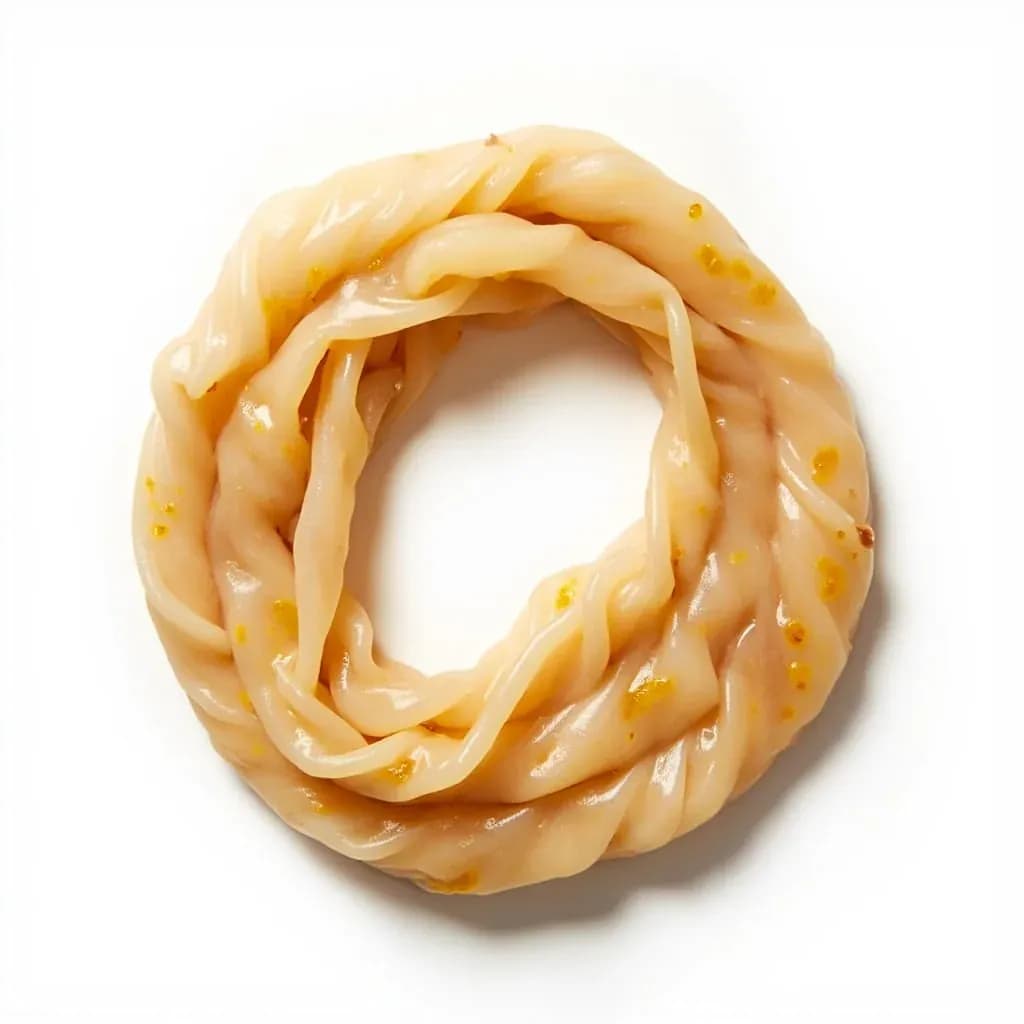
Natural hog casing is the cleaned, salted small intestine of a pig, sold packed in salt or brine and rinsed and soaked before use. Sausage makers slide it onto a stuffing horn and fill it with seasoned meat to make bratwurst, Italian sausage, and many fresh and cured links. It is edible, holds a satisfying snap when cooked, and breathes during smoking and drying, with diameter graded for different sausage styles.
Natural hog casing is the cleaned submucosa layer of a pig's small intestine — essentially a tube of nearly pure collagen that, once flushed of its salt pack, behaves like a soft, slimy sleeve ready to be slipped over a stuffing horn. It is the original sausage wrapper, used for centuries because nothing else replicates the audible snap, the translucent gloss, and the way it shrinks in lockstep with the meat as it cooks. Fully edible, it contributes a faint richness and a slightly chewy bite without any flavor of its own.
What makes hog casing irreplaceable is its permeability. Smoke drifts through it, curing salts migrate evenly, and moisture escapes at exactly the right rate during long drying — properties synthetic and reconstituted collagen casings cannot match. It also shrinks with the meat rather than pulling away from it, so a properly stuffed link tightens into a glossy, juicy sausage instead of weeping fat around a loose tube. This is why nearly every traditional dry-cured salami, every breakfast link, and every fresh bratwurst you have eaten came wrapped in gut.
The standard product is the 'hog middle,' sold in millimeter-diameter grades. Hog caps (from the cecum) and hog bungs (the terminal colon) are wider, shorter pouches reserved for mortadella, cotechino, zampone, and the largest salami. Global supply is dominated by China, with Germany, the Netherlands, Denmark, the U.S., and Brazil as major sources — most casings in American butcher shops are imported, though packers in Iowa, Illinois, and Minnesota still process meaningful domestic volume.
Alternatives
Types & varieties
The standard small-intestine casing; sold in graded diameters for everything from breakfast links (≈19–22 mm) to bratwurst (28–32 mm) and small salami (32–35 mm).
From the cecum; very wide (typically 75–100+ mm), short, and tied at one end. Used for mortadella, large salami, and stuffed capocollo.
Terminal end of the large intestine, tied off to form a fat pouch 75–150 mm across. Used for soppressata, cotechino, zampone, and certain salami.
Sold ready-to-stuff in salt brine or water; skip the long soaking step and are popular in small-batch kitchens.
Common commercial grades include 19/22, 22/25, 25/28, 28/30, 30/32, 32/35, 35/38, and 38/42 mm, named in mm by stuffed diameter.
Matching Diameter to the Job
The number on the label is the stuffed diameter in millimeters, not the raw tube width — the empty casing is roughly half the labeled diameter and stretches to its full size once meat is pushed through. Use this rough guide when ordering:
- 19–22 mm: breakfast links, chipolatas.
- 22–25 mm: fresh Mexican chorizo, merguez, and other thin North African lamb sausages.
- 28–32 mm: Italian-style fresh sausage (hot or sweet), bratwurst, knockwurst, andouille, boudin blanc.
- 32–35 mm: Spanish chorizo, Polish kielbasa, saucisson frais, small salami.
- 35–42 mm: large salami, finocchiona, soppressata, country-style smoked links.
Storage and Rehydration
Salt is the preservative, and how you remove it determines how the casing behaves on the horn. A rushed job leaves rubbery, brittle sections that tear; a patient job yields casing as supple as a wet noodle.
- Keep unused casing in its original salt, sealed against air, refrigerated at 0–4 °C. Airtight plastic tubs or heavy zip bags work well.
- Pull only what you need and rinse under cold running water until the milky salt water runs clear and no surface crust remains.
- Soak in tepid (not hot) water for 30 minutes to several hours; many makers refrigerate overnight for maximum pliability.
- Discard any casing that feels brittle, papery, or smells off after soaking — it will shred on the horn or split when twisted.
Common uses
Tips & pitfalls
- Flush a short section with water to spot holes before sliding the casing onto the stuffer horn — one weak link will burst at the worst moment and ruin a whole coil of sausage.
- Keep casings submerged in a bowl of water while stuffing so the dry sections don't crack as you work; wet hands help too.
- Aim to stuff to roughly 80–85% of casing capacity for fresh sausages; tighter than that and the casing splits during cooking, looser and you get wrinkled, oily links.
- Prick any visible air pockets with a sterilized pin before twisting or hanging — trapped air expands on the grill or in the smoker and tears the casing.
- Rest stuffed sausages uncovered in the refrigerator for 1–2 hours before cooking or smoking so the surface dries; this tightens the casing and improves snap and browning.
- For dry-cured sausages, stuff noticeably less full (often 70–75%) so the meat has room to shrink through months of drying without pulling away from the casing.
- Twist links only after the stuffed coil has rested 10–15 minutes; the meat relaxes and the casing grips properly, giving tidy, even links.
- Do not boil or cook casings in their salt pack — the heat sets the salt and the casing becomes inedibly briny and rubbery.
Good to know
- Material
- Submucosa layer of the pig's small intestine (hog middles); caps and bungs come from the cecum and terminal colon respectively.
- Composition
- Essentially pure collagen with a thin serosa and muscularis layer; fully edible and eaten with the sausage.
- Form sold
- Salt-packed hanks, bundles, or pre-flushed tubs; sometimes vacuum-sealed in brine.
- Length per hank
- Approximately 100 yards (≈91 m) of hog middles per standard hank, though counts vary by supplier.
- Diameter range
- Graded from roughly 16 mm up to 45 mm; the most commonly stocked sizes fall between 19 mm and 38 mm.
- Grading
- Typically sorted into A (clear, uniform, no holes), B (slightly cloudy or with minor defects), and reject (holes, weak spots, or excessive fat).
- Shelf life
- 1–2 years refrigerated in the original salt pack if sealed from air; longer in heavy salt if kept cold and dry.
- Storage temperature
- Refrigerated at roughly 0–4 °C (32–40 °F); do not freeze solid salt packs, as texture suffers.
- Yield
- One hank (≈100 yd) stuffs roughly 25–35 lb of fresh sausage, depending on diameter and link length.
- Permeability
- Permeable to smoke, moisture, and curing salts — essential for cold-smoked and dry-cured sausages.
Also called
Natural Sausage Casing · pork casing · sausage casing
Related

Aluminum Foil
Wraps, covers, and tents food for the oven and grill

Parchment Paper
Nonstick liner for clean, even baking and easy release

Wax Paper
Moisture-resistant sheet for wrapping and counter prep

Plastic Wrap
Clings tight to cover bowls and wrap leftovers

Silicone Baking Mat
Reusable nonstick liner that replaces parchment

Cheesecloth
Loose-woven cloth for straining stock and bundling herbs

Beeswax Food Wrap
Reusable wax wrap that molds around bowls and produce

Piping Tips
Shaped nozzles that turn frosting into stars and rosettes