Storage & Containers
Squeeze Honey Bottle
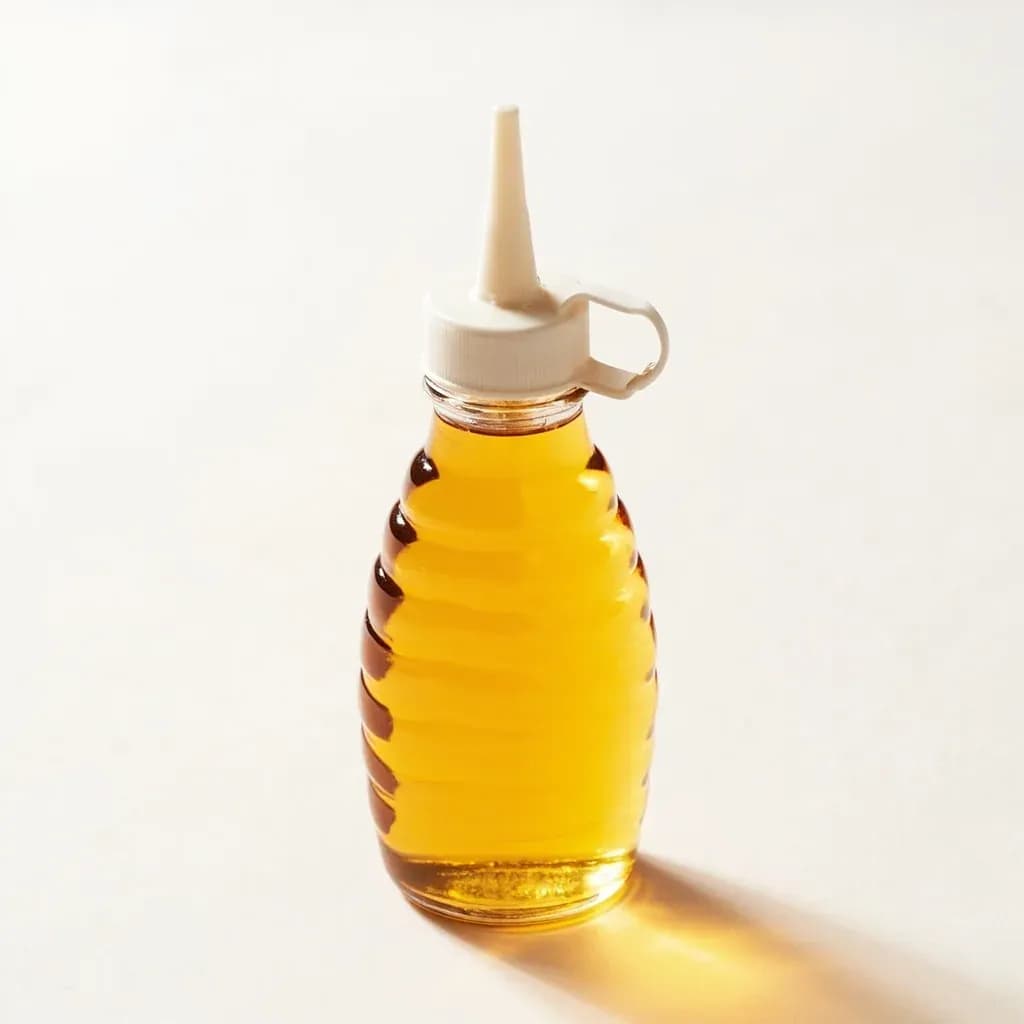
Soft plastic squeeze bottle with a flip nozzle for clean, drip-free honey pouring.
A squeeze honey bottle is a flexible plastic bottle, usually with a flip-top or no-drip nozzle, that dispenses honey in a controlled stream. The narrow tip lets cooks drizzle honey over toast, yogurt, or baked goods without sticky overflow. Many designs have an inverted, valved cap so honey is ready to squeeze straight from the cabinet.
A squeeze honey bottle is a soft-sided container — most often food-grade LDPE or PET — fitted with a hinged flip-top nozzle that pops open with a thumb press and snaps shut to seal. The whole point of the design is to solve the honey problem: honey is viscous enough that a spoon drips, a jar trails sticky threads back into itself, and the smallest spill draws ants and wasps. A squeeze bottle trades that mess for controlled, stream-on-demand flow — tip the bottle, flip the cap, give a short pulse, and honey threads out in a thin ribbon you can stop on a dime. Because honey keeps moving for a beat after you release pressure, control comes from light, brief squeezes rather than force.
Honey is also one of the few foods that crystallizes on the pantry shelf, and the flip-top format makes recovery simple: the whole bottle, or just the cap, can be warmed back into pouring condition without ever cracking a jar open to a sticky spoon. That combination of clean pouring, easy refilling from bulk pails, and forgiving cleaning is why the format has endured since Ralph Gamber designed the original honey bear for Dutch Gold Honey in Lancaster, Pennsylvania, in 1957.
The flip-top is more than convenience — it is also a hygienic seal. A clean snap-shut cap keeps honey from absorbing ambient moisture and from picking up dust or pantry odors. For cooks who go through a jar or two a month, a refillable squeeze bottle on the counter is the practical sweet spot between a sticky jar in the cupboard and a wooden honey dipper.
Alternatives
Types & varieties
The iconic bear-shaped squeeze bottle in clear or yellow plastic; the bear's head is the flip-top cap. The most recognizable honey container in the United States.
Tall, round LDPE or PET bottle with a flip-top cap; the workhorse commercial and home-kitchen form, sold in 1 lb and 2 lb sizes
Stored cap-down so gravity keeps honey primed at the nozzle; pours almost instantly with no shaking or waiting
Larger opening (often 38–63 mm) for easy decanting from 5 lb pails or 1 gallon jugs, paired with a flip-top cap
Multi-hole cap that splits the stream into several thin lines for plating drizzles over desserts, cheese, and toast
Glass jar with a flexible LDPE or silicone insert at the top; the only squeezable glass format widely sold, valued for keeping honey free of plastic contact
Decrystallizing and clearing a sticky bottle
Honey will eventually crystallize — granulated sugar falling out of solution — and a squeeze bottle makes recovery far easier than a glass jar. The key is gentle, even warming that liquefies the crystals without overheating the plastic or the honey itself. Heat above about 40 °C / 105 °F starts to degrade honey's delicate aromatics, and above roughly 70 °C / 160 °F an LDPE bottle can warp, while a flip-top gasket can lose its seal. Treat the bottle the way you would a soft cheese: warm it slowly, never blast it.
- For a mildly crystallized bottle, submerge it in a bowl of warm (not hot) tap water — about 40 °C / 105 °F — for 15 to 30 minutes, then swirl gently. Repeat if needed rather than raising the temperature.
- If only the cap is jammed, soak just the cap in warm water for 10 minutes, then work the hinge open and closed several times to clear crystallized honey from the nozzle before it re-solidifies.
- Never microwave a squeeze bottle; uneven heating warps the body and can drive honey temperatures well past the point where flavor compounds degrade.
- Never pour boiling water into or over the bottle. The thermal shock can warp PET, distort LDPE, and pop the cap seal.
- Once liquid, store the bottle cap-down (or switch to an inverted model) so the honey stays at the nozzle and pours cleanly the next time you reach for it.
Beyond honey: other liquids that suit the format
Anything that pours thick and slowly — and that you want to control in small amounts — works in a flip-top squeeze bottle. The format is essentially a metering tool for viscous liquids, which is why you'll find it reused across the pantry and even the condiment shelf.
- Maple syrup and agave nectar behave almost identically to honey and are the most natural reuse for the bottle.
- Chocolate syrup and hot fudge (warmed) work well, especially at ice cream or breakfast bars where guests serve themselves.
- Mustard, ketchup, and thick barbecue sauce pour cleanly from the same format, though you may want a dedicated bottle per condiment.
- Molasses and date syrup are thick enough to benefit from the wide-mouth refillable style.
- Avoid thin liquids (water, soy sauce, vinegar) — they pour uncontrollably and leak past the gasket when squeezed.
Common uses
Tips & pitfalls
- Squeeze gently — honey keeps flowing briefly after you release pressure, so control comes from short, light pulses rather than force.
- Store the bottle cap-down, or buy an inverted model, so honey stays primed at the nozzle and pours on the first try without shaking.
- Leave roughly 1 inch / 2.5 cm of headspace when refilling; overfilling makes the bottle hard to squeeze and can pop the cap seal.
- Hand-wash the cap thoroughly — sugar residue in the hinge is the single most common cause of sticky, non-sealing flip-tops.
- Choose PET if you want a clearer, more rigid feel that stands up well on the counter; choose LDPE for a softer, easier squeeze and lighter weight.
- Keep the bottle out of direct sunlight; UV degrades honey (it darkens and loses delicate aromatics) and embrittles the plastic over time.
- Refillable bottles pay for themselves quickly — a single 1 lb squeeze bottle can replace many single-use jars over a year and reduces sticky-lid landfill waste.
- Label the bottle if you ever decant a darker varietal (buckwheat, chestnut) into it; honey is hygroscopic and can carry a faint memory of strong ambient flavors, and the bottle may tint.
Good to know
- Primary material
- Food-grade LDPE (low-density polyethylene) or PET (polyethylene terephthalate) body with a polypropylene flip-top cap and a silicone or PE sealing gasket
- Origin of the iconic form
- The honey bear squeeze bottle was designed in 1957 by Ralph Gamber for Dutch Gold Honey in Lancaster, Pennsylvania; the bear shape is a registered trademark
- Common capacities
- 8 oz (227 g), 12 oz (340 g), 16 oz / 1 lb (454 g), 24 oz (680 g), and 32 oz / 2 lb (907 g); 1 lb and 2 lb are the most common retail sizes
- Cap mechanism
- Snap-open flip nozzle, sometimes called a spoon-cap or no-drip cap; opens with a thumb push and seals by snapping shut
- Temperature tolerance
- Body typically rated to about 60–70 °C / 140–160 °F; not suitable for boiling water or microwaving
- Cleaning
- Hand wash with warm water and mild soap; top-rack dishwasher safe on most models; air dry with cap flipped open
- Compatibility
- Also used for other viscous liquids: maple syrup, agave nectar, chocolate syrup, mustard, ketchup, and hot fudge
- Storage
- Room temperature away from direct sunlight; properly sealed honey itself keeps indefinitely
Also called
honey bottle · honey squeeze bottle · squeeze bottle
Related

Freezer Bags
Thick, sealable bags built to fight freezer burn

Storage Bags
Resealable bags for fridge storage and marinating

Storage Container
Lidded container for leftovers, prep, and meal kits

Glass Container
Oven-to-fridge glass that won't stain or hold odors

Plastic Container
Lightweight, stackable storage for everyday leftovers

Vacuum Sealer Bags
Airtight bags for long freezing and sous-vide

Reusable Bags
Washable silicone bags that replace single-use plastic

Mason Jar
Sealed glass jar for preserves, pickles, and storage