Heat & Safety
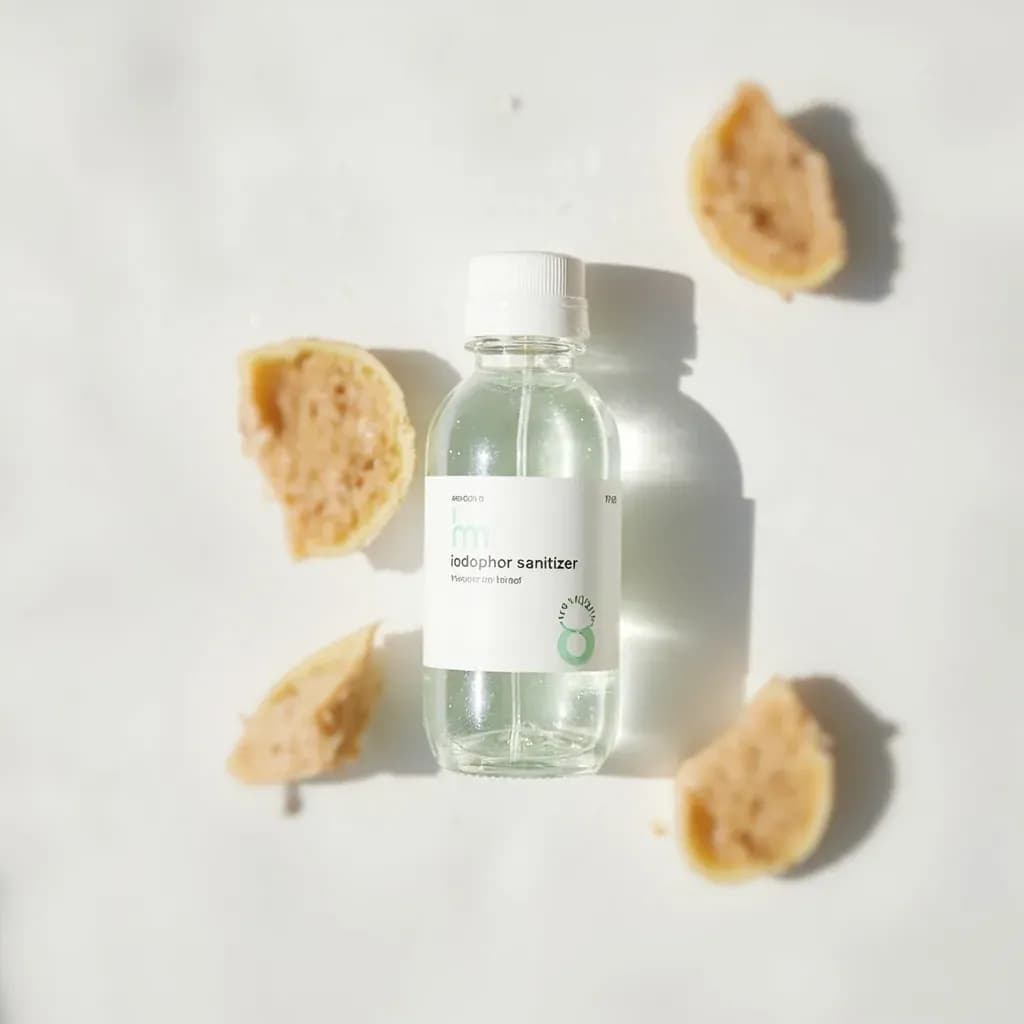
Iodophor Sanitizer
An iodine-based no-rinse sanitizer for brewing, dairy, and food equipment at low contact times.
Iodophor is an iodine-based sanitizer widely used in brewing, winemaking, and dairy to disinfect tanks, bottles, and tools. Diluted to the correct concentration, it sanitizes in a short contact time and is no-rinse, so it can air-dry on equipment before use. The amber color signals an active solution, and it is gentler on stainless steel than chlorine-based options.
Iodophor is a sanitizer built from three working parts: elemental iodine, a surfactant that carries the iodine into solution, and an acid (usually phosphoric) that holds the working pH between roughly 2.5 and 3.5. At that acidic pH, the iodine stays in its free, bactericidal form rather than tying up as harmless iodide. That same surfactant is why a properly diluted iodophor bath wets every surface it touches, including the nooks of a carboy neck or the threads of a bottle cap, instead of beading up like water on a waxed car.
What makes iodophor beloved in brewing, winemaking, cheesemaking, and small-scale food production is the combination of speed and forgiveness. At 12.5 to 25 parts per million of available iodine, it knocks down bacteria, yeasts, molds, and many viruses in about a minute at room temperature, and at that concentration it is officially a no-rinse sanitizer under the FDA Food Code — you drain it and move on. The brown color of the concentrate and the pale amber of the working solution are not decoration; they are your indicator. When the diluted bath goes clear, the iodine has been used up or has bound to organic matter, and it is time to remix.
The trade-offs are staining of soft plastics and fabrics, a per-gallon cost higher than household bleach, and a sensitivity to anything alkaline in the water or on the equipment. None of those are deal-breakers in a home brewery or a cheesemaker's kitchen, which is why a bottle of iodophor concentrate sits on the shelf alongside a phosphoric-acid foam sanitizer like Star San in most serious setups — each has a job it does better.
Alternatives
Types & varieties
The craft-brewing standard; roughly 1.75% available iodine, diluted 1 oz per 5 gal for ~12.5 ppm; dark brown liquid concentrate.
Brewing-industry concentrate in the same 1.5–1.75% iodine range, diluted identically; widely stocked at homebrew shops.
The general food-and-beverage form — iodine complexed with a surfactant and buffered to pH ~3 with phosphoric or similar acid for maximum free-iodine release.
Buffered closer to pH 6–7; gentler on some soft metals but slower acting and uncommon in kitchens or breweries.
EPA-registered concentrates from makers such as Diversey, Ecolab, and Sterilex; typically used at 25 ppm with built-in acid buffers for CIP (clean-in-place) lines.
Iodophor vs. other common sanitizers
Each of the sanitizers a cook or brewer reaches for has a different balance of cost, speed, materials, and paperwork. Iodophor's niche is the one-minute, no-rinse middle ground.
- Iodophor vs. chlorine bleach: Bleach (sodium hypochlorite) is cheaper per gallon and works at 50–100 ppm, but it must be made fresh daily, fumes at low pH, and tastes like a swimming pool if any residue reaches the food. Iodophor is more expensive and stains surfaces it contacts, but it is gentler on most equipment, faster, and reliably no-rinse.
- Iodophor vs. quaternary ammonium compounds (quats): Quats are stable, non-staining, and cheap for food-contact surfaces, but they need 1–2 minutes of wet contact and most formulas require a final potable rinse. Iodophor is faster and truly no-rinse at use dilution.
- Iodophor vs. phosphoric-acid foam sanitizers (Star San, Saniclean): The acid sanitizers foam into cracks, work in 30 seconds, and leave no taste or odor, but they have almost no margin for error on dilution and any organic soil destroys them quickly. Iodophor tolerates a small amount of residual soil and is easier to verify with a test strip.
- Iodophor vs. hot-water sanitizing (171°F/77°C for ≥30 sec): Heat leaves zero chemical residue and kills everything, but it is energy-hungry, softens some plastics, and cannot reach the inside of a sealed keg without specialized equipment. Iodophor reaches where hot water cannot and is far cheaper to run.
Common uses
Tips & pitfalls
- Clean before you sanitize — any visible soil, milkstone, hop resin, or biofilm binds iodine and drops the working concentration fast.
- Mix only what you will use in a session; a bucket of diluted iodophor goes from amber to clear in about 24 hours and is no longer trustworthy.
- Use an iodophor test strip the first few times you mix; eyeballing a "faint tea" color is unreliable and gets harder in hard water.
- Cold equipment slows the kill — a 4°C/40°F fermenter pulled from the fridge needs the full 2-minute contact, not the 60-second room-temperature minimum.
- Never mix iodophor with chlorinated cleaners, quaternary ammonium sanitizers, or alkaline detergents; they neutralize each other and the reaction can release fumes.
- If plastic picks up a light brown stain, soak it in a solution of sodium thiosulfate (photographer's "hypo") or 1:1 white vinegar and water; the discoloration is cosmetic, not a contamination risk.
- Very hard or alkaline tap water can drag the working pH above 4 and silently kill the sanitizer's effectiveness; if your water is alkaline, add a splash of phosphoric-acid sanitizer (Star San) to the bucket before the iodophor, or use distilled water for the bath.
- Pour, dunk, or spray iodophor — do not put iodophor-soaked equipment into a hot oven or steam it without rinsing first, because heat accelerates iodine corrosion of soft metals and some plastics.
Good to know
- Type
- Iodine-based, no-rinse chemical sanitizer
- Effective concentration
- 12.5–25 ppm available iodine; commercial concentrates (1.5–1.75% iodine) typically dilute at 1 oz per 5 gal water
- Contact time
- ≥1 minute at ~20°C/68°F; allow ≥2 minutes on cool surfaces or under 15°C/59°F
- Rinse required
- No, at proper dilution — drain the vessel and proceed
- Working pH
- 2.5–3.5; efficacy collapses above pH 4
- Spectrum
- Bactericidal, yeasticidal, mold-static, and effective against many viruses
- Storage
- Concentrate is stable for years in a sealed, cool, dark container; diluted working solution loses activity within about 24 hours
- Material compatibility
- Safe on stainless steel, glass, and most food-grade plastics; will stain ABS, fabrics, wood, natural rubber, and some softer plastics
Also called
Iodophor Sanitizer · Iodine Sanitizer · Iodophor Solution
Related

Paper Towels
Disposable sheets for spills, drying, and patting dry

Kitchen Towels
Reusable cloths for drying, gripping, and wiping

Oven Mitts
Heatproof gloves to handle hot pans and trays safely

Disposable Gloves
Single-use gloves for safe, mess-free handling

Cleaning Cloths
Reusable cloths for wiping counters and spills

Tortilla Warmer
Insulated holder that keeps tortillas warm and soft

Trivet
Heatproof stand that shields surfaces from hot pots

Ice Bath Setup
Bowl of ice water that halts cooking and sets color