Wraps & Liners
Cellophane Jar Cover
A wettable cellophane disc that shrinks tight over jars of preserves to seal them.
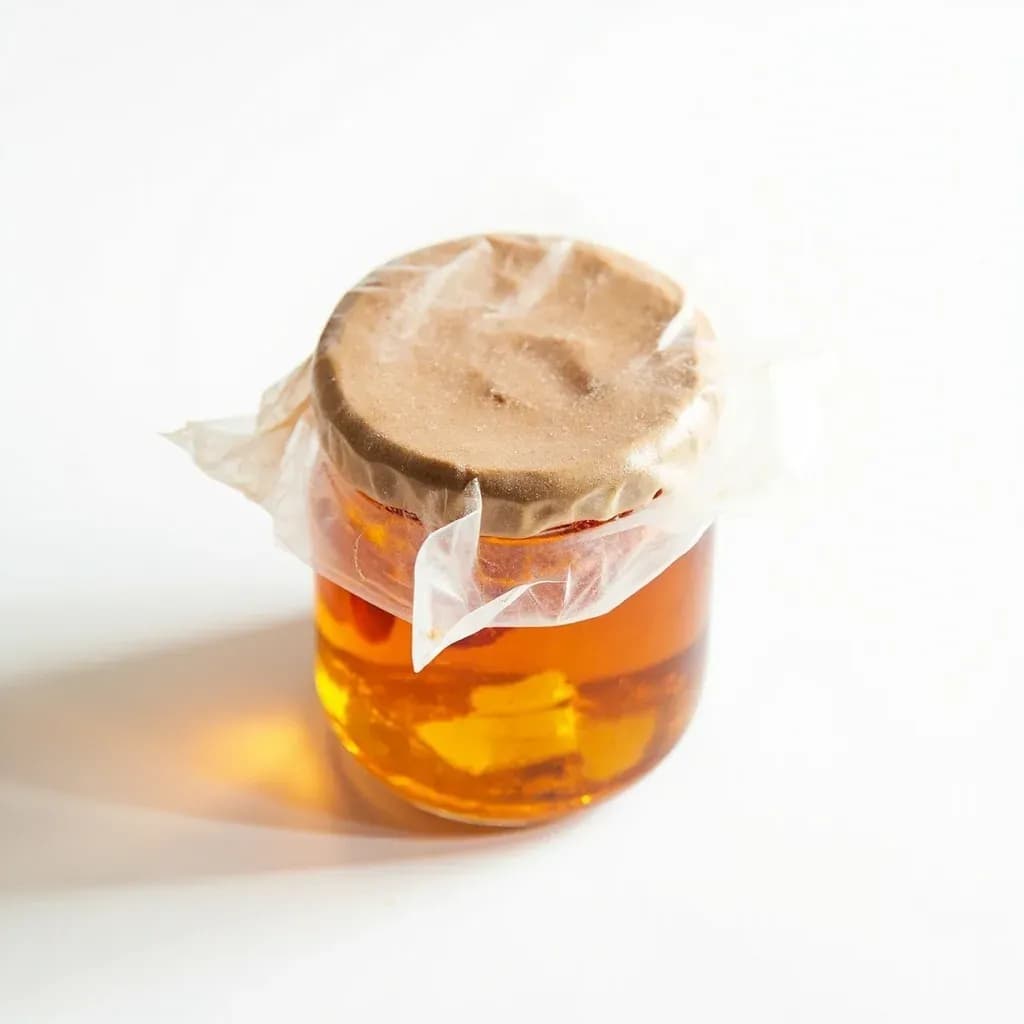
A cellophane jar cover is a thin disc moistened and stretched over the mouth of a jam or pickle jar, then secured with a band so it dries taut into a seal. It is a traditional, low-cost cover for home preserves where a metal lid is not used. The dampen-and-tighten method gives a snug skin as the cellophane dries.
The cellophane jar cover is a pre-cut disc of regenerated cellulose that, when wetted and stretched over a jar mouth, dries taut like a drum skin to give the traditional 'homemade' finish on a jar of preserve. It is not, despite appearances, a true preservation seal: the keeping qualities of the food come from its sugar and acid, often reinforced by a paraffin wax disc laid directly on the cold surface, and the cellophane's real job is to hold that wax disc flat, keep dust off the rim, and deliver the slightly crinkled, gift-worthy look that has signalled home-made jam since the interwar years.
The discs work by shrinking. A dry cover is briefly dipped in water or brushed with a wet pastry brush, laid over the jar, and held in place with a rubber band. Over the next 12–24 hours, as the film dries, it contracts uniformly and pulls tight across the rim, taking wrinkles out of itself; the disc tears or is cut when removed and cannot be reused.
Reserve cellophane for high-sugar, high-acid preserves — jams, jellies, marmalades, fruit curds, sweet mincemeat, some chutneys — where the food itself is the seal. For anything that genuinely needs heat processing or a vacuum closure (whole fruit in syrup, tomatoes, vegetables, soups, meats, fish), use a two-piece metal canning lid (Ball, Mason, Kerr) or a gasket-and-clip jar (Weck, Fido, Le Parfait); the two systems are not interchangeable, and confusing them is one of the most common — and dangerous — mistakes in home preserving.
Alternatives
Types & varieties
Traditional regenerated cellulose; slightly porous, relies on the wax disc and the preserve's own sugar and acid for the real barrier.
Cellophane laminated with a thin polyethylene layer; lower permeability and a little tougher once shrunk, the most common modern type.
Sold as 'Sealwrap' or 'Heatseal' covers; very durable, can be water- or heat-activated, and resists tearing when removed.
Gingham, tartan, fruit or festive prints — purely decorative and a fixture of Christmas hampers and gift jars.
Sold as a matched pair: a paraffin disc for the food surface plus a cellophane disc for the visible top — the traditional British system.
Larger cellophane for cutting to odd jar sizes or for wrapping entire jar necks decoratively; used more for presentation than for sealing.
The wax disc beneath: how the system actually works
A cellophane cover looks like a seal but is really a tidy hat. The work of keeping air and mould off the surface of the preserve is done by a thin paraffin wax disc, sometimes called a 'jam seal', pressed directly onto the cold jam or jelly before the cellophane goes on. The cellophane's role is to hold that wax disc flat, exclude dust from the rim, and create the taut, slightly crinkled drum-skin finish that signals homemade. Skipping the wax disc and relying on cellophane alone is tempting but risky: the cellophane is permeable enough to let surface mould get a hold on a low-sugar preserve, and the cover gives a false sense of security. Press the wax disc down firmly, pushing out any trapped air, and only then wet and apply the cellophane on top.
- Pour the preserve, let it cool fully, then press a wax disc directly onto the surface — this is the real seal.
- Trim the wax disc if needed so it sits inside the rim, not on the glass.
- Wet the cellophane disc, lay it over the wax disc and rim, and secure with a rubber band while it shrinks.
- For very wet curds or mincemeat where the wax disc will not sit, accept that the cellophane is decorative and refrigerate the jar instead.
Cellophane covers versus proper canning lids
The single most important thing to know about cellophane jar covers is what they are not. They do not form a vacuum, do not withstand boiling-water processing, and are not a food-safety device. Jars sealed only with cellophane and a rubber band keep because they contain enough sugar (and usually enough acid) to inhibit mould and bacteria — not because the cover is preserving them. For low-acid foods, low-sugar preserves, or anything that needs long ambient storage, reach for a two-piece metal canning lid (Ball, Mason, Kerr) processed in a water-bath or pressure canner, or a gasket-and-clip jar (Weck, Fido, Le Parfait) with its rubber ring. The two systems look superficially similar in the cupboard but behave very differently in practice.
- Use cellophane for jams, jellies, marmalades, curds, sweet mincemeat — the food is the preservative.
- Use metal canning lids or gasket jars for whole fruit in syrup, tomatoes, vegetables, low-acid chutneys to be stored at room temperature for months, soups, meat and fish.
- Cellophane can sit on top of a two-piece metal lid band for a decorative finish once the jar has cooled and the lid has sealed — a common compromise for gift jars.
- Modern plastic 'jam covers' sold in hardware stores are not interchangeable with cellophane: they do not shrink, are more permeable, and are easily confused with food wrap at the till.
Common uses
Tips & pitfalls
- Wipe the jar rim with a clean damp cloth and dry it thoroughly before applying the disc; any trace of jam or sugar syrup on the rim stops the cover seating flat and creates a leak path.
- Dip the disc in a shallow bowl of warm water for 5–10 seconds, or brush both sides with a wet pastry brush, then shake off the excess — the disc should be limp, not dripping.
- Lay the wet disc on the jar and smooth from the centre outwards to push out air bubbles and wrinkles before it begins to grip the glass.
- Hold the disc in place with a strong rubber band, kitchen twine, or the screw band of a two-piece lid; a loose disc will not shrink evenly and stays baggy at the edge.
- For extra mould protection on a soft set, dampen the disc with a little vodka or clear spirit instead of plain water — a small amount of alcohol discourages surface mould while still letting the film shrink.
- Wait 12–24 hours for the cover to become fully drum-tight before moving jars to long-term storage, stacking, or wrapping them for gifts — handling them too early causes permanent creases.
- Label the cellophane with a permanent marker once it is dry, or fix a small tag with a rubber band; pen on wet cellophane smears and is illegible.
- Do not use cellophane covers on anything that needs real canning — their job is decorative, the safety comes from sugar and acid in the food, and heat-processing will melt or distort the film.
Good to know
- Material
- Regenerated cellulose film (cellophane), sometimes laminated with a thin polyethylene or polyester layer for lower permeability and tear resistance.
- Standard disc sizes
- Pre-cut rounds from roughly 30 mm to 90 mm; the most common are 70 mm (US regular half-pint), 81 mm (UK 1 lb) and 86 mm (US wide-mouth pint).
- Sealing mechanism
- A wetted disc shrinks as it dries, pulling taut across the rim and holding a wax disc (if used) flat against the preserve.
- Shrink time
- Roughly 12–24 hours to become drum-tight, depending on ambient humidity.
- Best paired with
- A paraffin wax disc pressed directly onto the cold surface of the preserve, which provides the actual moisture and air barrier.
- Suitable for
- High-sugar/high-acid preserves: jams, jellies, conserves, marmalades, fruit curds, sweet mincemeat and some high-sugar chutneys.
- Not suitable for
- Low-acid or low-sugar foods (whole fruit in syrup, tomatoes, vegetables, soups, meat, fish) — these need heat processing with proper canning lids or gasket-and-clip jars.
- Reusability
- Single-use; the disc tears or is cut when removed.
Also called
cellophane-jar-cover · jar-sealing-water · jam pot cover · preserve cover
Related

Aluminum Foil
Wraps, covers, and tents food for the oven and grill

Parchment Paper
Nonstick liner for clean, even baking and easy release

Wax Paper
Moisture-resistant sheet for wrapping and counter prep

Plastic Wrap
Clings tight to cover bowls and wrap leftovers

Silicone Baking Mat
Reusable nonstick liner that replaces parchment

Cheesecloth
Loose-woven cloth for straining stock and bundling herbs

Beeswax Food Wrap
Reusable wax wrap that molds around bowls and produce

Piping Tips
Shaped nozzles that turn frosting into stars and rosettes