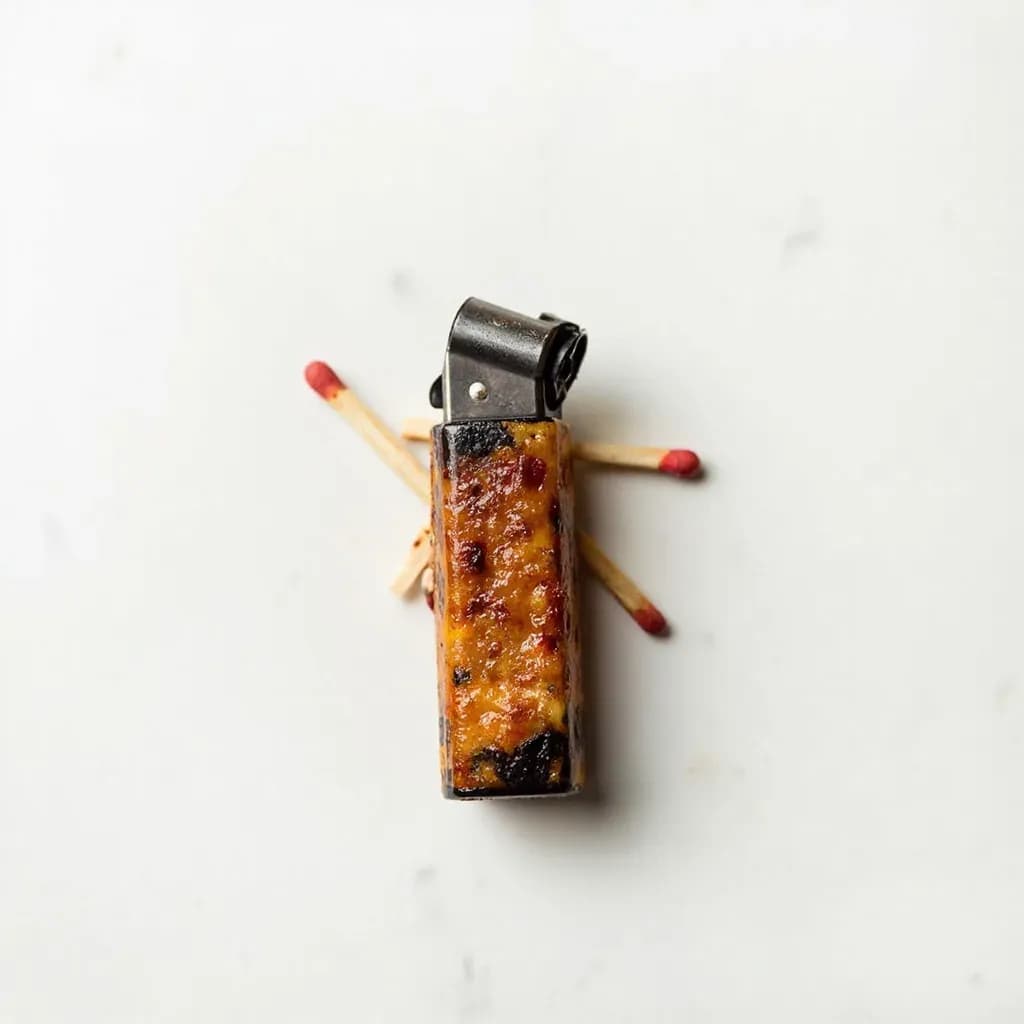
Heat & Safety
Long-Reach Lighter / Matches
An extended-stem lighter or long matches for igniting grills, ovens, and burners at a safe distance.
A long-reach lighter is a butane lighter with an extended stem, or a box of long fireplace matches, used to light flames from a safe distance. Cooks use them to start charcoal chimneys, gas grills, pizza ovens, pilot lights, and brulee torches without singeing their fingers. The long neck keeps the hand well away from the ignition point and reaches deep into recessed burners.
A long-reach lighter puts fire where your hand cannot safely go. The standard form is a butane flame on a rigid metal stem 15–30 cm (6–12 in) long, fired by a trigger behind a child-safety lock. Long-stem safety matches — 10–20 cm (4–8 in) of wooden stick tipped with a match head — cover the same niche with a visible, disposable flame and no pressurized fuel.
The tool earns its place in any gas kitchen because built-in igniters are usually the first component to fail. Piezo modules corrode, spark gaps widen, and burner caps flood with spills. A long-reach lighter sidesteps the whole problem: point the nozzle at the port, click, and the gas lights at a safe distance. Outdoors it relights a blown-out grill burner and starts a charcoal chimney without crumpled newspaper; indoors it reaches into the recesses of a gas cooktop or the pilot port of a wall oven.
Refillable butane models use a universal valve and 5–6× purified fuel for roughly 200–300 ignitions per 5–6 g fill; disposable utility lighters are cheaper up front but sealed when empty. The 2019 extension of 16 CFR Part 1210 made the child-resistant trigger near-universal on anything sold for kitchen use, and most models are also certified to ASTM F2201.
Alternatives
Types & varieties
The standard kitchen model: rigid metal stem, trigger, child lock; refillable from a butane canister.
Bendable shaft for reaching recessed pilot-light housings on gas ovens, water heaters, and furnaces.
Higher upfront cost but cheaper long-term; uses a universal butane refill valve and 5–6× purified fuel.
Sealed fuel cell; cheaper and widely available but non-refillable. Usually 20–28 cm (8–11 in) overall.
Wooden matches on extended sticks (~10–20 cm / 4–8 in); sold in kitchen long-match boxes and fireplace boxes.
Extra-long (~20 cm / 8 in) matches with oversized heads for grills, fireplaces, and camp stoves; burn 8–10 seconds.
Flameless electric arc; windproof and fuel-free, but less reliable for tight pilot ports than a true butane flame.
Refilling a Butane Lighter
A refillable utility lighter pays for itself within a year for anyone who lights a gas burner more than a few times a month. The process takes about a minute and depends almost entirely on using the right fuel grade. Cheap 1× or 2× butane contains impurities that deposit in the jet and progressively choke the flame until the lighter is unusable.
- Set the lighter fill-valve side up on a flat surface; rest a 5–6× purified butane canister upside-down in the valve socket.
- Press down firmly for 5–7 seconds — a brief hiss confirms liquid fuel is entering the chamber. Stop if fuel spits from the valve; the tank is full.
- Wait 3–5 minutes before igniting to let the butane equilibrate to room temperature; lighting immediately produces a weak, sputtering flame.
- Before refilling a partly used lighter, purge the line for 2–3 seconds with the valve pressed and no fuel attached to clear stale gas and air.
- If the flame still sputters or leans after a clean refill, work a wooden toothpick gently into the nozzle jet — never a metal pin, which can deform the orifice and ruin the lighter.
When Long Matches Are the Better Tool
A butane lighter is faster and more controllable for daily burner work, but a box of long-stem matches is worth keeping in a dry drawer as a backup. They need no fuel, no valve, and no piezo unit, so they still work when the lighter has run dry, the piezo has given up, or you cannot find the refill canister. They are also cheap enough to use once and discard, which makes them practical for messy jobs like lighting a charcoal chimney or a tiki torch where a sticky lighter is a nuisance to clean afterwards. The catch is humidity: match heads absorb moisture readily, so they must be stored in a sealed tin with the striker strip or they will fail to light — and like any flame, a lit match should never be brought near a burner port where gas has pooled, because the accumulated gas will flash back just as violently as it would with a lighter.
Common uses
Tips & pitfalls
- Refill with 5–6× purified butane only; cheaper 1× or 2× grades leave residue that clogs the nozzle and shortens the lighter's life.
- Before refilling, purge the lighter for 2–3 seconds (press the fill valve with no fuel attached) to clear air and old gas from the line.
- Store away from direct sun and any heat source above 50 °C; pressurized butane can vent or burst when warm.
- Clean the nozzle with a wooden toothpick if the flame sputters or leans — never use metal wire, which can deform the jet and ruin the lighter.
- If you smell gas while leaning toward a burner, vent the area first; do not ignite, because accumulated gas can flash back.
- Always engage the child-safety lock between uses; utility lighters account for several thousand U.S. burn injuries a year.
- Keep long-stem matches in a sealed tin with the striker strip and strike against the box strip, not a counter or stovetop, to avoid flaring sideways toward the hand.
- When the flame shrinks or fails to light after a refill, the piezo unit is usually spent — replace the lighter rather than continuing to spark.
Good to know
- Type
- Extended-stem butane gas lighter and/or long-stem safety match
- Typical stem length
- 15–30 cm (6–12 in) on utility lighters; 10–20 cm (4–8 in) on long-stem matches
- Fuel
- Butane (refillable models) or sealed fuel cell (disposable)
- Ignition
- Piezoelectric on butane models; friction-strike on matches
- Operating flame temperature
- Approximately 1,300 °C (2,370 °F) at the nozzle
- U.S. safety standard
- ASTM F2201; child-resistant mechanism required under 16 CFR Part 1210
- Typical refill cycle
- 200–300 ignitions per 5–6 g butane fill
- Also known as
- Barbecue lighter, stove lighter, gas-range lighter, utility lighter, fireplace lighter, gas oven lighter
Also called
BBQ Lighter · Utility Lighter · Long Matches · Fireplace Matches
Related

Paper Towels
Disposable sheets for spills, drying, and patting dry

Kitchen Towels
Reusable cloths for drying, gripping, and wiping

Oven Mitts
Heatproof gloves to handle hot pans and trays safely

Disposable Gloves
Single-use gloves for safe, mess-free handling

Cleaning Cloths
Reusable cloths for wiping counters and spills

Tortilla Warmer
Insulated holder that keeps tortillas warm and soft

Trivet
Heatproof stand that shields surfaces from hot pots

Ice Bath Setup
Bowl of ice water that halts cooking and sets color