Wraps & Liners
Lotus Leaf (Wrapping)
Large dried or fresh lotus leaf used to wrap rice and meats for steaming, adding tea-like aroma.
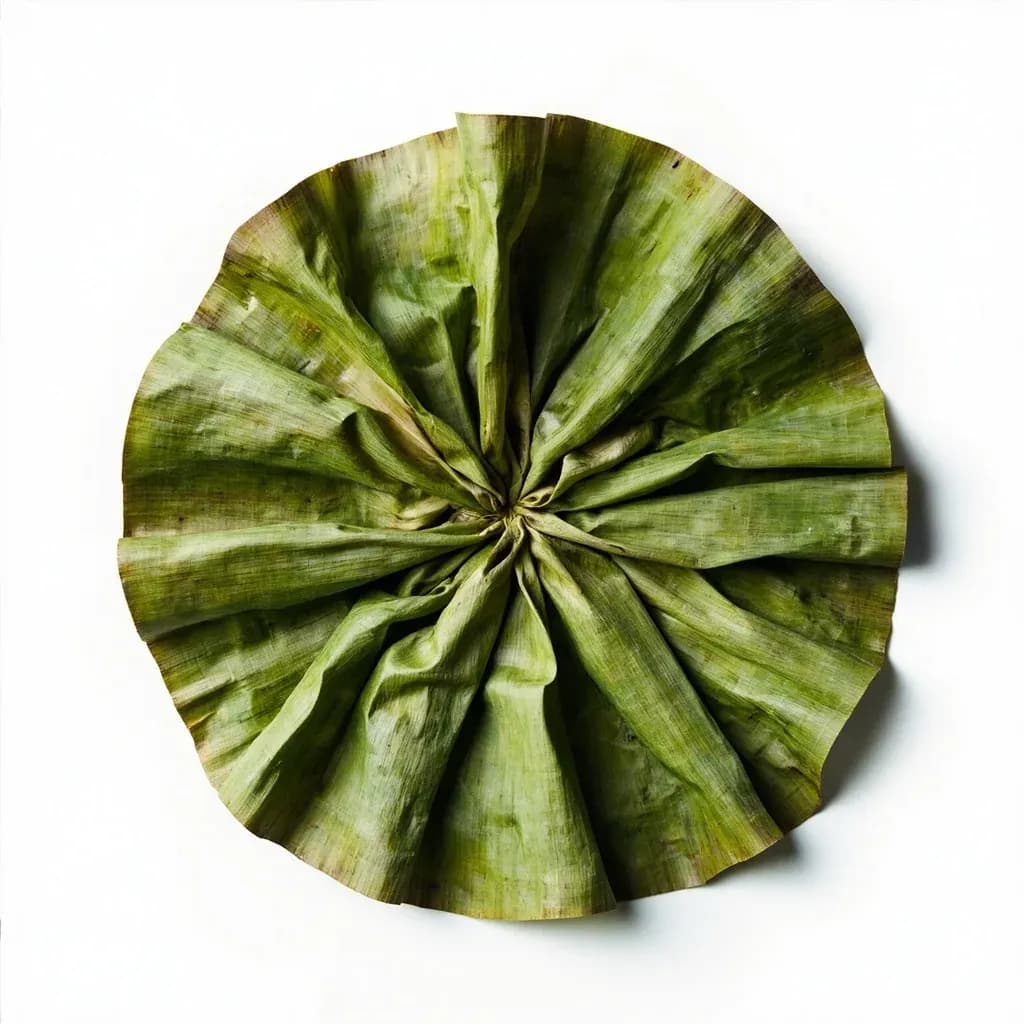
A lotus leaf is a broad round leaf, used fresh or dried and rehydrated, to wrap food before steaming. In Chinese cooking it parcels glutinous rice for lo mai gai and zongzi, and encloses chicken or fish so the bundle steams in its own moisture. The leaf imparts a subtle, earthy tea-like fragrance and is removed before eating.
Lotus leaves are the broad, circular leaves of the sacred lotus (Nelumbo nucifera), an aquatic plant cultivated across East and South Asia. In the kitchen they serve as both wrapper and aromatic liner — almost never eaten themselves. Dried leaves are the everyday form: brittle, brown-olive discs sold in stacks, with a faint straw-like smell out of the package. Fresh leaves appear seasonally at Chinese wet markets in summer; they are supple, deep green, and carry a greener, more delicate scent. Both are large — typically 30 to 60 cm across — which is why they suit parcels of sticky rice, whole fish, or deboned poultry.
The leaf's real magic only shows up with heat and moisture. Once steamed against food, it releases a dry, grassy, faintly smoky, tea-like aroma that subtly perfumes whatever it wraps without competing with the filling. Dried leaves contribute almost no aroma on their own; that grassy, tea-like scent only emerges under steam, which is why they must be softened in hot water before wrapping. Boiling, by contrast, would simply wash those volatile oils away. The leaf also acts as a gentle moisture regulator, holding steam around the food so glutinous rice steams to a tender, glossy texture rather than drying out at the edges of the basket.
Alternatives
Types & varieties
The standard export form. Brown-olive discs, 35–55 cm, used for lo mai gai and large steamed packages; need hot-water soaking.
Pre-trimmed quarters or smaller pieces sold for home use and smaller parcels like individual dim sum.
Available in summer at Chinese wet markets; softer, greener, more delicate aroma, no soaking required. Used in Cantonese steaming and for wrapping steamed chicken or fish.
Smaller, thinner fresh leaves prized in Cantonese cooking for their milder scent; often used to line steamer baskets.
Working with dried leaves
Dried leaves arrive brittle and smell of straw; the rehydration step is where most home cooks go wrong, and it determines whether your parcel steams into a fragrant, intact package or a torn, waterlogged mess. Treat the leaf gently at every stage — once wet it is tough but pliable, and it can still tear if handled roughly.
- Soak in a large bowl or sink of just-off-the-boil water, weighting the leaves with a plate so they stay submerged; aim for 30–60 minutes until the color deepens to a rich olive-green and the leaf bends without cracking.
- Refresh the water once if it cools too quickly — lukewarm water leaves the central rib stiff and prone to piercing the upper layer during wrapping.
- Lift leaves out one at a time and pat both sides dry with a clean kitchen towel; surface water dilutes the filling and seeps out as a pale, starchy broth during steaming.
- Trim the thick woody midrib flush with the leaf using kitchen shears before wrapping; leaving it in place invites splits and steam leaks.
- Brush the inner surface very lightly with neutral oil when wrapping sticky glutinous rice so the cooked rice releases cleanly from the leaf.
Sourcing and storage
Look for leaves labeled 'scented lotus leaves' from Jiangnan or Hunan regions, which are generally more aromatic than Thai or Indian commercial grades. Inspect for holes, splits, or dark fuzzy patches before buying and again after soaking; any musty odor means the leaf is past its prime.
- Buy from Chinese or pan-Asian supermarkets, dim sum supply shops, or online retailers; packs of 10–20 dried leaves typically run $2–6 in the U.S.
- Store dried leaves flat in a sealed bag or tin with a desiccant packet to keep pantry moths and humidity at bay.
- Test aged leaves by bending: a good leaf flexes, a stale one snaps — discard any that crack rather than curve.
- Wrap fresh leaves in a barely damp cloth and refrigerate; use within 3–5 days for best aroma.
Common uses
Tips & pitfalls
- Wrap food on the matte (underside) of the leaf; the smoother upper side faces out and resists tearing against the steamer walls.
- Use a double wrap (two leaves layered) for wet or saucy fillings — single leaves can leak fat and juices into the steamer water.
- Always steam parcels seam-side down so the folded edge stays sealed and the leaf cannot spring open as the filling expands.
- Do not boil lotus-wrapped parcels; steaming is the intended method, and boiling washes out the aromatic oils the leaf is meant to lend.
- Reuse a leaf that held dry items (rice, plain dumplings) for stock or aroma in a broth, but discard leaves used with strongly flavored or oily fillings — they absorb too much to give back.
Good to know
- Source
- Leaves of the sacred lotus (Nelumbo nucifera), a large aquatic plant cultivated across East and South Asia.
- Form sold
- Almost always dried (brown-olive, papery discs); fresh green leaves appear seasonally at Chinese markets in summer.
- Typical diameter
- 30–60 cm (12–24 in); premium whole leaves often run 40–50 cm across.
- Texture when dry
- Brittle and paper-like; must be softened in hot water before wrapping.
- Flavor contribution
- A dry, grassy, faintly smoky, tea-like aroma; subtle and aromatic rather than strongly herbal.
- Rehydration time
- 30–60 minutes in hot water, or 1–2 hours in warm water, until fully pliable and dark green.
- Shelf life (dried)
- Indefinite (1–2 years commonly cited) if kept dry, sealed, and away from light and pantry pests.
- Common pairings inside the wrap
- Glutinous rice, chicken, Chinese sausage (lap cheong), shiitake, dried shrimp, pork belly, salted egg yolk, chestnuts.
Also called
dried lotus leaf · lotus leaf wrapper · he ye
Related

Aluminum Foil
Wraps, covers, and tents food for the oven and grill

Parchment Paper
Nonstick liner for clean, even baking and easy release

Wax Paper
Moisture-resistant sheet for wrapping and counter prep

Plastic Wrap
Clings tight to cover bowls and wrap leftovers

Silicone Baking Mat
Reusable nonstick liner that replaces parchment

Cheesecloth
Loose-woven cloth for straining stock and bundling herbs

Beeswax Food Wrap
Reusable wax wrap that molds around bowls and produce

Piping Tips
Shaped nozzles that turn frosting into stars and rosettes