Wraps & Liners
Mesh Food Cover (Tudung Saji)
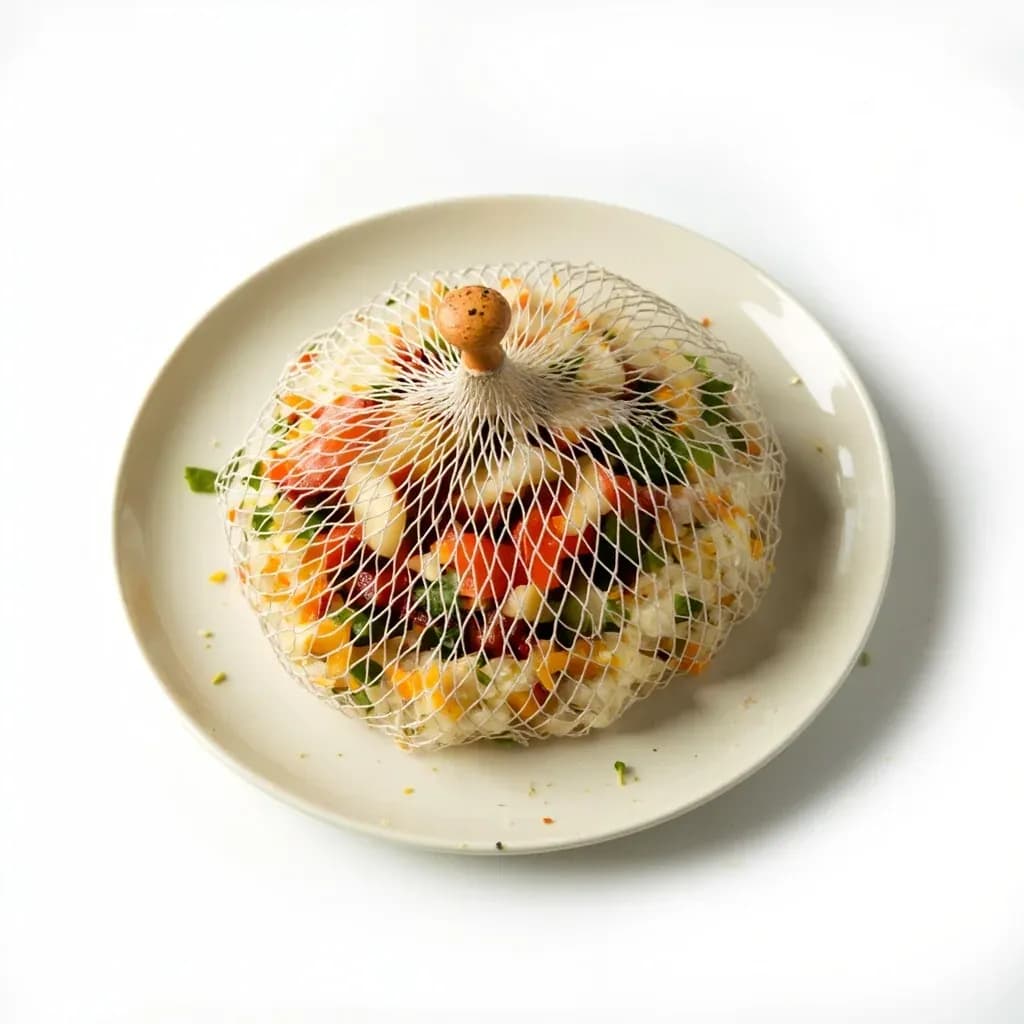
A domed mesh or woven cover set over served dishes to keep flies and dust off while food sits out.
A mesh food cover, known as tudung saji in Malaysia and Indonesia, is a lightweight dome of fine mesh or woven material placed over plates and bowls. It shields cooked dishes from flies, dust, and debris while letting food breathe and stay at room temperature on the table or counter. Traditional versions are colorful woven cones, while modern ones are collapsible wire-and-net umbrellas.
The tudung saji — Malay for "serving cover," from tudung (veil/cover) and saji (serving/dishes) — is a domed mesh screen set over food to keep insects and dust off while it sits out. Unlike a solid cloche or plastic dome, the open weave lets steam escape and air circulate, so hot rice, fried chicken, or kueh don't sweat under the cover. The concept is simple but the execution is regional: across Malaysia, Indonesia, Singapore, and Brunei it is a daily table item, often crocheted at home or bought from a pasar in cotton or acrylic yarn, and traditionally given as a wedding or housewarming gift.
In practice, a tudung saji is a tool for open-air and family-style eating. At a hawker stall, a pasar malam spread, or a long lunch under a fan, it solves the eternal problem of flies landing on the food without sealing the dish the way a lid would. The mesh is also why it works for hot food: a closed dome would fog up and drip condensation back onto the plate, but air passes freely through the netting so the surface of fried foods and steamed cakes stays intact.
For cooks outside Southeast Asia, the tudung saji belongs to the same family as the Western wire food umbrella, the Chinese brass or steel mesh food cover on a stand, and — at the cloth end of the spectrum — the Japanese furoshiki wrap. What sets the Malay version apart is the height of the dome (generous enough to clear a tall layer cake or upright fried items) and the strong crocheted-craft tradition that makes the cover itself a small piece of household textile art.
Alternatives
Types & varieties
The classic home/handmade style, worked in cotton or acrylic yarn with a scalloped or picot edge; lightweight, decorative, breathable.
Rigid, sturdy, traditional Southeast Asian style; more durable than yarn but heavier and needs to be kept dry to prevent splitting or mildew.
Collapsible spring-steel or plastic frame with fine nylon netting; folds flat for storage, common for picnics, buffets, and outdoor catering.
Vintage or shabby-chic style; a wire skeleton dressed in cotton lace or netting, sometimes with embroidered detailing.
Not technically mesh but used for the same job; airtight so it traps steam, making it better suited to cold dishes, cakes, and cheese boards than hot food.
Sheer decorative fabric stretched over a frame; more ornamental than functional, used at festive or wedding buffets.
Why mesh, not solid?
The defining feature of a tudung saji — and what separates it from a Western cloche or a cake dome with a knob — is that air passes through it. A solid cover traps the steam rising from hot food; the steam condenses on the inside of the dome and drips back down, soggying rice, wilting herbs, and ruining the crust on fried items. A mesh cover lets that steam vent while still blocking flies, mosquitoes, gnats, and dust. The same property makes the cover useful for proofing dough or cooling bread: the loaf can breathe, so the crust stays crackly rather than going soft.
Choosing the right size and shape
A tudung saji has to clear the food it covers, not just span the plate. For a standard dinner plate of rice and sides, a 30 cm (12 in) dome is enough. For a tall layer cake, a stack of kueh lapis, or upright fried chicken, look for a higher-rising dome of 20–30 cm (8–12 in) in height — anything shorter will press into the top of the food. For rectangular platters and long serving boards, two smaller round domes placed side by side cover more reliably than one oversized round cover, which leaves the corners exposed.
- Low dome (10–15 cm high) for plates, fruit, cheese, and bread.
- Medium dome (15–20 cm high) for general serving and most cakes.
- Tall dome (20–30 cm high) for layer cakes, upright fried items, and stacked kueh.
- Two smaller domes beat one big round dome for rectangular platters.
Care across materials
Different covers want different handling. Crocheted yarn covers should be hand-washed in cool water with mild soap, gently pressed (never wrung), and dried flat on a towel so the scalloped edge does not stretch out of shape. A damp cover can be reshaped over an inverted bowl of the correct size and left to air dry. Rattan and bamboo are sturdy but vulnerable to humidity: keep them out of prolonged direct sunlight, wipe spills quickly, and store them in a dry corner to prevent splitting and mildew. Pop-up nylon covers with a wire or plastic frame can usually be wiped or rinsed, but the frame must be dried at the hinges to keep spring steel from rusting.
Common uses
Tips & pitfalls
- Match the dome's height to the food: a tall layer cake or upright fried chicken needs a high-rising cover, otherwise the mesh will dent the top.
- Let hot food cool for 2–3 minutes before covering, or steam will condense on the inside of the dome and drip back onto the dish, making rice and fried foods soggy.
- Wash crocheted covers by hand in cool water with mild soap; do not wring, and dry flat so the scalloped edge is not pulled out of shape.
- Keep rattan and bamboo versions out of prolonged direct sunlight and away from damp corners; natural fiber can crack, fade, or grow mildew.
- For pop-up mesh covers, wipe the frame dry after washing to prevent the spring steel from rusting at the hinges.
- Use two covers side by side over rectangular platters rather than one oversized round dome, which leaves gaps at the corners.
- If a crocheted cover loses its shape, lightly mist it with water, reshape it over an inverted bowl of the correct size, and let it air dry.
- Avoid placing solid plastic domes over very hot food; the trapped steam will fog the inside and water down the dish.
Good to know
- Origin
- Southeast Asia, particularly Malaysia, Indonesia, Singapore, and Brunei; the term 'tudung saji' is Malay, with 'tudung' meaning cover/veil and 'saji' meaning serving/dishes.
- Also called
- Food dome, food umbrella, mesh food tent, anti-fly food cover.
- Shape
- Domed or bell-shaped (hemispherical), tall enough to clear upright foods like layer cakes or stacked fried items.
- Common materials
- Crocheted cotton or acrylic yarn; woven rattan or bamboo strips; nylon or polyester netting on a wire or plastic frame; sometimes cotton lace with embroidered trim.
- Typical diameter
- Around 25–50 cm (10–20 in) to fit a single dinner plate up to a large serving platter; taller cake-sized versions run 20–30 cm high.
- Primary function
- Keeps flies, mosquitoes, dust, and falling debris off food while it sits out; the open weave allows steam to escape and air to circulate so food does not sweat.
- Breathability
- Open mesh construction is the key advantage over solid domes; food stays dry and condensation does not drip back onto the dish.
- Care
- Yarn and rattan versions are usually hand-washed in cool water and air-dried flat; mesh-on-frame versions can be wiped or rinsed.
- Storage
- Foldable pop-up mesh versions collapse flat; rigid crocheted or rattan covers are stored upright so the shape is not crushed.
Also called
Tudung Saji · Food Net Cover · Fly Dome Cover
Related

Aluminum Foil
Wraps, covers, and tents food for the oven and grill

Parchment Paper
Nonstick liner for clean, even baking and easy release

Wax Paper
Moisture-resistant sheet for wrapping and counter prep

Plastic Wrap
Clings tight to cover bowls and wrap leftovers

Silicone Baking Mat
Reusable nonstick liner that replaces parchment

Cheesecloth
Loose-woven cloth for straining stock and bundling herbs

Beeswax Food Wrap
Reusable wax wrap that molds around bowls and produce

Piping Tips
Shaped nozzles that turn frosting into stars and rosettes