Storage & Containers
Mesh Net Bag
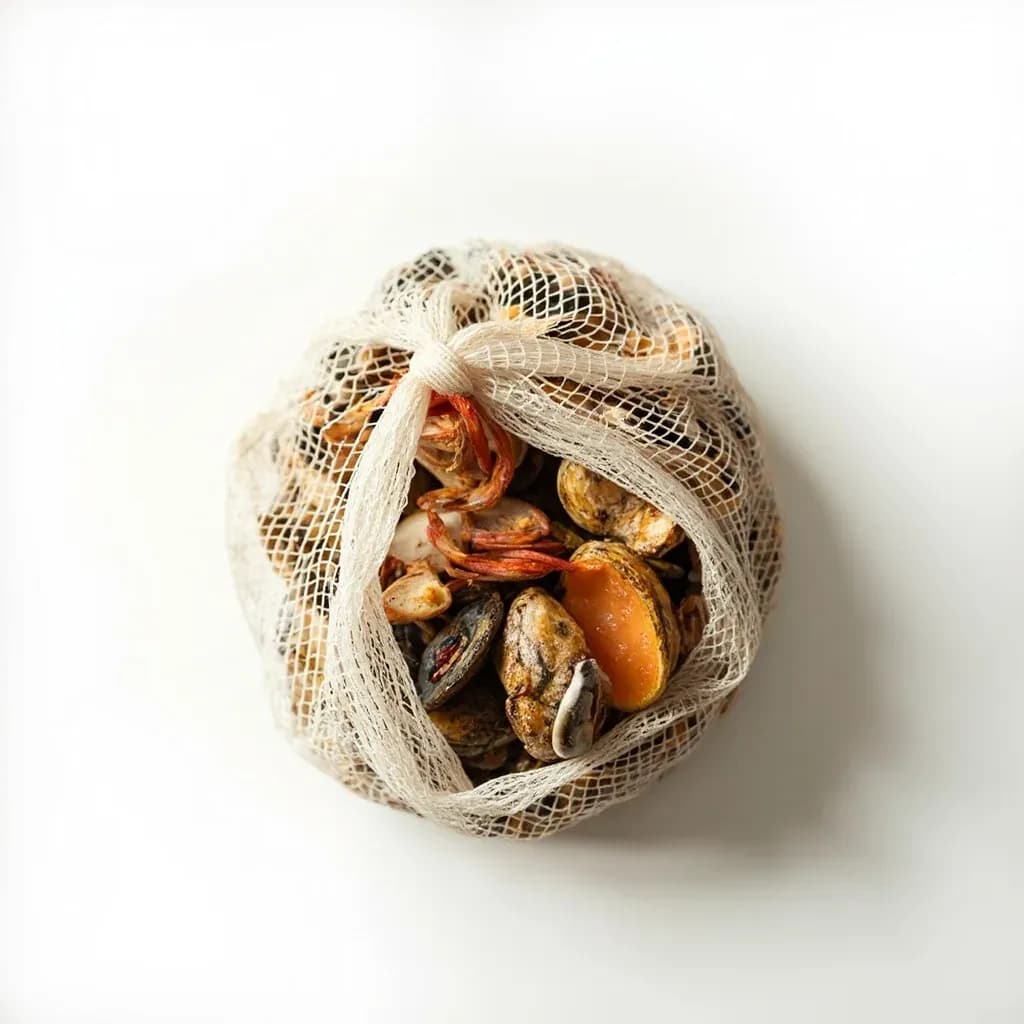
Open-weave net bag for holding shellfish, produce, or aromatics in liquid.
An open-weave net bag used to hold shellfish, citrus, or aromatics so they stay contained while liquid or air passes freely. Cooks drop mussels and clams in one to purge and boil them, bundle pickling spices, or hang produce to cure and dry. The mesh lets water, brine, and smoke circulate while keeping the contents together for easy retrieval.
A mesh net bag is a reusable, drawstring pouch made from heat-resistant nylon or polyester monofilament, designed to hold aromatics, spices, bones, or shellfish in simmering or boiling liquid and then be lifted out cleanly in a single motion. Its value is structural: the open weave allows liquid to circulate freely around the contents so flavor extraction is efficient, while the bag itself contains every solid so the cook never has to fish a stray bay leaf out of a consommé or strain peppercorn grit from a court bouillon. In professional kitchens it has largely displaced cheesecloth for infusion work because it delivers a clear, sediment-free liquid without a second straining pass.
The tool covers tasks that would otherwise require cheesecloth and a chinois, butcher's twine tied around a bundle of herbs, or simply leaving loose spices in a stock and accepting a cloudy result. Fine-mesh versions handle powdered spices and tea; coarse-mesh versions are suited to woody stems, peppercorns, and citrus peel. Because the bags are food-grade and non-reactive, they can be used in acidic braises, salty brines, and dairy infusions alike, and they tolerate the temperatures of a rolling boil or a low simmer without shedding filaments.
Alternatives
Types & varieties
Small fine-mesh drawstring pouch used to enclose peppercorns, bay leaves, thyme, parsley stems, and garlic for stocks, braises, and poaching liquids so they can be lifted out cleanly.
Larger version used to contain bones, trimmings, or shellfish shells during simmering; prevents small fragments from clouding the liquid and makes retrieval one-handed.
Wide, heavy-mesh bag for holding live crab, lobster, shrimp, or corn on the cob in a stockpot; the open weave lets water circulate fully and a single lift removes the entire batch.
Fine-mesh pouch used to steep vanilla bean, citrus zest, cardamom, or tea leaves in dairy for custards, ice cream bases, and panna cotta without leaving sediment.
Small bag for whole spices — mustard seed, coriander, allspice, Sichuan peppercorn — in brines, vinegars, and pickling syrups, so the spices can be removed after flavor extraction.
Choosing the right size and mesh
Matching the bag to the task matters more than it sounds. A bag that is too small forces aromatics into a tight wad where liquid cannot penetrate, leading to weak, uneven extraction; a bag that is too large floats above the liquid line and contributes nothing. Mesh aperture is the other key variable — fine mesh (around 1 mm) is necessary for anything that would otherwise escape into the liquid as grit (ground spices, loose tea, fine zest, cracked pepper), while coarse mesh (3–5 mm) gives better circulation around bulky items like woody herb stems, cracked cardamom pods, and large citrus peels.
- Spice sachet (4–6 in, fine mesh): peppercorns, star anise, cloves, cracked cardamom for stocks and mulled wine.
- Bouquet-garni bag (8–10 in, medium mesh): thyme, parsley stems, bay leaf, garlic clove, leek top for braises and court bouillon.
- Infusion bag (6–8 in, fine mesh): vanilla bean, citrus zest, Earl Grey tea leaves for cream, custard, or simple syrup.
- Stock / bone bag (10–14 in, coarse mesh): roasted bones, chicken feet, veal trim, par-cooked shellfish shells.
- Boil bag (14–18 in, coarse heavy mesh): live crab, lobster, clams, corn on the cob, hard-boiling a large batch of eggs.
Mesh bag vs. cheesecloth vs. twine bundle
Each of these accomplishes containment, but with different trade-offs. Cheesecloth requires a strainer or chinois to recover the liquid, and unwrapping a hot cheesecloth bundle is awkward. A twine-tied herb bundle (a true bouquet garni) is elegant but hard to retrieve from a deep, narrow pot and can come undone mid-simmer. The mesh bag is the practical middle ground: it behaves like a bouquet garni but is closed on all sides, so nothing escapes, and it can be lifted with tongs in seconds.
Common uses
Tips & pitfalls
- Tie the bag tightly and double-knot the drawstring; peppercorns and mustard seeds slip out of loosely closed bags and create bitter, gritty pockets in a finished sauce.
- Choose fine-mesh for powdered spices, tea, and fine zest; coarse-mesh for woody herbs and peppercorns, otherwise particles migrate through and defeat the purpose of the bag.
- Rinse the bag immediately after pulling it from hot liquid — cooked-on residue is hard to remove and can flavor the next use.
- Label the bag (a strip of tape on the drawstring, or a wooden clothespin clipped to it) before dropping it into a dark stockpot, since all submerged sachets look identical.
- Do not overfill: leave room for the contents to expand and for liquid to circulate, otherwise extraction is uneven and the bag is hard to close.
- Weight the bag with a clean metal spoon, a trivet, or another heavy aromatic if it floats above the liquid line in a deep pot.
- Reuse a bag within a single cooking session for multiple infusions of the same flavor (e.g., stepping up a stock), but dedicate separate bags to sweet versus savory uses to avoid carryover between, say, a vanilla custard and a beef braise.
- Replace bags that have become stiff, discolored, or torn — old mesh can shed filaments into delicate sauces and custards where they are impossible to remove.
Good to know
- Material
- Nylon or polyester monofilament mesh, heat-resistant to roughly 400°F / 200°C
- Closure
- Drawstring with lock bead or simple tie cord
- Common sizes
- Small (~4–6 in / 10–15 cm) for spice sachets; medium (~8–10 in / 20–25 cm) for herbs and bouquet garni; large (~12–18 in / 30–45 cm) for shellfish, corn, or large bones
- Mesh aperture
- Fine (~1 mm) for ground spices, tea, and fine zest; coarse (~3–5 mm) for whole herbs, peppercorns, and citrus peel
- Reusability
- Reusable and dishwasher-safe; rinse promptly after use to prevent cooked-on residue
- Food safety
- Food-grade, BPA-free, non-reactive with acidic, salty, or dairy liquids
- Alternative names
- Sachet bag, spice bag, stock bag, étamine (French), 料包 / liào bāo (Chinese)
Also called
Mesh Shellfish Bag · Net Bag · Produce Net Bag · Mesh Bag
Related

Freezer Bags
Thick, sealable bags built to fight freezer burn

Storage Bags
Resealable bags for fridge storage and marinating

Storage Container
Lidded container for leftovers, prep, and meal kits

Glass Container
Oven-to-fridge glass that won't stain or hold odors

Plastic Container
Lightweight, stackable storage for everyday leftovers

Vacuum Sealer Bags
Airtight bags for long freezing and sous-vide

Reusable Bags
Washable silicone bags that replace single-use plastic

Mason Jar
Sealed glass jar for preserves, pickles, and storage