Wraps & Liners
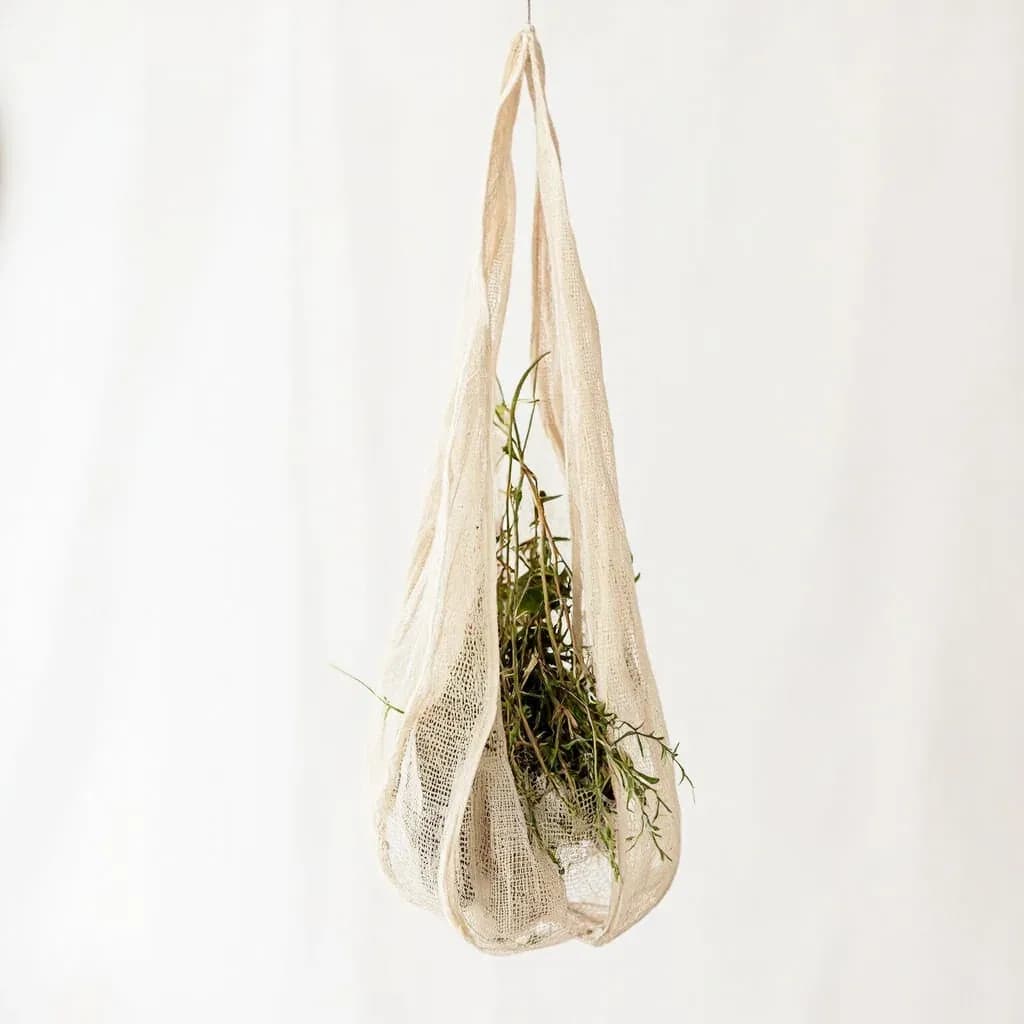
Muslin Drying Net
Fine mesh muslin net used to air-dry herbs, mushrooms, or cured foods while keeping insects out.
A muslin drying net is a breathable fabric enclosure that lets air circulate around food while shielding it from flies and dust. Cooks and foragers use it to dry herbs, chilies, mushrooms, and small cured items, and to protect cheeses or charcuterie as they age. The fine weave is the key feature: it blocks pests yet still allows moisture to escape so food dries evenly.
A muslin drying net is a taut sheet of fine-weave, food-grade cotton muslin stretched across a rigid frame — usually a wooden hoop, bamboo ring, or stainless-steel rectangle — so that food laid on it dries evenly on all sides while flies, dust, and stray debris cannot reach it. It occupies a useful middle ground between the energy cost of an electric dehydrator and the unprotected looseness of hanging herb bunches from a rafter: a single layer of leaves, slices, or seed heads rests on a breathable surface, and air moves freely around each piece instead of just over the top.
The key to the tool is the balance of openness and tightness in the weave. Loose enough to let moisture wick away and warm air circulate, tight enough to keep out insects and hold the lightest seeds and petals. The frame keeps the cloth drum-tight so items do not sag into damp pockets, and most designs are made to be hung, stacked, or set on a trivet with airflow underneath. In European kitchen gardens, the round wooden-hoop version is the classic; rectangular and tiered frames suit larger harvests.
Behaves best in a warm, dry, shaded space with gentle cross-ventilation — a pantry shelf, an airy attic corner, or a larder near (not directly over) a heat source. Direct sun bleaches chlorophyll and cooks volatile oils out of herbs; still air causes sogginess and mould. Treat the net as a clean-cloth tool: it should be washed, thoroughly dried, and stored flat between uses so the weave does not stretch out of true.
Alternatives
Types & varieties
Traditional circular frame with muslin pulled taut like a drumhead; the classic shape for single-layer herb drying
Larger, flatter surface suited to sliced fruit, mushroom slices, and flat trays of seed heads
Multiple frames held by corner posts so several layers dry at once without touching; saves counter space
Suspended by cords from a beam or rack; maximises airflow from below as well as above
Tighter mesh for small leaves (thyme, oregano, mint) and seed heads where exclusion of insects matters most
Looser weave that dries faster; good for larger leaves (basil, sage), sliced fruit, and sliced mushrooms
Frame wrapped in webbing or cord for rigidity when loaded with heavier items like whole mushrooms or fruit halves
Choosing the Right Mesh
The weave is the working part of the net, and a finer cloth trades air exchange for exclusion. For kitchen-garden herbs with small leaves, edible flowers, or any seed heads destined for the pantry, choose the finest weave you can find — a housefly is patient, and a single fly deposit on a drying tray is enough to spoil a batch. For larger leaves, fruit slices thicker than about 5 mm, and mushroom pieces, a medium weave dries faster and is less likely to stay damp at the cloth interface, which is where mould starts.
- Fine weave: thyme, oregano, mint, marjoram, chamomile, seed heads, edible petals
- Medium weave: basil, sage, bay, lovage, apple or pear slices, tomato halves, 3–5 mm mushroom slices
- Avoid cheesecloth as a permanent substitute — it is too loosely woven, stretches when wet, and offers almost no insect protection
- If the weave is so tight that surface moisture sits visibly before soaking in, expect slower drying and rotate the net more often
Siting and Airflow
Where you put the net matters as much as how you load it. A warm, dim, breezy corner will outperform a sunny windowsill every time. Direct light bleaches green herbs to straw-yellow and drives off the volatile oils that give them flavour. Stagnant air, on the other hand, lets the last 10% of moisture linger at the cloth and starts mould colonies exactly where you laid the food.
- Aim for 20–30 °C (68–86 °F), under 60% relative humidity if you can measure it
- Provide airflow on both sides: set the net on a trivet, hang it, or use a tiered stand
- In humid climates, a small fan moving air across (not onto) the net shortens drying and discourages mould
- Bring outdoor nets in at night — dew and temperature drops rewet the food and undo the day's work
- Keep nets away from cooking vapour, smoke, and strong pantry smells; muslin absorbs odours readily
Care, Cleaning, and Storage
Treat the net as you would a linen tea towel: wash, rinse, and fully dry before it goes back into the cupboard. Mould spores and stray flavours carry over from one batch to the next, and a damp muslin folded into a drawer is a self-starter culture of mildew.
- Hand wash in cool water with mild, unscented soap; avoid bleach and fabric softener
- Rinse until water runs clear — residual soap leaves a taste on the next batch
- Air-dry the cloth fully on the frame or flat, away from direct sun
- Store flat or nested in a dry cupboard away from rodents and pantry moths
- Inspect the weave each season: stretched, frayed, or holed muslin should be replaced; a patch is a food trap
Common uses
Tips & pitfalls
- Dry in a single layer — overlapping pieces trap moisture between them and almost always mould
- Keep herb nets out of direct sunlight; UV bleaches chlorophyll and breaks down the essential oils that carry flavour
- Choose a ventilated, dim spot with gentle warmth — a pantry shelf, larder, or airy attic corner
- Elevate the net on a trivet or hang it so air circulates underneath as well as above
- Pre-slice mushrooms 3–5 mm thick; thicker pieces stay gummy at the centre even when the surface feels dry
- Blot washed herbs and fruit thoroughly before laying them out — surface water adds hours to drying time
- Inspect daily and discard anything showing fuzzy growth or off odours; one spoiled piece can contaminate a whole batch
- Use only untreated, unbleached, food-grade muslin — sizing, dyes, and fabric softeners can transfer to food
Good to know
- Material
- Fine-weave cotton muslin (sometimes nylon mesh) stretched over a wooden or metal frame
- Typical frame sizes
- Round hoops 30–50 cm (12–20 in) diameter; rectangular frames roughly 25 × 35 cm to 40 × 60 cm
- Frame materials
- Beech, bamboo, or stainless-steel hoops; plastic frames also available
- Mesh type
- Open-weave muslin that admits air but excludes flies, dust, and most insects
- Best environment
- Warm (20–30 °C / 68–86 °F), low humidity, shaded, with steady cross-ventilation
- Drying time
- Herbs 1–4 days; sliced fruit 2–4 days; sliced mushrooms 1–3 days depending on humidity and thickness
- Load density
- Single non-overlapping layer is ideal; roughly 50–100 g fresh herbs per standard round net
- Care & food-safety
- Hand wash in mild soap, rinse thoroughly, air-dry fully; use only untreated, unbleached, food-grade muslin
Also called
herb drying net · hanging drying net
Related

Aluminum Foil
Wraps, covers, and tents food for the oven and grill

Parchment Paper
Nonstick liner for clean, even baking and easy release

Wax Paper
Moisture-resistant sheet for wrapping and counter prep

Plastic Wrap
Clings tight to cover bowls and wrap leftovers

Silicone Baking Mat
Reusable nonstick liner that replaces parchment

Cheesecloth
Loose-woven cloth for straining stock and bundling herbs

Beeswax Food Wrap
Reusable wax wrap that molds around bowls and produce

Piping Tips
Shaped nozzles that turn frosting into stars and rosettes