Wraps & Liners
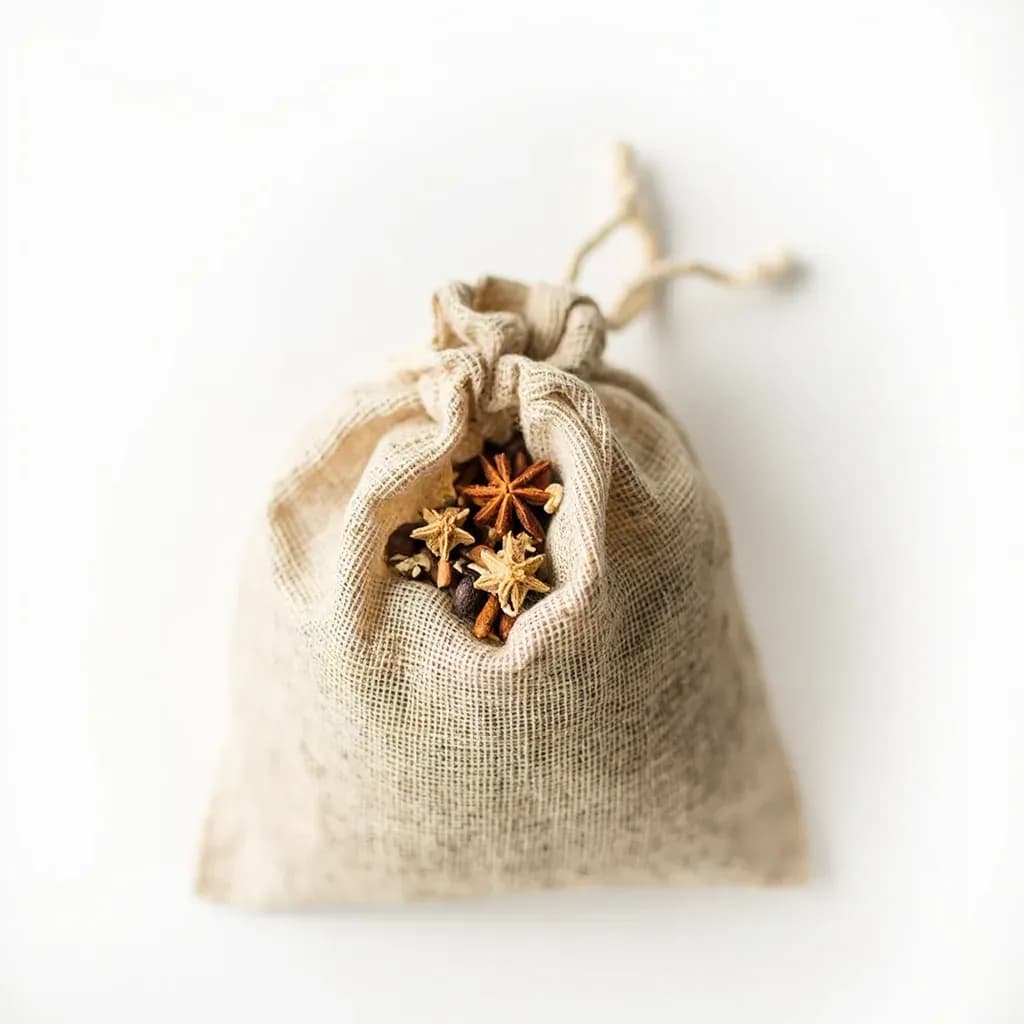
Muslin Spice Bag
Small drawstring muslin pouch that holds whole spices for easy removal from stocks, brines, and mulled drinks.
A muslin spice bag is a fine-weave cloth pouch used to bundle whole spices, herbs, or aromatics so they flavor a liquid without dispersing into it. Cooks drop it into stocks, brines, pickling liquid, or mulled wine, then lift it out cleanly when the infusion is done. It works like a built-in bouquet garni and saves straining, with reusable versions that can be washed between uses.
A muslin spice bag is a small, loosely woven cotton pouch used to bundle whole spices and aromatics so they can steep in liquid without escaping into the finished dish. The weave is deliberately porous — tight enough to contain peppercorns, broken cinnamon sticks, and bay leaves, but open enough to let water, wine, and oil circulate freely and pull flavor from the contents. In French culinary tradition this bundle is called a sachet d'épices, and the technique runs through the Escoffier canon: court bouillon, aspics, stocks, and braising liquids all rely on contained aromatics that can be lifted out cleanly at the end of cooking.
The practical value is twofold. First, it eliminates the final strain-and-discard step, which means the liquid stays clear and unclouded by spice dust or herb fragments. Second, it lets the cook control extraction precisely — the bag is in for as long as the flavor needs, and out before the aromatics turn bitter or medicinal. A serious cook keeps a small graduated stack on hand: a 3×4 for drinks, a 4×6 for brines, a 5×7 for everyday stocks, and an 8×12 or larger for the big stock pot and clarification work.
Muslin is preferred over cheesecloth because the fibers are more tightly woven and don't shed lint, and preferred over a metal infuser because the bag can hold several ounces of aromatics and sit in a simmering pot for hours without imparting a metallic note.
Alternatives
Types & varieties
Pre-sewn cotton pouch with a cotton drawstring. The most common form in home kitchens and the easiest to fill and retrieve.
Unfinished squares sold by the dozen for wrapping spices and tying with kitchen twine. Preferred in professional kitchens for flexibility in size and shape.
Narrow cylindrical bag roughly 1×6 in, used for a single aromatic like a vanilla bean or a cinnamon stick.
8×12 in or larger, sized to hold several ounces of bones, herbs, and aromatics for clarifying consommés and large-format stocks.
Unbleached (natural cream) is the default; bleached white is sometimes chosen for pale stocks, aspics, and consommé where any fiber shed or tint from the bag would show.
Commercial single-use sachets (pickling spice, mulling spice) sold ready-filled for convenience.
Choosing the Right Size
Match the bag to the volume of liquid and the quantity of spice. A small bag jammed full of aromatics won't let liquid circulate, and an oversized bag in a small pot is awkward to retrieve. The rough rule: the bag should be roughly half full, with enough slack for spices to move freely.
- 3×4 in — single drinks (mulled wine, cider, wassail), a single serving of chai, one vanilla bean or cinnamon stick
- 4×6 in — brines, court bouillon, poaching liquid for fruit, small-batch infusions
- 5×7 in — everyday stocks, risotto finishing, simmering cream for custards
- 8×12 in and up — full stock pots, pot-au-feu, pho-style broth, and consommé clarification rafts
Muslin Bag vs. Cheesecloth vs. Metal Infuser
Each option has its place. Cheesecloth folded into a bundle and tied with twine is the traditional substitute, but it sheds lint and requires more handling. Stainless steel mesh infusers are tidy for small quantities of fine spices but don't scale to stock-pot volume and can leave a faint metallic note on very long simmers. Muslin is the middle ground: open enough for full flavor extraction, tight enough to stay clean, and big enough for serious volume.
- Muslin bag — best all-around choice; reusable, lint-free, scales from a mug to a stock pot
- Cheesecloth bundle — acceptable substitute when you have no muslin; tie firmly with twine and expect some fiber loss
- Stainless tea ball / mesh infuser — fine for teas and a tablespoon of spices; too small for stock aromatics
- Tea infuser spoon — convenient for a single drink, but impractical for anything simmering more than a few minutes
Building a Classic Sachet d'Épices
The canonical French sachet bundles the aromatics most often called for in stocks and court bouillon. Build it loose — never compressed — so each spice can release its oils into the surrounding liquid.
- 2 bay leaves (crushed once)
- 1 tsp black peppercorns
- 1 tsp whole allspice or cloves
- 4–6 fresh parsley stems
- 1 small sprig fresh thyme
- Optional: a blade of mace or a 1-inch strip of lemon peel
Common uses
Tips & pitfalls
- Toast or dry-roast whole spices in a dry pan before bagging them — the heat releases essential oils and noticeably deepens the finished liquid.
- Leave at least a 6-inch tail of twine and drape it over the rim of the pot so the bag is easy to fish out without a spoon or tongs.
- Pre-wet the bag with cold water before adding it to hot fat or oil; this prevents scorching of the fibers and helps the bag sink rather than bob on the surface.
- Do not overfill: the bag should be roughly half full so liquid can circulate freely through the spices.
- For long simmers (over an hour), remove the bag once the desired intensity is reached — whole spices continue to extract and can turn bitter or medicinal.
- Use plain cotton kitchen twine or unflavored dental floss; avoid synthetic or colored string, which can leach dye or melt at simmering temperatures.
- When running more than one bag in a pot, label each tail with a small piece of masking tape marked with a Sharpie (e.g., 'sweet' vs. 'savory') to avoid mix-ups.
- Do not use muslin bags for powdered or finely ground spices — they will leach through the weave and cloud the liquid; reserve bags for whole or coarsely cracked aromatics.
Good to know
- Material
- Loosely woven, undyed cotton muslin, typically 100% cotton and food-safe
- Closure
- Cotton drawstring, cotton twine tie, or heat-resistant cotton thread
- Common sizes
- 3×4 in (drinks), 4×6 in (brines), 5×7 in (stocks), 8×12 to 12×18 in (large stock pots and clarification)
- Heat tolerance
- Safe for simmering, boiling, and braising; not intended for direct flame or oven above 400°F
- Reusability
- Washable and reusable; typically lasts dozens of uses before fraying at the seams
- Also known as
- Sachet d'épices, spice sachet, bouquet bag, brewing bag
- Shelf life
- Indefinite when kept dry and away from strong odors
- Origin
- French culinary tradition; pre-sewn muslin bags became standard in professional kitchens in the late 20th century
Also called
Spice Bag · mulling spice bag · brew bag
Related

Aluminum Foil
Wraps, covers, and tents food for the oven and grill

Parchment Paper
Nonstick liner for clean, even baking and easy release

Wax Paper
Moisture-resistant sheet for wrapping and counter prep

Plastic Wrap
Clings tight to cover bowls and wrap leftovers

Silicone Baking Mat
Reusable nonstick liner that replaces parchment

Cheesecloth
Loose-woven cloth for straining stock and bundling herbs

Beeswax Food Wrap
Reusable wax wrap that molds around bowls and produce

Piping Tips
Shaped nozzles that turn frosting into stars and rosettes