Wraps & Liners
Non-Stick Aluminum Foil
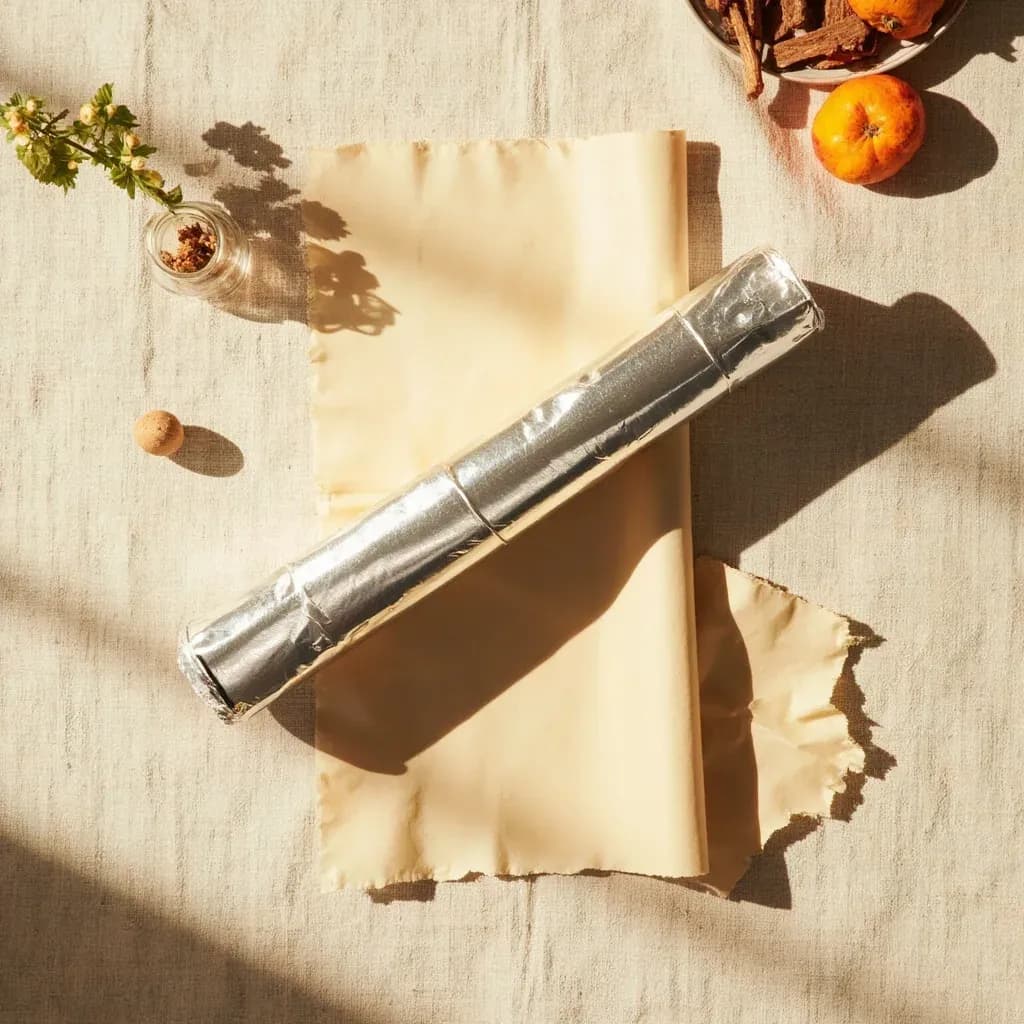
Aluminum foil with a food-safe nonstick coating on one side so cheese, fish skin, and sticky glazes release cleanly; the coated side faces the food, unlike plain foil.
Non-stick aluminum foil is a single-use hybrid: a standard aluminum foil substrate with a food-safe release coating — almost always a silicone-based formula from the same family used on silicone baking mats — bonded to one side. The aluminum carries the structural and thermal job (folding, crimping, conducting heat, holding shape over a sheet pan), while the coating handles release, keeping cheese, fish skin, honey glazes, and egg-washed pastries from fusing to the metal. Sold as a roll that looks nearly identical to ordinary foil at a glance, it is the source of most of the confusion around which side is which.
The product exists because plain foil's worst behavior — sticky, sugary, or cheesy foods welding to the metal and forcing a long soak — is exactly what home cooks most want to avoid on a weeknight. Non-stick foil trades a small premium over plain foil for dramatically easier release on sheet-pan chicken thighs, foil-packet fish, and caramel work. It is not, however, a wholesale replacement for parchment: parchment tolerates higher sugar loads and is compostable in many municipal programs, so most bakers still default to parchment for cookies and pastries and reach for non-stick foil when they also need foil's heat-shielding or packet-shaping properties.
It is also a constrained tool. The coating has a temperature ceiling (roughly 400°F/204°C for household products, 450°F/232°C for heavy-duty lines), cannot survive the dishwasher, and degrades with prolonged contact with very acidic ingredients. Treat it as disposable, keep the coated side against the food, and stay within the package's rated temperature, and it does exactly what it promises: clean release without scrubbing.
Alternatives
Types & varieties
The familiar 18-inch-wide supermarket roll (typically around 50 sq ft); sufficient for sheet-pan lining and most wrapping tasks.
Thicker gauge with the same coating; better for grill packets, bone-in roasts, and items that need more structural support.
18- to 24-inch widths for full-sheet-pan-sized sheets without seaming; common in restaurant and bakery back-of-house.
Cut-to-fit rectangles sized for half- or full-sheet pans; popular in commercial bakeries and meal-prep kitchens for speed and consistency.
Reynolds Wrap Non-Stick is the most visible national brand; Kirkland (Costco), Great Value (Walmart), Kroger, and others offer equivalent products at lower prices.
Identifying the coated side
The non-stick coating is applied to the dull, matte side of the foil; the shiny side is bare aluminum. On most rolls the contrast is clear — the shiny side reflects light almost like a mirror, while the coated side has a softer, satiny finish. The coated side goes against the food; the bare aluminum side faces up, where it browns and crisps predictably and gives you a clean surface to grip when lifting the liner off the pan. If the contrast is hard to read on a particular roll, the package will state which side is coated, and a clean, dry fingertip will pick up the slightly grippier texture of the silicone-coated surface.
Non-stick foil vs. parchment paper
Both are release liners, and for many weeknight jobs either will work. Reach for non-stick foil when you need foil's structural properties — crimping a packet, molding around a bone-in roast, lining a pan you intend to lift by the edges, or shielding the top of a casserole from over-browning. Reach for parchment when sugar load is high (candy work, very sticky cookies) or when you want compostable disposal. For routine sheet-pan dinners — roasted vegetables, chicken thighs, fish — non-stick foil earns its small price premium over plain foil; for cookie sheets and pastries, parchment is usually the better tool.
Common uses
Tips & pitfalls
- Place the coated (dull) side against the food; the shiny aluminum side facing up is the structural surface and crisps or browns predictably.
- Don't preheat an empty sheet lined with non-stick foil above the package's rated temperature — the coating can scorch and smoke without food to absorb the heat.
- Avoid metal utensils, scouring pads, and knives on the coated side; even light scoring permanently marks the release layer.
- Skip the dishwasher. The coating is not engineered to survive wash cycles, and the foil itself tears under water jets.
- For very wet or very sugary bakes, still give the foil a light mist of cooking spray. The coating reduces sticking but does not eliminate it at high sugar loads or with runny batters.
- Under the broiler, keep the food at least 4 inches from the element on continuous high — radiant heat at the surface can exceed the coating's tolerance even when the oven thermometer reads 400°F.
- On a grill, double-wrap below the food packet. Direct contact with grates above an open flame can burn through the coating, and a plain foil layer underneath protects it.
- For long marinades with citrus, tomato, or wine, line the pan with plain foil first and place the food on a sheet of non-stick foil on top — acid degrades the coating and adds a metallic taste.
- If you only need release properties for a small job, parchment paper is cheaper and fully recyclable; non-stick foil earns its keep mainly when you also need foil's heat-shielding or shaping properties.
Good to know
- Material
- Aluminum foil substrate with a food-safe, silicone-based non-stick coating bonded to one side — the same family of release coatings used on silicone baking mats.
- Coated side
- The dull (matte) side carries the coating; the shiny side is bare aluminum and acts as the structural surface.
- Temperature limit
- Standard household rolls are rated to about 400°F (204°C); heavy-duty lines to about 450°F (232°C). Defer to the package rating.
- Microwave
- Not recommended — the metallic foil can arc and the coating can break down.
- Recyclability
- Generally not curbside-recyclable, because the silicone coating contaminates the aluminum recycling stream. Check local guidance.
- Acidic foods
- Long contact with tomato, citrus, or vinegar-heavy sauces can degrade the coating and add a metallic taste; use plain foil as a barrier for long acidic marinades.
- Reusability
- Single-use. The coating abrades with washing and loses its release properties, and the foil itself tears if handled repeatedly.
- Storage
- Store flat or on the roll in a cool, dry cabinet, box closed, away from heat sources so the coating does not pick up dust or off-odors.
Also called
non-stick foil · release foil · coated aluminum foil
