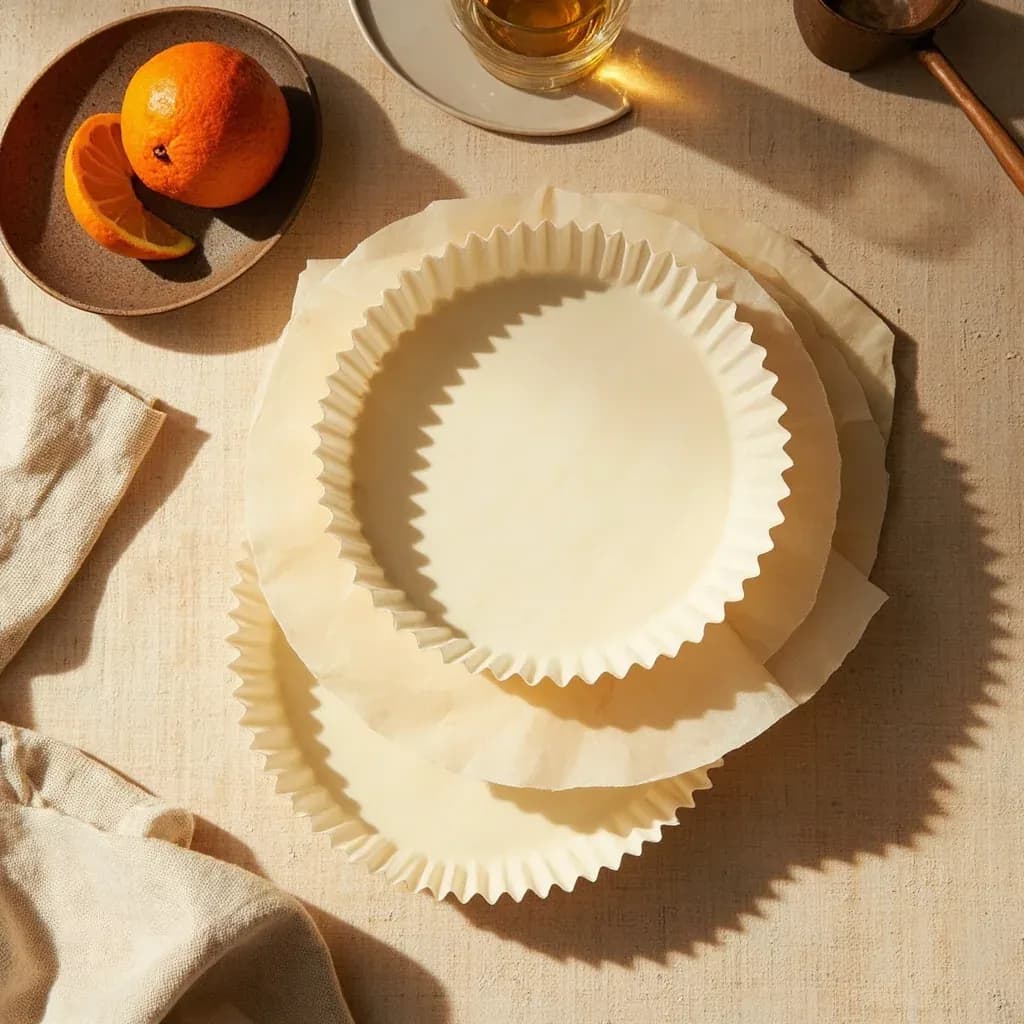
Wraps & Liners
Parchment Round (Cake-Pan Liner)
Pre-cut circle of parchment sized to a cake pan so layers release cleanly without sticking; saves tracing and cutting from a flat parchment sheet for every bake.
A parchment round is a pre-cut circle of silicone-coated baking parchment, sized to fit standard cake-pan diameters from 6 to 14 inches. The silicone layer is what makes the paper genuinely nonstick in the oven; the paper itself is a dense, heat-tolerant cellulose that holds its shape under wet batter rather than going limp the moment it gets damp. The pre-cut shape exists for one practical reason: it removes the small but constant chore of inverting a pan onto parchment, tracing with a pencil, and cutting a circle by hand before every bake.
The value is most obvious with batters that cannot be unmolded by inversion — cheesecakes, flourless chocolate cakes, almond tortes, and any shortbread-crust dessert. Without a liner, these often crack, tear, or cling stubbornly to the pan base, and the damage is usually irreversible. The round also matters in volume baking, where tracing and cutting two dozen circles in a single shift is real labor. For home bakers it is less about throughput and more about consistency: a properly seated round means the cake comes out looking like the one in the photograph.
Standard silicone-coated rounds are rated to roughly 420 to 450°F (215 to 232°C) and behave predictably through the entire cake-baking range, though they are not designed for broilers, open flames, or direct contact with toaster-oven heating elements. Heavy-duty 60 to 70 gsm versions resist the buckling that lighter rounds show when weighted with thin or liquid batters. Bleached (white) and unbleached (tan) rounds perform identically; the color is purely a visual choice, not a functional one.
Alternatives
Types & varieties
Modern retail standard; the silicone layer provides the nonstick release and is FDA-approved for direct food contact.
Natural tan color from unbleached pulp; functionally identical to bleached rounds, preferred by bakers who want a natural look under rustic or honey-colored cakes.
Thicker paper (60+ gsm) with a heavier silicone coat; stiffer, more resistant to buckling, and preferred for delicate batters, flourless cakes, and tall layer cakes.
Pre-shaped with wavy or doily-style edges; used as a presentation liner visible beneath the finished cake or pastry.
Sized and slightly stiffened to sit flat against the base of a springform pan, sealing the seam where batter most often leaks.
Commercial / foodservice grade pre-sprayed with a light oil coating; mainly sold to high-volume bakeries to skip the pan-grease step.
Parchment vs. Wax Paper vs. Kraft Paper
These three papers sit on the same shelf and are routinely confused, but the substitutions are not interchangeable. The functional element of a baking parchment round is its silicone coating, which gives it both nonstick release and heat resistance to roughly 420°F or higher. Wax paper is coated with paraffin, which softens, smokes, and can ignite in a hot oven; it is intended for cold work like lining cake boxes, wrapping sandwiches, or rolling sticky dough between sheets in the refrigerator. Butcher or kraft paper is uncoated cellulose, used for wrapping meat, lining deli cases, and sometimes steaming fish; it has no nonstick release and will bond to a cake as it cools.
The practical rule is simple: if a paper is going in the oven above 350°F, it must be silicone-coated parchment. If a recipe calls for a parchment round and you only have wax paper on hand, do not substitute — butter and flour the pan properly, or cut a custom round from a flat sheet of silicone-coated parchment. The cost of a wrong substitution is rarely visible until you unmold and find half the cake still in the pan, or worse, smoke in the oven.
Common uses
Tips & pitfalls
- Grease the pan first, lay the parchment round in, then grease (and optionally flour) the parchment itself — parchment reduces sticking but does not replace greasing for most cakes.
- If the round slides around when you pour the batter, anchor it with a small dab of soft butter or a smear of the batter in the pan before placing it.
- Press the round firmly into the base of a springform pan, paying special attention to the inner seam under the clip, where batter most often escapes.
- Trace the pan onto a flat sheet and cut just inside the line for a perfect custom round that lies flat with no curl up the sides.
- Save the round that comes out of the pan after baking; it doubles as a nonstick mat for frosting and stacking layers on a turntable.
- Do not place under a direct broiler, open flame, or toaster-oven heating element — the silicone can scorch and the paper can ignite at very high direct heat.
- Reuse rounds that are lightly stained; discard anything that has browned deeply, as the silicone coating is breaking down and release performance is lost.
- In a pinch, lightly dampen the pan before laying the round — the water holds it flat while you pour the batter.
Good to know
- Material
- Food-grade parchment coated with food-grade silicone for nonstick release; older quilon-coated versions existed but have largely been phased out of consumer use.
- Standard diameters
- 6, 7, 8, 9, and 10 in are the most common; 12 and 14 in available for large pans or pizza work.
- Heat tolerance
- Typically rated 420–450°F (215–232°C) for silicone-coated grades; some heavy-duty brands list up to 465°F.
- Thickness
- Standard ~40–41 gsm; heavy-duty / premium grades run 60–70 gsm and resist buckling under wet batters.
- Bleached vs unbleached
- Bleached (white) is the most common retail form; unbleached (natural tan) is widely available and performs identically.
- Edge style
- Plain straight cut is standard; some brands offer fluted, scalloped, or doily-style decorative edges.
- Reusability
- Can usually be wiped and reused 1–3 times if not heavily browned, torn, or grease-saturated.
- Typical pack size
- Sold in packs of 50, 100, or 200 rounds; restaurant-supply brands sell 500–1,000 count cases.
Also called
parchment circle · cake pan liner · round parchment · pre-cut parchment
