Heat & Safety
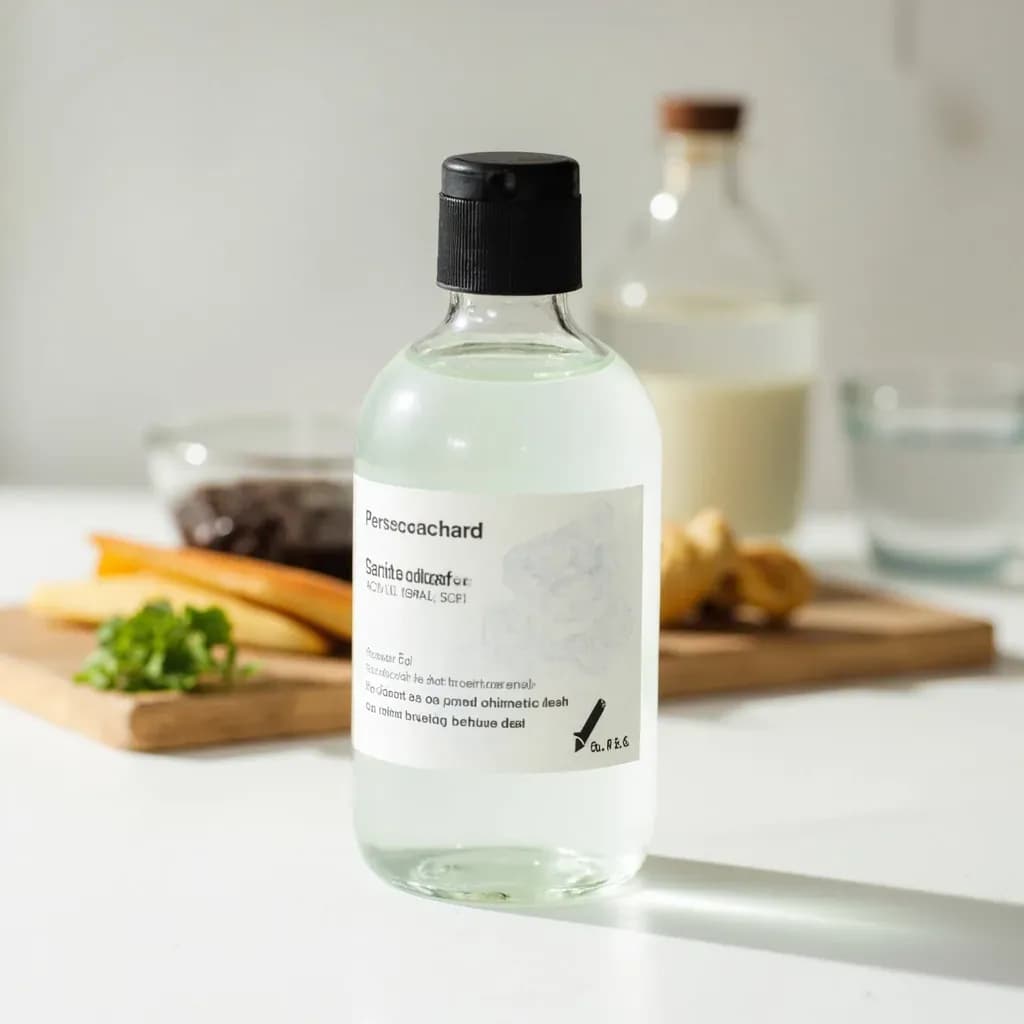
Peracetic Acid Sanitizer
No-rinse food-contact sanitizer used to disinfect surfaces, tanks, and equipment.
Peracetic acid sanitizer is a strong oxidizing chemical diluted to disinfect food-contact surfaces and equipment. Breweries, dairies, and kitchens use it as a no-rinse sanitizer for tanks, fermenters, lines, and tools because it breaks down into harmless residues. It is effective at low temperatures and short contact times, but it is corrosive and must be diluted and handled with care.
Peracetic acid (PAA) is the equilibrium mixture of acetic acid and hydrogen peroxide that forms when those two react in the presence of a catalyst. In plain kitchen terms, it is a powerful, fast-acting oxidizing sanitizer that is FDA- and EPA-registered for direct food-contact use at prescribed dilutions, then breaks down to nothing more than vinegar, water, and oxygen. That clean decay profile is the reason it has largely displaced chlorine bleach and iodophors in craft breweries, dairies, and beverage plants: it kills bacteria, yeasts, and molds in seconds, rinses-free, and leaves no off-flavors behind.
Behaviorally, PAA works across a wide window — from near-freezing temperatures up to about 50 °C / 120 °F — and is highly effective in the acidic pH 2–4 range that the working solution naturally sits in. It is gentle on stainless steel and food-grade plastics, tolerates organic soil far better than chlorine once surfaces are pre-cleaned, and works at concentrations as low as roughly 100–200 ppm. The trade-off is corrosiveness: PAA will eat copper, brass, carbon steel, and mild steel, and the concentrate burns skin and eyes on contact, so it demands respect that a bottle of dilute quat spray does not.
In a home kitchen, a small bottle of no-rinse PAA is genuinely useful for a home brewer, a cheesemaker, or anyone who wants a serious surface sanitizer without the chlorine taste. In a busy professional kitchen, the cost and handling burden usually point to iodophors or quaternary ammonium sprays instead. Knowing where PAA fits is the heart of using it well.
Alternatives
Types & varieties
Workhorse formulation for breweries, dairies, and food plants; diluted with water to working strength.
Contains sequestrants and stabilizers that slow decomposition and extend shelf life of the concentrate.
Adjusted pH and additive package tuned for specific targets, hard water, or heavier soil loads.
Pre-diluted for spot sanitizing of small surfaces and tools; higher cost per liter, less waste.
Used in large food, pulp, and water-treatment operations; requires stricter handling controls.
Why brewers, vintners, and dairies reach for PAA
PAA is the dominant sanitizer in modern craft and commercial brewing, cider, wine, and dairy production for three converging reasons. First, at no-rinse dilutions it does not leave the chlorophenol off-flavors that bleach can transfer to finished beer, or the iodine notes that iodophors can leave on stainless. Second, it tolerates organic soil far better than chlorine and works cold, so it slots into cold CIP loops and cold-side bottle rinses without heating energy. Third, its breakdown products (acetic acid, water, oxygen) pose no residue risk to fermenting or aging product, which is why regulators permit no-rinse use on food-contact surfaces.
- Rotating sanitizer chemistry (for example, PAA and a quat) over time discourages resistant microbial populations.
- Off-flavors in finished beer, wine, or cider are rare at proper dilutions — a key reason PAA dominates over iodine and chlorine in modern beverage production.
Safe handling and storage
The concentrate is a strong oxidizer, a severe skin and eye irritant, and corrosive to several common metals. Treat it with the same caution you would give concentrated lye: gloves, splash goggles, and decanting in a well-ventilated area are not optional. Keep concentrate in its original opaque container, cool, dark, and tightly sealed — heat and sunlight accelerate decomposition. Working solutions lose activity within about 24 hours, so mix only what you will use in a shift and discard the rest rather than topping it up.
- Never mix PAA concentrate with chlorine bleach, acids, or reducing agents — toxic chlorine and/or chloroform gases can form.
- Keep an eyewash station within arm's reach of any decanting or dilution point.
- Use only stainless steel, HDPE, or PP spray heads, fittings, and tubing; copper, brass, and carbon steel will corrode and contaminate the solution.
Common uses
Tips & pitfalls
- Always pre-clean — sanitizers do not penetrate heavy soil, fat, or biofilm. Wash, rinse, then sanitize, in that order.
- Test concentration with PAA test strips at the start of every shift; working solution drifts as it ages and is consumed.
- Discard diluted working solution after about 24 hours — activity drops sharply once mixed, and topping off only makes it worse.
- Never mix PAA with chlorine bleach, acids, or reducing agents; toxic chlorine or chloroform gases can form in seconds.
- Store concentrate in its original opaque container, cool, dark, and tightly sealed — heat and sunlight accelerate decomposition.
- Wear chemical-resistant gloves and eye protection when handling concentrate; it is corrosive to skin and eyes on contact.
- PAA works cold — there is no need to heat the sanitizer, which saves energy in cold CIP loops and produce washes.
- At no-rinse dilutions (typically ≤200 ppm), draining and air-drying is sufficient — no potable rinse required.
Good to know
- Chemical name
- Peracetic acid (peroxyacetic acid, PAA), CH₃COOOH
- Composition
- Equilibrium mixture of acetic acid and hydrogen peroxide
- Use dilution
- Roughly 100–200 ppm for no-rinse food-contact sanitizing; confirm with test strips
- Contact time
- 30 seconds to 5 minutes depending on target organism
- Effective temperature
- Active from near-freezing up to about 50 °C / 120 °F
- Breakdown products
- Acetic acid, water, and oxygen — food-grade residues
- Material compatibility
- Safe for stainless steel, HDPE, and most plastics; corrosive to copper, brass, carbon steel, and mild steel
- Regulatory (US)
- FDA-approved no-rinse food-contact sanitizer; EPA-registered hard-surface disinfectant
Also called
PAA sanitizer · peracetic sanitizer · no-rinse acid sanitizer
Related

Paper Towels
Disposable sheets for spills, drying, and patting dry

Kitchen Towels
Reusable cloths for drying, gripping, and wiping

Oven Mitts
Heatproof gloves to handle hot pans and trays safely

Disposable Gloves
Single-use gloves for safe, mess-free handling

Cleaning Cloths
Reusable cloths for wiping counters and spills

Tortilla Warmer
Insulated holder that keeps tortillas warm and soft

Trivet
Heatproof stand that shields surfaces from hot pots

Ice Bath Setup
Bowl of ice water that halts cooking and sets color