Storage & Containers
Perforated Fermentation Bag
Vented plastic bag that lets fermenting foods release gas while keeping out contaminants.
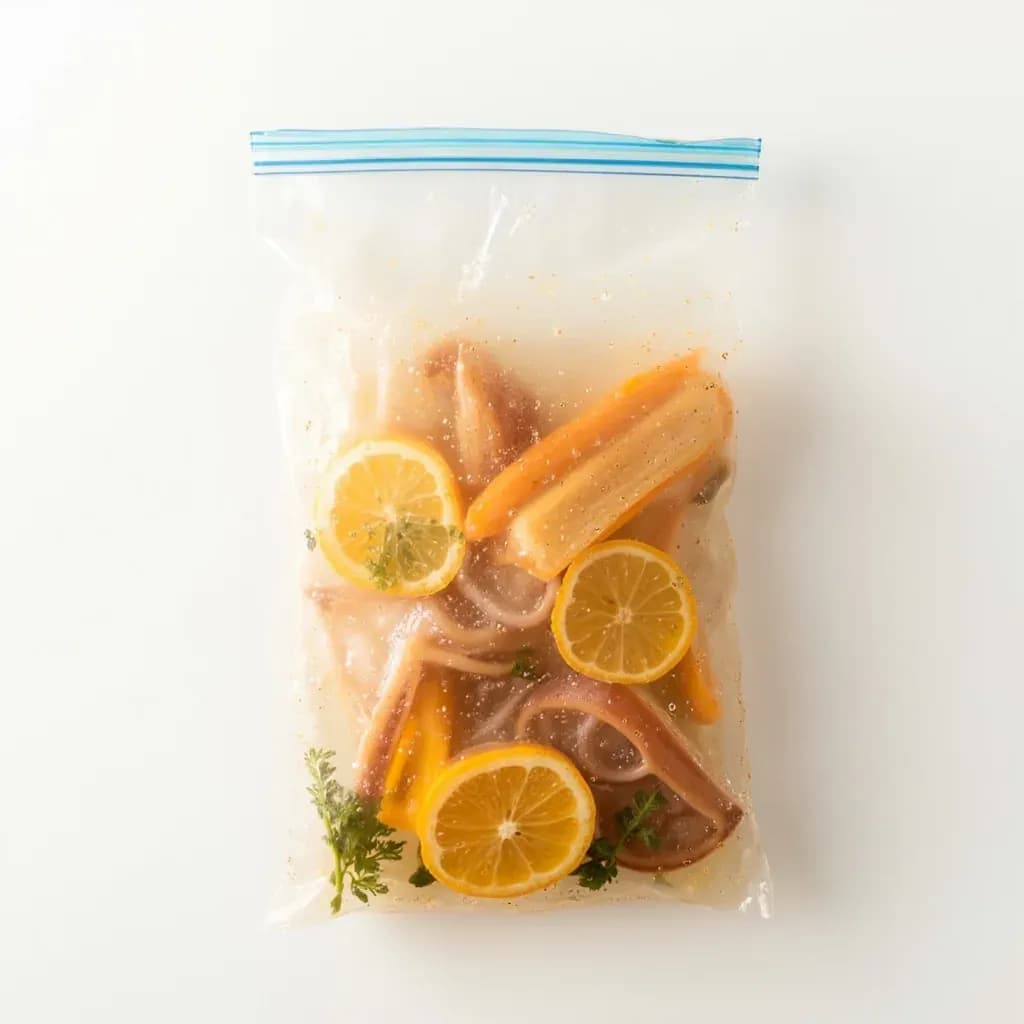
A perforated fermentation bag is a plastic pouch with tiny vent holes used to ferment foods. The perforations let carbon dioxide escape and allow controlled airflow so molds like koji or tempeh can grow, while still shielding the contents from larger contaminants. Cooks use it for incubating cultured products and resting doughs, choosing the hole pattern to match how much air the ferment needs.
A perforated fermentation bag is a food-grade polyethylene or polypropylene pouch whose walls are punctured with micro-holes, each just a fraction of a millimeter across. Those holes are small enough to exclude dust, splash, and most insects, yet large enough to let carbon dioxide — the gas that lactic acid bacteria generate as they convert sugars into lactic acid — seep out continuously. In effect, the bag performs the same job as the water trap on a traditional fermentation crock: it relieves pressure and admits a slow trickle of fresh air without ever fully opening the vessel.
The reason this matters is that active ferments produce a surprising volume of CO₂. In a sealed container that gas has nowhere to go, so the lid balloons, brine weeps out of the seal, and the food can end up exposed to oxygen at exactly the wrong moment. A vented bag solves that problem passively: the gas escapes as fast as it forms, and because CO₂ is heavier than air, a protective blanket tends to linger at the surface of the food, discouraging the aerobic yeasts and molds that would otherwise colonize it.
Bags are not, however, a magic shortcut. They do not replace correct salt levels, fully submerged food, or clean technique, and for long, slow ferments in the multi-week or multi-month range many producers still reach for a ceramic crock, a glass jar with an airlock lid, or a food-grade bucket with a gasketed cover. What the bag does offer is a lightweight, disposable, low-commitment way to ferment small batches on a countertop or to line a larger vessel so the finished food can be lifted out cleanly.
Alternatives
Types & varieties
Standard LDPE produce bags with tiny laser-punched holes; handy for small countertop ferments and very low cost.
Thicker PE or PP bags sized to line a bucket or crock; widely used in commercial sauerkraut and kimchi production.
Pre-sized pouches with vent perforations designed for sauerkraut, kimchi, curtido, and similar submerged ferments.
Sealed film pouches fitted with a small mechanical valve that releases CO₂ while limiting oxygen ingress.
Large, unsealed bags used as a removable liner inside a crock or bucket; the crock's own weight keeps food submerged.
How the Gas Exchange Works
The perforations on a fermentation bag are sized deliberately: big enough that carbon dioxide, which is a small linear molecule, can diffuse outward at roughly the rate it is being produced, but small enough that liquid brine cannot pass through by surface tension. This is the same principle behind the micro-porous lids used on many commercial fermenting jars. The result is a slow, one-way traffic of gas out of the bag, with very little oxygen moving in the opposite direction because the holes are constantly bathed in rising CO₂ from below.
- CO₂ escapes passively; there is no airlock to monitor or burp.
- A natural CO₂ blanket forms at the surface of the brine, discouraging aerobic spoilage organisms.
- The bag is not a vacuum — small amounts of oxygen still enter, which is why salt and acidity still matter.
Bag or Crock: Choosing the Right Vessel
Perforated bags shine for short, room-temperature ferments of a few days to a couple of weeks, for small test batches, and for lining a larger crock or bucket so the finished ferment can be lifted out in one piece. For longer ferments, for ferments that need to be tasted and pressed down repeatedly, or for anything where the cook wants a hermetic seal, a traditional crock or an airlock-fitted jar is the more dependable tool.
- Choose a bag for sauerkraut, quick kimchi, curtido, and small pickle batches.
- Choose a crock for multi-month ferments, dry-salted crocks that need pressing, or anything stored at warm ambient temperatures for weeks.
- Choose a jar with an airlock for ferments you want to monitor closely or sample repeatedly.
Common uses
Tips & pitfalls
- Leave 20–25% headspace at the top of the bag; fermenting vegetables and trapped CO₂ expand, and a tight bag can split at the seam.
- Use only bags labeled food-grade; ordinary trash or storage bags can leach plasticizers into acidic brine.
- Set the bag on a rimmed sheet, in a bowl, or inside a bucket to catch the inevitable slow leak.
- Do not enlarge the factory perforations with a knife — torn openings leak brine and admit surface mold.
- Do not substitute a vacuum-seal bag; it has no vent and will balloon or burst from CO₂ pressure.
- Wipe the outside of the bag before opening, and open it under brine or over a clean vessel to keep surface yeasts from falling in.
- For long ferments (weeks to months), choose a thicker bag or double-bag to prevent slow seam leaks.
- Keep the food fully submerged under brine with a weight; the bag itself does not replace proper weighting.
Good to know
- Material
- Food-grade low-density polyethylene (LDPE) or polypropylene film
- Perforation style
- Laser- or needle-punched micro-holes, generally a fraction of a millimeter across
- Operating temperature
- Intended for cool, room-temperature, and refrigerated ferments; not designed for boiling or hot-fill
- Typical capacity
- From roughly 1 L (1 qt) consumer pouches up to 50 L (13 gal) commercial liners
- Closure
- Heat-sealed, twist-tied, zip-lock, drawstring, or open-top with a separate weight
- Reusability
- Most are single-use; thicker food-grade versions can be rinsed and reused a few times
- Gas exchange
- Permits CO₂ release while excluding dust, splash, and most insects
- Common alternative
- Functionally similar to a fermentation crock with a water-sealed airlock, but lighter and disposable
Also called
Ferment Bag · vented fermentation bag · perforated culture bag
Related

Freezer Bags
Thick, sealable bags built to fight freezer burn

Storage Bags
Resealable bags for fridge storage and marinating

Storage Container
Lidded container for leftovers, prep, and meal kits

Glass Container
Oven-to-fridge glass that won't stain or hold odors

Plastic Container
Lightweight, stackable storage for everyday leftovers

Vacuum Sealer Bags
Airtight bags for long freezing and sous-vide

Reusable Bags
Washable silicone bags that replace single-use plastic

Mason Jar
Sealed glass jar for preserves, pickles, and storage