Wraps & Liners
Perforated Mold Liner
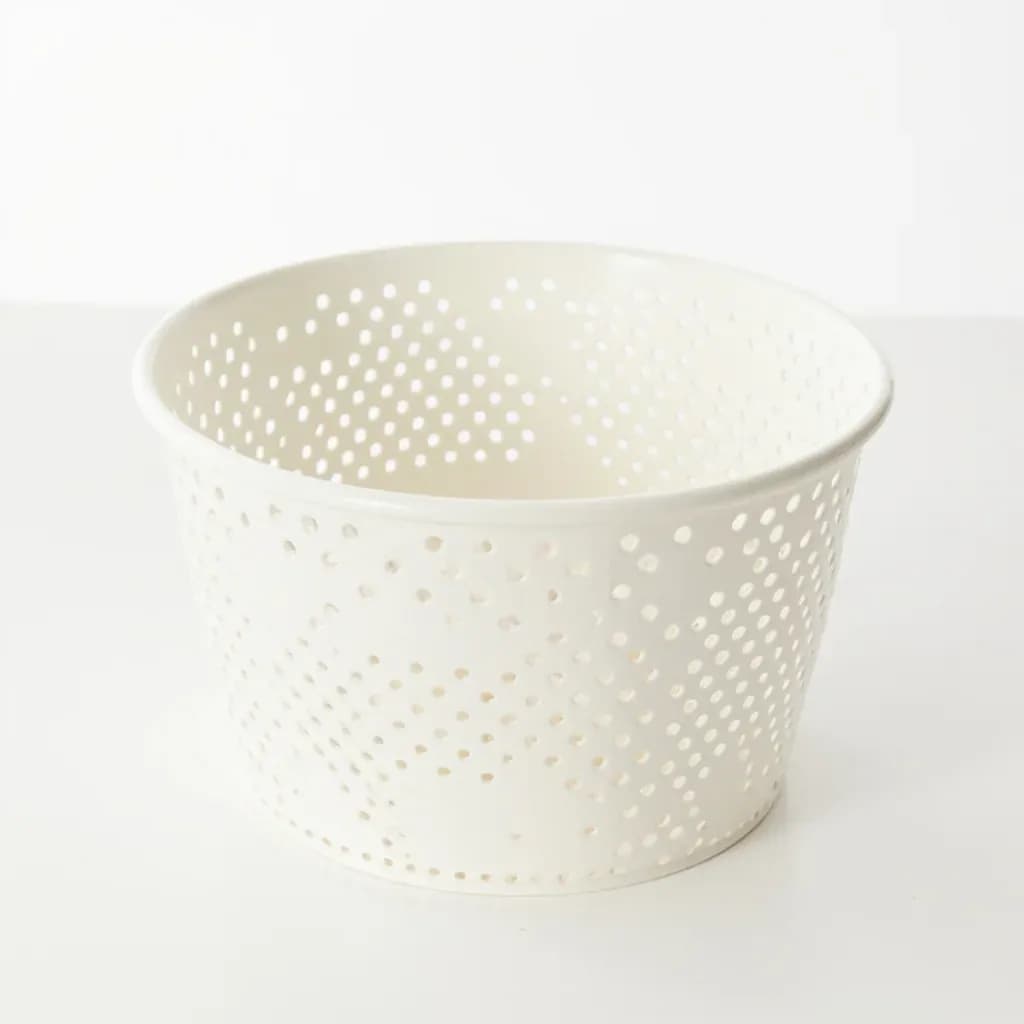
Vented liner placed inside cheese or terrine molds to drain whey and shape the curd.
A perforated mold liner is a thin sheet of vented plastic or mesh fitted inside a forming mold. In cheesemaking it lines the hoop so whey drains away through the holes while pressing, leaving a clean surface and imprinting a subtle texture. Similar liners are used in terrine and pâté molds to wick excess moisture and help unmold the finished shape neatly.
A perforated mold liner is a thin, food-grade sheet — usually plastic, occasionally stainless steel mesh — that sits inside a cheese or terrine mold to do three jobs at once: let whey or rendered juices escape, hold fragile curds or forcemeat together, and keep the food from bonding to the mold wall. The mold itself is rigid and provides shape; the perforations do the drainage; the liner provides a clean, food-safe barrier between the two. Without it, soft curds slump and stick, pressed wheels emerge scarred where they tore against the mold seam, and a terrine loses the fat and juices you actually want to drain off.
The item is deceptively simple, but perforation size, material, and handling change the outcome. A fine-perforation liner protects delicate lactic curds; a coarse one is right for a heavily pressed Gouda or tomme where aggressive whey removal is part of the recipe. Plastic versions are cheap and forgiving but warp with age and heat; stainless mesh costs more but survives boiling, autoclaves, and years of service, which is why small dairies and labs standardize on it. In a home kitchen, the perforated disk is the single piece of kit that makes a small batch of crottin, a rectangular farmhouse cheese, or a pâté en croûte actually behave the way the recipe assumes.
Alternatives
Types & varieties
Standard liner for cylindrical cheese molds; flexible, lightweight, inexpensive
Used in loaf molds for terrines, pâtés, and farmhouse-style rectangular cheeses
Reusable, autoclavable, tolerates boiling and hot sanitizing cycles; preferred in small dairies, labs, and serious home setups
Smaller holes for soft cheeses, fresh cheeses, and delicate curds that would slip through a coarse liner
Larger holes for hard, pressed cheeses such as Gouda-style wheels or tomme, where aggressive whey drainage is wanted
Cut to match a named mold size (8-inch crottin, 1 kg tomme) so no trimming is required
A tougher fabric alternative to cheesecloth when a more durable, washable liner is preferred
Plastic versus stainless: choosing the right material
For most home cooks, plastic perforated liners are the right starting point: they are cheap, easy to trim, and behave predictably at room temperature and in a cool press. The trade-off is lifespan and heat tolerance. Polyethylene begins to soften around 80 °C, which rules it out of any hot rinse or high-heat sanitize cycle, and over time it clouds and warps — that milky haze is micro-scratches, and it is a sign the liner should be replaced, not sanitized harder. Stainless steel mesh costs more and is stiffer to work with, but it tolerates boiling water and full dishwasher sanitizing, lasts essentially forever, and is the standard in professional dairies and labs. If you make cheese weekly or share equipment with a small production, stainless pays for itself quickly.
- Pick plastic for casual home use, soft cheeses, and routine washing on a dishwasher's top rack (avoid high-heat sanitize cycles).
- Pick stainless mesh for repeated use, hot sanitizing, or any setup where multiple batches cycle through.
- Discard any plastic liner that warps, cracks, or develops a milky haze — it has micro-scratches that harbor bacteria.
- Confirm food-contact certification (EU food-grade or US FDA 21 CFR) on the label before purchase.
Matching perforation size to the job
Perforation size is the variable that matters most, and it is worth thinking about in terms of the particle size of what you are molding. For fresh lactic curds — chèvre, fromage frais, a young lactic tomme — the curds are small and fragile, and a fine-perforation liner keeps them in the mold while still letting whey weep. For a pressed cheese where the curds are already partly fused, coarser holes speed drainage without losing curd. A common mistake is to assume finer is always safer; in practice, a too-fine liner on a pressing cheese stalls drainage, traps lactic acid against the surface, and produces a sour, sticky rind. As a rule of thumb, holes should be small enough to retain the curd but large enough that whey flows freely under light pressure.
- Fine holes (around 1 mm) for fresh cheeses, ricotta, paneer, and delicate lactic curds.
- Medium holes (around 2 mm) for most semi-pressed and tomme-style cheeses.
- Coarse holes (2–3 mm) for heavily pressed wheels like Gouda, Edam, and aged farmhouse cheeses.
- For terrines, medium perforations work for most forcemeats; very fine holes clog with rendered fat.
Common uses
Tips & pitfalls
- Match perforation size to curd size: too coarse and small curds escape; too fine and drainage stalls, leaving the cheese sour.
- Pre-wet plastic liners and press them flat against the mold wall — wrinkles print straight into the rind.
- Always sanitize the liner before use; residual whey carries bacteria that can throw off an entire make.
- For tall presses, cut the liner a little large so it can fold up over the curd as it compresses instead of tearing.
- Don't substitute regular plastic film or a plastic bag — they trap moisture and defeat the purpose of the liner entirely.
- Store liners flat or gently rolled; a sharp fold creates a permanent crease that prints into the next wheel.
- Label liners by cheese type if you make several — strongly flavored cheeses can ghost-flavor the next batch.
- When unmolding aged wheels, leave the liner in place briefly on the aging mat so the underside dries evenly with the rest of the rind.
Good to know
- Primary material
- Food-grade polyethylene or polypropylene plastic; stainless steel mesh is the professional alternative
- Typical shapes
- Round disks for cylindrical cheese molds; rectangular sheets for loaf and terrine molds
- Common mold diameters
- Round sizes from about 6 cm (small goat molds) up to 30 cm (large wheels); rectangular sheets roughly 10 × 20 cm to 30 × 60 cm for pâté en croûte
- Perforation size
- Evenly spaced holes, generally 1–3 mm — finer for soft or fresh curds, larger for pressed and aged cheeses
- Heat tolerance
- Polyethylene softens above ~80 °C; polypropylene tolerates ~120 °C; stainless mesh is oven- and autoclave-safe
- Primary function
- Allows whey or juices to escape during pressing while supporting the curd or forcemeat and preventing it from sticking to the mold wall
- Rind effect
- Produces a smoother, more uniform rind by keeping the cheese surface open to airflow during pressing and early drying
- Cleaning & service life
- Rinse cool, sanitize with food-safe detergent or in a dishwasher (top rack for plastic); plastic lasts months to a few years, stainless is essentially permanent
Also called
cheese mold liner · vented mold liner · draining mold liner
Related

Aluminum Foil
Wraps, covers, and tents food for the oven and grill

Parchment Paper
Nonstick liner for clean, even baking and easy release

Wax Paper
Moisture-resistant sheet for wrapping and counter prep

Plastic Wrap
Clings tight to cover bowls and wrap leftovers

Silicone Baking Mat
Reusable nonstick liner that replaces parchment

Cheesecloth
Loose-woven cloth for straining stock and bundling herbs

Beeswax Food Wrap
Reusable wax wrap that molds around bowls and produce

Piping Tips
Shaped nozzles that turn frosting into stars and rosettes