Storage & Containers
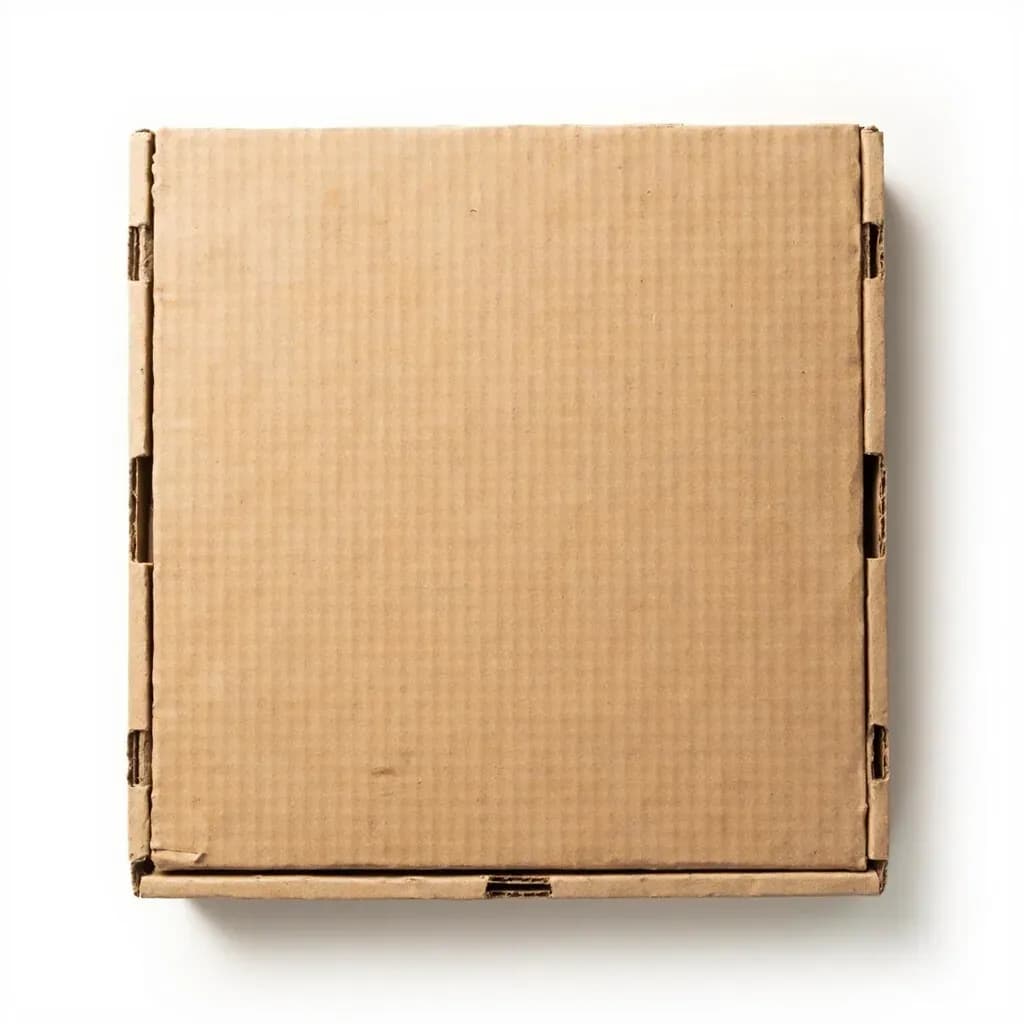
Corrugated Pizza Box
A square corrugated cardboard box that carries and insulates a hot pizza for delivery or takeaway.
A corrugated pizza box is a flat-folded square cardboard container that holds a whole pizza for transport. The corrugated walls insulate the pie and vent steam through small holes so the crust stays crisp rather than soggy. Pizzerias use them for delivery and takeaway, and the box can be home-composted or recycled if not greasy.
The corrugated pizza box is a deceptively engineered piece of packaging asked to do two contradictory jobs: trap enough heat to keep a pie from a 475 °F oven warm through a 20-minute drive, while letting just enough steam escape so the bottom crust doesn't turn to cardboard. The trick is the fluting — that wavy inner layer sandwiched between two flat kraft liners. The dead-air pockets between the flutes act as a thin blanket of insulation, while the kraft faces resist grease, take a printed logo cleanly, and give the lid the rigidity to be stacked, slid, and folded without collapsing.
A home cook who bakes pizza in a home or outdoor oven runs into the same problems a pizzeria does: how to move a finished pie from oven to table without losing heat, without sogginess, and without the toppings sliding off. A well-sized, vented box solves all three; a wrong-sized or fully sealed box makes them worse. The basic square design dates to U.S. Patent 3,420,365, granted in 1969 to Carmela Vitale, and the shape has barely changed since — modern refinements are mostly about vent geometry, food-safe inks, and compostable coatings rather than the box itself.
For the home pizza maker, the box is most useful as a carry-and-hold vessel. It also doubles as a serving surface (the lid opens flat and the bottom cradles the pie), a makeshift splatter lid for low-temperature oven reheating, and — once empty — a sturdy source of compostable cardboard.
Alternatives
Types & varieties
Classic hinged-lid corrugated box in sizes from 8″ personal up to 18″ party size
Taller sidewalls (often 2.5–3″) to accommodate thick pan, Sicilian, or Detroit-style pizzas
Small open-top corrugated tray sized for one or two foldable slices
Die-cut holes or side vents that release steam to keep the crust crisp on longer carries
Two-layer corrugated or foil-lined construction for longer delivery routes or cold-weather transport
Press-molded pulp alternative; compostable, popular with greener chains
Unbleached fiber with soy-ink printing, certified compostable for sustainability-minded kitchens
Venting, steam, and crust texture
The single biggest variable in a pizza box is whether steam can escape. A pie straight from the oven vents water vapor from the cheese, sauce, and crust; in a sealed box, that vapor condenses on the inside of the lid and drips back down, soaking the top of the pie and turning the bottom crust gummy. Ventilated boxes address this with small die-cut holes on the lid or slots on the sidewalls, and even unvented boxes can be 'vented' by leaving one corner unsealed or propping the lid with a folded napkin. For a 15-minute carry in mild weather, venting matters more than insulation. For a 5-minute walk home, a sealed standard box is fine.
- Vented boxes are worth the small upcharge for any carry longer than about 10 minutes.
- Leaving a corner unsealed mimics venting and is a free fix if you only have standard boxes on hand.
- Cold pizza can be more pleasant in a sealed box — trapped moisture softens a stiff crust, much the way a room-temperature slice from yesterday often eats better than one straight from the fridge.
Sizing the box to the pie
A box should be just large enough to hold the pie with about half an inch of clearance on each side. Too small and the toppings smear the lid; too large and the pie slides around, the cheese breaks, and the pizza has to heat a larger volume of air inside the box, cooling faster. A 12″ pie belongs in a 12″ box, not a 14″. Deep-dish, Sicilian, and Detroit pies need the taller-walled variant regardless of footprint — a standard 14″ square box won't clear a 2.5″-tall pan pizza.
- Match box diameter to pizza diameter, not to the pan you baked in.
- For a rectangular Sicilian or grandma pie, use a rectangular box or cut parchment 'rails' inside a square box to keep the pie from sliding.
- Personal pies (8–10″) deserve their own size — over-boxing a small pie is the most common cause of cheese-sticking-to-the-lid.
Reheating with the box
The box is genuinely useful as an oven accessory, not just a delivery vessel. A flipped-open pizza box set on a sheet pan makes a serviceable splatter lid when reheating at low oven temperatures, and the lid itself can shield the top of the pie from direct heat. The limits are real: adhesives, inks, and any stickers or tape can off-gas at high heat, so keep temperatures at or below 400 °F / 205 °C and strip off labels first.
- Set the open box (or just the lid) over a slice or two on a baking sheet at 375 °F for 5–8 minutes to re-melt cheese without drying the crust.
- Never microwave inside the box — adhesives, inks, and the cardboard itself aren't designed for the microwave and can scorch, off-gas, or ignite.
- For a frozen slice, a 350 °F oven on a sheet pan with the box as a loose lid revives it far better than the microwave.
Common uses
Tips & pitfalls
- Don't seal the lid on a pie straight from the oven — leave a corner open or use a vented box so trapped steam doesn't soggy the crust.
- Keep delivery or carry time under about 30 minutes; beyond that the cheese firms and the crust loses quality even inside an insulated bag.
- Stack no more than three boxes high and never put heavy items on top, or the lower pies will compress and stick to the lid.
- Skip the microwave inside the box — adhesives and inks may off-gas; transfer slices to a plate or microwave-safe surface first.
- If reheating in the oven with the box, keep temperatures under 400 °F / 205 °C and remove any printed stickers, labels, or tape first.
- For deep-dish or heavily sauced pies, line the bottom of the box with parchment to keep cardboard from absorbing moisture and leaking through.
- Buy boxes from a food-service supplier in case quantities (50–100) — they're far cheaper than retail packs and the sizing is consistent across batches.
- Store empty boxes flat in a dry area; humidity warps the corrugation and makes lids fit poorly when you need them most.
Good to know
- Material
- Single-wall corrugated fiberboard, typically kraft (brown) paper with a fluted inner liner
- Standard flute
- B-flute (~3 mm) for strength and insulation; E-flute (~1.5 mm) for smoother print surfaces
- Common sizes (U.S.)
- 8″, 10″, 12″, 14″, 16″, and 18″ square, plus rectangular and deep-dish variants
- Insulation window
- Retains useful heat for roughly 20–30 minutes; cools to room temperature in about 1–2 hours
- Temperature tolerance
- Rated for foods up to roughly 200 °F / 93 °C in short contact
- First U.S. patent
- U.S. Patent 3,420,365 granted in 1969 to Carmela Vitale for a 'package for pizza'
- Typical load capacity
- Engineered to support a stacked pizza load of roughly 5–10 lb (2.3–4.5 kg) per box
- Recyclability
- Widely recyclable and compostable; modern MRFs accept grease-soiled boxes if flattened and food scraps are removed
Also called
Pizza Box · Cardboard Pizza Box
Related

Freezer Bags
Thick, sealable bags built to fight freezer burn

Storage Bags
Resealable bags for fridge storage and marinating

Storage Container
Lidded container for leftovers, prep, and meal kits

Glass Container
Oven-to-fridge glass that won't stain or hold odors

Plastic Container
Lightweight, stackable storage for everyday leftovers

Vacuum Sealer Bags
Airtight bags for long freezing and sous-vide

Reusable Bags
Washable silicone bags that replace single-use plastic

Mason Jar
Sealed glass jar for preserves, pickles, and storage