Heat & Safety
Pizza Saver (Box Tripod)
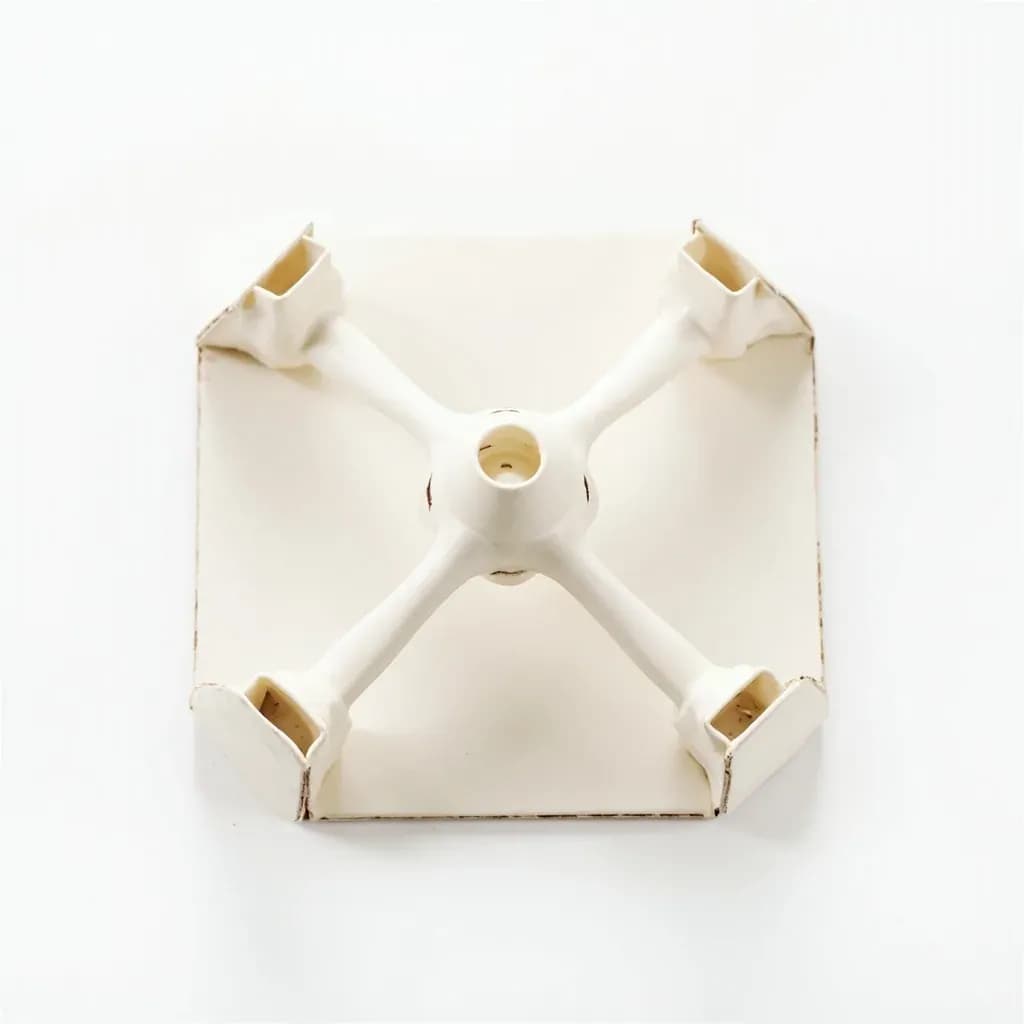
Small three-legged plastic tripod set in the center of a pizza box to stop the lid sagging onto the cheese.
A pizza saver is a tiny plastic tripod placed in the middle of a hot pizza before the box is closed. Its three legs hold the box lid up off the surface so the cardboard does not collapse and stick to the melted cheese during delivery. It is a single-use takeaway accessory that keeps the pie intact and presentable until the box is opened.
The pizza saver — that small, three-legged plastic tripod that shows up in nearly every delivery box — is a deceptively clever piece of packaging engineering. Patented in 1984 by Carmela Vitale, a New York mother who grew tired of ruined pies, it solves a problem most of us have lived with for years: steam rising from a hot pie condenses on the inside of the cardboard lid, softens the board, and gradually sags the lid down onto the cheese. The tripod's job is twofold: it props the lid up at its weakest point (the center) and holds the box in a slightly tented shape so steam can vent through the side seams instead of pooling on top of the pizza.
In practice, the saver matters most on the first pie in a stack, where the lid above is just cardboard. When boxes are piled three or four deep on a delivery run, the domed cap bears real weight and the tripod distributes that load through three legs that meet the pizza at a stable footprint. Most home cooks underestimate how much structural work that little plastic tripod is doing — the difference between a delivered pizza with a clean, dry top and one with a slick of condensation grease on the cheese usually comes down to the presence (or absence) of a functioning saver.
Beyond delivery, the humble tripod has earned a second life in home kitchens as a mini-stand, spacer, and drying rack. Its three-point geometry is inherently stable, the plastic is food-safe at normal temperatures, and the size is conveniently suited to a surprising range of small tasks — from cooling dipped chocolates to propping up a wobbly cutting board.
Alternatives
Types & varieties
The classic, most widely distributed version; cheapest to mold and easy to print on.
Used by some pizzerias so the logo or cheese pattern remains visible through the lid.
Promotional or seasonal versions in brand colors or themed palettes (red/green for holidays, school colors for sports promotions).
Carries a restaurant, sports team, or sponsor logo on the cap; often collected by fans and given out at events.
Made from PLA or other plant-based plastics; introduced in the 2010s by eco-focused chains and now common in Europe and parts of the US.
Smaller version used in personal-size or lunchbox pizza containers where the box footprint is reduced.
Why three legs and a dome?
The geometry is not arbitrary. A three-point base is the most stable configuration on any surface — even a bowed, condensation-weakened cardboard lid — because it always contacts the surface in exactly three places, distributing load without rocking. The cap is equally deliberate: its wide diameter keeps the load-bearing surface large enough that the lid above (or the next box in a stack) does not punch through the narrow gap between the legs, which is critical because the cardboard is often softened by steam. Polystyrene was the original material of choice because it is cheap to mold, rigid at room temperature, and rated for food contact.
Beyond the box: kitchen reuses
The same three-point stability and food-safe plastic that protect a pizza make the saver useful for a handful of small kitchen jobs. Treat it as a piece of equipment, not trash.
- Drying stand for chocolate-dipped strawberries, truffles, or pretzels — set them on a wire rack over a sheet pan and use a saver to keep dipped items from rolling.
- Mini trivet for a single warm cup or small ramekin on a wood counter (avoid very hot items; polystyrene softens well below boiling).
- Foot or shim slipped under the corner of a wobbly cutting board, mixer, or small appliance to stop it from rocking.
- Non-slip bumper tucked under a serving tray or a stack of takeout boxes on a slick car seat or delivery bag.
- Marker or spacing peg in seed-starting trays, where the three legs nest neatly into cells.
Common uses
Tips & pitfalls
- Do not put a pizza saver in the microwave or oven — most are not heat-rated and will warp, melt, or leach chemicals into the food.
- Reuse them rather than tossing them: a single polystyrene tripod can last for years with gentle hand-washing in cool or lukewarm water as a mini drying stand or spacer.
- If a saver arrives broken, the lid has already been compromised — request a fresh box rather than eating a smushed pie whose cheese has been pressed flat.
- The saver does its hardest work on the first box in a stack; the weight of the boxes above it is what truly tests the lid, not the cheese alone.
- Eco versions made of PLA or other bioplastics are not dishwasher safe and will deform above roughly 110°F/43°C — wash them by hand in cool water only.
- For thicker pizzas (deep-dish, Sicilian, Detroit-style) leave the saver in the box for the first 5–10 minutes after delivery so steam can vent before you cut; removing it too early lets the lid drop back onto the surface.
- Avoid stacking hot boxes without letting the first one vent for a minute or two — even a perfect saver cannot stop moisture that has nowhere to go.
- If you bake pizza at home and need to transport it in a box, snap a saved pizza saver into the center the same way the pizzeria does; it costs nothing and prevents a soggy top.
Good to know
- Inventor
- Carmela Vitale, Dix Hills, New York
- Year patented
- Filed 1983; US Design Patent D274,696 granted July 17, 1984
- Original purpose
- Prevent the pizza box lid from sagging onto cheese and toppings during delivery
- Material
- Molded plastic (originally opaque white polystyrene); now also clear, colored, and compostable bioplastic
- Standard form
- Three-legged tripod with a domed or flat cap; roughly 1 inch (2.5 cm) tall, cap diameter about 1.5 inches (3.8 cm)
- Adoption
- Widespread by the late 1980s after Domino's and other major chains began including one in every delivery box
- Common nicknames
- Pizza saver, box tripod, package saver, pizza stack, pizza ottoman, pizza nipple
- Food-safety status
- Polystyrene version is food-safe at room temperature; PLA versions are compostable but heat-sensitive and will deform above roughly 110°F/43°C
Also called
pizza table · box tripod · package saver
Related

Paper Towels
Disposable sheets for spills, drying, and patting dry

Kitchen Towels
Reusable cloths for drying, gripping, and wiping

Oven Mitts
Heatproof gloves to handle hot pans and trays safely

Disposable Gloves
Single-use gloves for safe, mess-free handling

Cleaning Cloths
Reusable cloths for wiping counters and spills

Tortilla Warmer
Insulated holder that keeps tortillas warm and soft

Trivet
Heatproof stand that shields surfaces from hot pots

Ice Bath Setup
Bowl of ice water that halts cooking and sets color