Wraps & Liners
Plastic Dough Cover Sheet
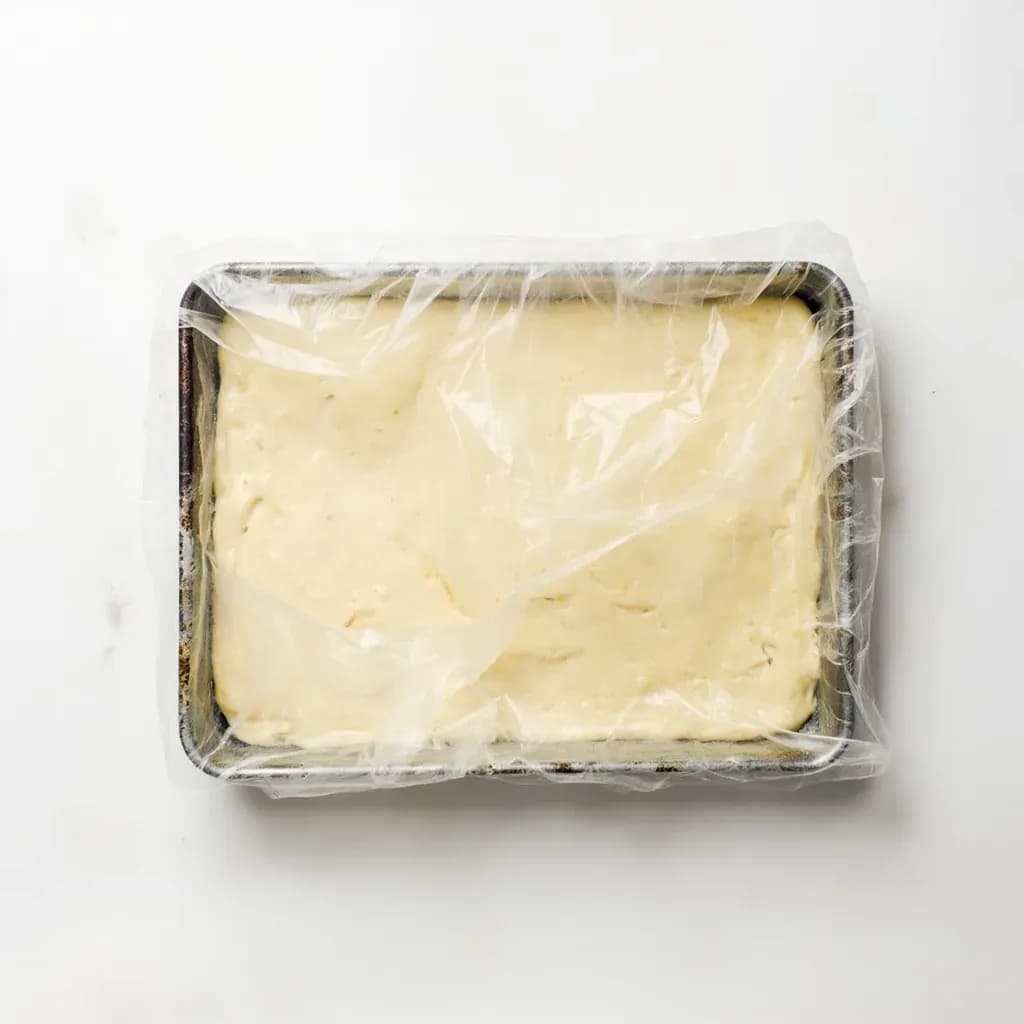
Thin plastic sheet draped over proofing dough or trays to stop it drying out.
A plastic dough cover sheet is a thin film or reusable plastic sheet laid over rising dough and dough trays. It traps surface moisture so the dough does not form a dry skin or crust while it proofs. Bakers use it over bench dough, pizza dough boxes, and bannetons; reusable versions wipe clean and replace single-use cling film.
A plastic dough cover sheet is a flexible, food-grade polyethylene sheet — most often low-density polyethylene around 0.02 to 0.06 mm thick — used to drape loosely over fermenting dough. It exists because both of the traditional alternatives have a real drawback: cling film seals too tightly, so enriched or high-hydration dough sweats underneath and turns gummy on top, while a damp tea towel stays workable for only an hour or so before drying out or dripping condensate onto the dough. The cover sheet threads the needle between those two. It is thicker and stiffer than cling film, so it holds its shape in a gentle tent, yet it is just permeable enough that moisture can pass slowly in both directions, keeping the dough's surface supple without smothering it.
For most home bakers the value is less about gadgetry than about timing. A properly draped sheet lets you walk away from a bulk ferment for two, three, even six hours and come back to dough that has not formed the dry, leathery skin that traps gas unevenly and ruins oven spring. It also covers cleanly — no floury lint, no wet streaks on your couche or banneton, and no wrestling with film that has fused to itself. In a busy kitchen the same sheet gets pulled from one tub to the next all day, wiped down between batches, and replaced only every few months.
Compared with what it is often confused with, the cover sheet is its own tool. A baker's couche is a floured linen sleeve that supports and separates shaped loaves upright in a banneton; a silicone baking mat is a thick, heat-resistant work surface. The cover sheet does neither — it has no loft, no flour, and is not built for the oven. Think of it as the lid your dough wants when you cannot be standing over it.
Alternatives
Types & varieties
The most common home-baking format: several pre-cut rectangles in different sizes, often with printed measurements on the edges.
Wide rolls (often 60–90 cm) sold by the metre for commercial bakeries; cut to the size of the tray, tub, or sheet pan.
Thinner, sometimes pre-cut film used in high-volume production where rapid turnover and hygiene trump reusability.
A lightly matte or pebbled surface that grips the bench or tray, reducing slippage when draped.
Sold in white, green, or blue so dough residue, flour, and oil are easy to spot during cleaning.
Wide formats around 80 × 100 cm for draping across multiple loaves or large sheet-pan doughs on the bench.
Cling film, damp towel, or dough cover sheet?
The choice between the three comes down to how wet the dough is and how long you need to leave it. Cling film is best for short, sealed rests — say, 20 minutes while a shaped baguette relaxes before scoring. A damp tea towel works for medium-length bench proofs of an hour or so on lean dough. The plastic cover sheet earns its place on the long, humid jobs: enriched doughs (brioche, panettone), high-hydration breads (ciabatta, focaccia), and overnight cold ferments where cling film would condensate and a towel would either dry out or drip.
- Use cling film for short, sealed rests where you want minimal air exchange.
- Use a damp tea towel for medium-length bench proofs on lean dough; rewet if it dries out.
- Use a dough cover sheet for long bulk ferments, enriched doughs, and any proof over an hour where a skin is likely to form.
- Use a couche for support inside a banneton, not as a cover — it is meant to cradle, not drape.
Care and longevity
Treat the sheets the way you would a good plastic cutting board: wipe, don't scrub, and let them air-dry flat. Mild dish soap in lukewarm water is plenty; hot water can cloud and warp LDPE over time. Stains from saffron, beet, or heavily oiled focaccia can set in permanently, so lay a sheet of parchment between the dough and the cover if colour transfer is a concern. Hard creases are the usual failure point — store the sheets flat or loosely rolled, and retire any sheet that has gone cloudy, brittle, or scratched, since a degraded surface grips dough and is harder to clean.
Common uses
Tips & pitfalls
- Drape the sheet loosely — never press it directly onto the dough, or you will get flattened spots and a tacky patch where plastic meets dough.
- For very tacky, high-hydration doughs like ciabatta, mist the underside of the sheet with water or oil it very lightly before draping.
- Do not use the sheet in the oven or in a proofing drawer above roughly 80 °C / 175 °F; LDPE will soften, warp, and may transfer to the dough.
- Wipe clean with a soft cloth rather than scrubbing — abrading the surface makes future dough more likely to stick.
- Store flat or loosely rolled. Hard creases become weak points that eventually tear.
- Lay a sheet of parchment between the cover and any strongly coloured or heavily oiled dough (saffron, beet, olive-oil-rich focaccia) to avoid permanent staining.
- For long cold ferments of 12 hours or more, leave a small gap or fold back one corner so gas can escape — a fully sealed cover can over-acidify the surface.
- Keep a separate sheet for sweet and savoury doughs when possible; lingering fat and sugar residues are hard to fully remove and can transfer flavour.
Good to know
- Primary material
- Food-grade low-density polyethylene (LDPE) or HDPE; some versions are PVC or polypropylene
- Typical thickness
- Approximately 0.02–0.06 mm (2–6 mil) — thicker than cling film, thinner than a heavy zip bag
- Standard sizes
- Rectangles from about 40 × 50 cm up to 70 × 90 cm; also sold as wide rolls cut to size
- Heat resistance
- Not oven-safe. LDPE softens around 80–95 °C / 175–200 °F; use is limited to room temperature and refrigeration
- Permeability
- Slightly breathable compared to cling film — slows surface drying without creating a fully sealed, humid microclimate
- Reusability
- Reusable for months with gentle cleaning; commercial bakeries sometimes use single-use disposable sheets for hygiene turnaround
- Food contact safety
- Reputable versions are BPA-free and labelled food-grade, with a cup-and-fork symbol or FDA/EU food-contact compliance
- Cost range
- Roughly $5–$20 USD for a home set of 3–6 sheets; commercial rolls are inexpensive per square metre
Also called
dough proofing cover · dough sheet cover
Related

Aluminum Foil
Wraps, covers, and tents food for the oven and grill

Parchment Paper
Nonstick liner for clean, even baking and easy release

Wax Paper
Moisture-resistant sheet for wrapping and counter prep

Plastic Wrap
Clings tight to cover bowls and wrap leftovers

Silicone Baking Mat
Reusable nonstick liner that replaces parchment

Cheesecloth
Loose-woven cloth for straining stock and bundling herbs

Beeswax Food Wrap
Reusable wax wrap that molds around bowls and produce

Piping Tips
Shaped nozzles that turn frosting into stars and rosettes