Heat & Safety
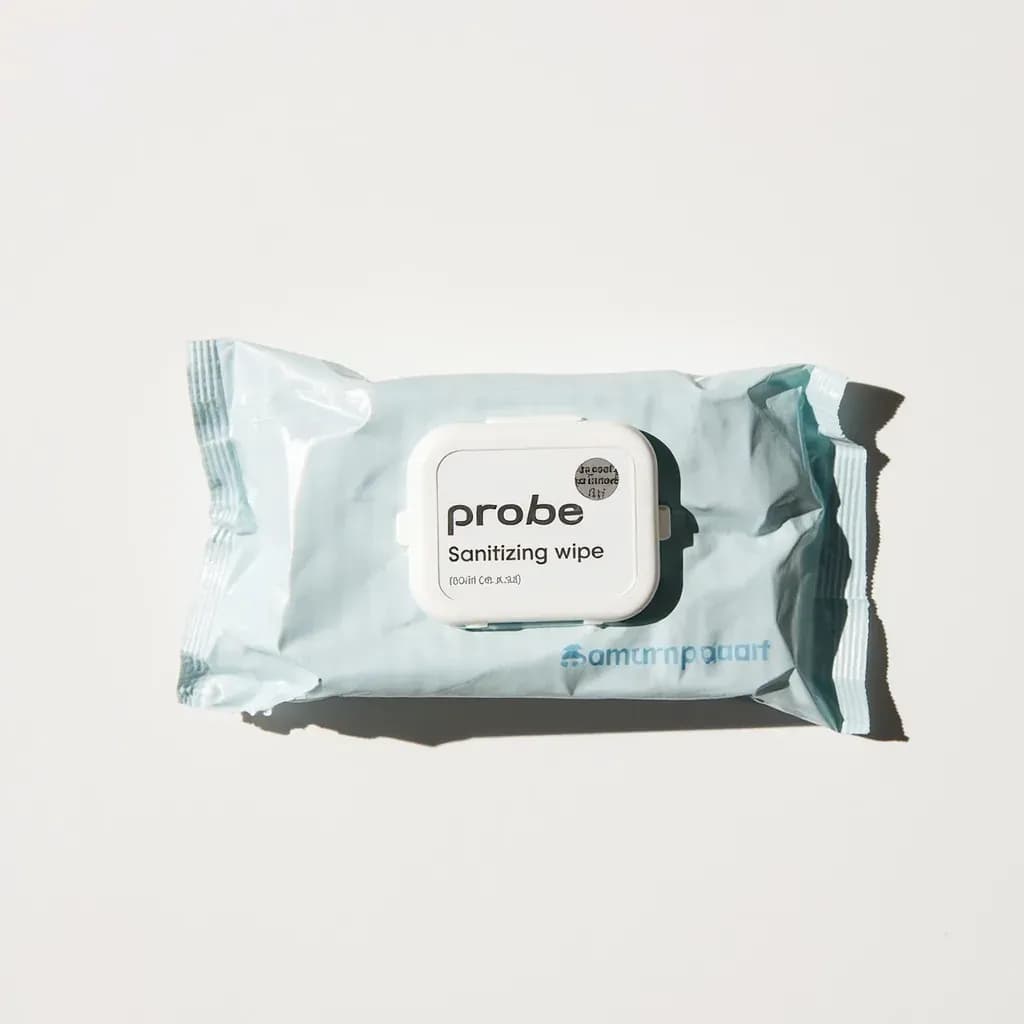
Probe Sanitizing Wipe
Single-use alcohol wipe used to disinfect thermometer probes between foods.
A probe sanitizing wipe is an individually packaged disinfectant wipe used to clean a thermometer probe between checks. Cooks wipe the probe before and after measuring different foods to avoid cross-contamination, especially between raw and cooked items. The wipes are food-safe, fast-drying, and a key part of HACCP temperature-checking routines.
A probe sanitizing wipe is a pre-saturated, single-use cloth—most commonly a 5-by-7-inch non-woven sheet pulled from a pop-up canister—that food professionals use to disinfect the shaft and tip of a thermometer between probes. The active ingredient is typically 70% isopropyl alcohol, the concentration at which water and ethanol work together to denature microbial proteins most effectively. Wipes are a sanitizing tool, not a cleaning tool: they are designed for a probe that is already free of visible fat, char, or food residue, and they sit at the center of the standard HACCP workflow for raw-protein cook lines, where the same instant-read thermometer is moved from chicken to pork to fish dozens of times in a single service.
In a U.S. commercial kitchen, wiping the probe between uses is not optional housekeeping—it is a regulatory expectation codified in the FDA Food Code (3-301.11 and 4-302.13), and the wipe a cook reaches for is generally NSF-registered as a D2 food-contact sanitizer. The canister lives at the station, usually clipped to a rail or tucked into a caddy, so the motion—read, wipe, reinsert—is frictionless enough to actually happen in a busy pass. For the home cook, the same product offers a way to keep a favorite instant-read thermometer from being a vector for Salmonella when moving between a cooling roast and a salad being plated for guests.
The wipes are not interchangeable with household disinfecting wipes, hand-sanitizer sheets, or quat sprays sold for floors and counters. Those products either lack an NSF food-contact registration or contain fragrances, surfactants, or skin emollients that have no business migrating onto something that will touch food. Used correctly—wet contact for at least ten seconds, full air-dry before the next insertion, single use, lid closed between pulls—a probe wipe is the cheapest insurance a cook can buy against a cross-contamination incident.
Alternatives
Types & varieties
The standard commercial format; 70% IPA outperforms 91% or 99% solutions because the water fraction is what ruptures bacterial cell walls and denatures proteins.
Non-alcohol alternative with longer residual antimicrobial activity; chosen by plants that want a non-flammable sanitizer and a low-odor station.
Combine the fast kill of alcohol with a lingering quat film for sustained sanitizing between probes.
Specifically labeled for use on food-contact surfaces under 40 CFR §180.940 tolerances; required for many third-party audit schemes.
Two-part system where dry non-woven sheets are moistened on demand from a pump bottle of 70% IPA; popular in kitchens that prefer to control their own saturation level and cost.
Sanitizing Is Not Cleaning
The most common mistake with probe wipes is using them on a probe that is dirty. Alcohol is a sanitizer: it reduces the number of pathogens already on a clean surface to safe levels. It does not penetrate fat, char, dried blood, or sauce film, and it will simply redistribute that soil (and the bugs living in it) across the next food you probe. A probe that comes out of a roast with visible grease, or out of a grill-marked steak with blackened residue, needs to be washed with hot soapy water and dried before it ever sees a wipe. The intended workflow is: read temperature → wipe probe → read next product, where "wipe" is a quick between-use pass on a probe that is already in good shape. Think of the wipe as a hand-wash for an already-clean hand, not as a substitute for the wash.
HACCP and Audit Reality
In any U.S. operation inspected under the FDA Food Code, the rule of thumb is concrete: a probe that touches raw animal product must be sanitized before it touches ready-to-eat food, and the sanitation step has to be auditable. A canister of NSF-registered wipes at every thermometer station, with a documented procedure (contact time, single use, lid closed) is what a third-party auditor wants to see. The probe-wipe action is one of the cheapest compliance points on the line—far less expensive than a dedicated probe for every product or a probe-washer sink that has to be plumbed, monitored, and logged.
Common uses
Tips & pitfalls
- Use 70% isopropyl alcohol, not 91% or higher—the water content is what actually ruptures bacterial cells; stronger solutions evaporate faster and are less effective as sanitizers.
- Hold the wet wipe on the probe shaft for a full 10 seconds before air-drying; a quick swipe does not achieve the contact time the EPA registration is based on.
- Wait until the alcohol has fully evaporated before reinserting the probe—particularly important with raw doughs, chocolate, ganache, and delicate garnishes where any off-flavor will be obvious.
- Never wipe a hot probe. Alcohol is flammable and will flash on metal just out of an oven, grill, or fryer; let the probe cool, or switch to a quat-based wipe for hot-side work.
- Wipe the entire shaft that may have contacted food, not just the tip—pathogens transfer anywhere the metal touched the product.
- Single-use only. Folding a wipe over to a clean face and reusing it recontaminates both the probe and the wipe, which is the exact failure mode the wipe is supposed to prevent.
- Keep the canister lid snapped shut between pulls—alcohol wipes dry out within days if left open, and a bone-dry wipe is no wipe at all.
- For allergen control (peanut butter, shellfish, gluten-heavy batters), use a fresh wipe; alcohol alone does not remove protein residues, and a detergent wash should precede the wipe on these probes.
- Do not substitute household disinfecting wipes on food-contact probes. They are not NSF-registered as food-contact sanitizers and can leave residues not approved to migrate into food.
Good to know
- Type
- Pre-saturated single-use wipe, typically dispensed from a pop-up canister
- Active ingredient
- 70% isopropyl alcohol (sometimes blended with quaternary ammonium compounds)
- Sheet material
- Non-woven fabric, generally polypropylene or a cellulose/polyester blend
- Typical sheet size
- Approximately 5 x 7 inches (12.7 x 17.8 cm)
- Canister count
- Commonly 70, 100, or 200 wipes per canister; refill bags also sold
- Effective contact time
- 10–30 seconds of wet contact, then air-dry
- Kill spectrum
- Bacteria including Salmonella, E. coli, and Listeria, plus many viruses; not sporicidal
- Certification
- NSF registered as a D2 food-contact surface sanitizer in commercial products
- Flammability
- Flammable until the alcohol fully evaporates; never use on a hot probe or near open flame
- Storage
- Cool, dry location below ~110°F/43°C; lid kept closed to prevent evaporation
- Shelf life
- 2–3 years unopened; most operations discard open canisters after 30–60 days per internal SOP
- Compatible with
- Thermistor, thermocouple, and infrared probe thermometers; safe on stainless steel probe shafts
Also called
Probe Wipe · thermometer wipe · alcohol probe wipe
Related

Paper Towels
Disposable sheets for spills, drying, and patting dry

Kitchen Towels
Reusable cloths for drying, gripping, and wiping

Oven Mitts
Heatproof gloves to handle hot pans and trays safely

Disposable Gloves
Single-use gloves for safe, mess-free handling

Cleaning Cloths
Reusable cloths for wiping counters and spills

Tortilla Warmer
Insulated holder that keeps tortillas warm and soft

Trivet
Heatproof stand that shields surfaces from hot pots

Ice Bath Setup
Bowl of ice water that halts cooking and sets color