Heat & Safety
Smoker Fuel (Pellets / Burlap)
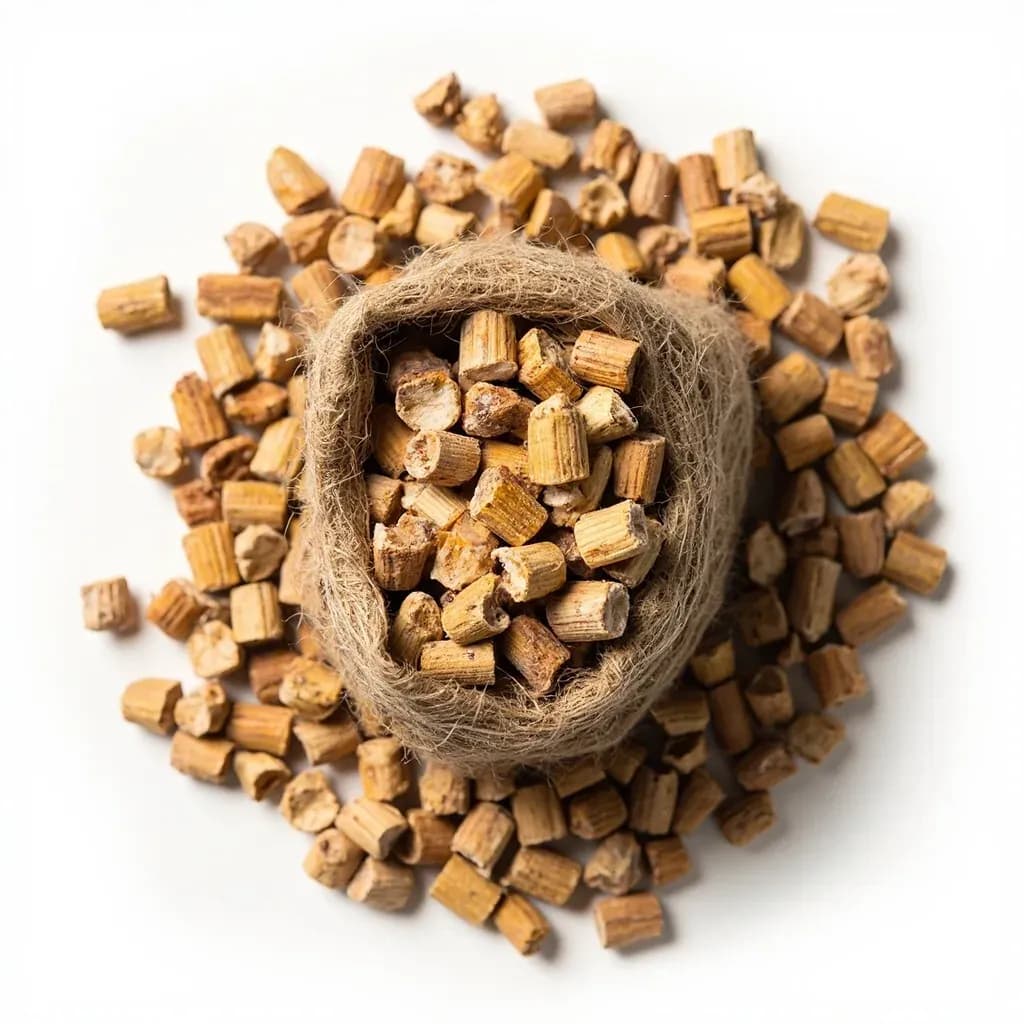
Combustible fuel such as wood pellets or smoldering burlap used to generate smoke for flavoring food.
Smoker fuel is the combustible material burned to produce smoke that flavors and preserves food. Wood pellets feed automated smokers for steady low-and-slow heat, while smoldering burlap or sawdust is used in cold-smoking and some regional techniques to make dense, cool smoke. The fuel type shapes both the temperature and the character of the smoke, so cooks choose it to match the dish.
Smoker fuel is the combustible material—most commonly compressed hardwood pellets, occasionally a square of smoldering burlap—that generates the flavoring smoke inside a grill, offset smoker, cold-smoke generator, or finishing tube. The pellet format is engineered: 100% compressed hardwood sawdust (oak, hickory, fruit woods, and the like) held together by the wood's own lignin, cut to a uniform 6 mm × 25 mm so it feeds cleanly through an auger or burns steadily in a maze or tube. Burlap sits at the opposite end of the technology spectrum: a loose square of jute, hemp, or sisal fabric that smolders at 200–250 °C and is set beneath or beside cold-smoked fish to lay down a slow, tea-like haze. Both fuels work on the same principle—pyrolysis of clean, dry lignocellulose—and both are judged by the same yardstick: the smoke should be thin, almost invisible, and bluish. Anything thicker carries creosote and soot rather than the volatile phenols, carbonyls, and Wood-Gas compounds that actually taste good.
The cook's job is mostly restraint. Pellets deliver a measured BTU output—roughly 3,000–8,000 BTU per pound depending on density—that a pellet grill uses to hold set temperatures between about 70 °C and 260 °C (160–500 °F), so the wood choice becomes the dominant flavor lever. Burlap generates essentially no usable heat and is reserved for cold-smoking applications below 30 °C (85 °F), where the food is cured, dried, or already cooked and is acquiring smoke as a surface flavor and preservative. Choosing the wrong wood is the single most common smoking mistake: a heavy mesquite on a 90-minute chicken breast turns the skin bitter, while a delicate alder on a 14-hour brisket disappears into the bark. Match the wood's intensity to the cook's length, the food's fat content, and the desired finish.
Safe fuel is a short list: untreated, food-grade hardwood pellets or plain, unsized, unprinted burlap. Anything else—softwoods (pine, spruce, fir, cedar), pressure-treated lumber, plywood, MDF, painted or stained wood, or modern printed feed sacks—off-gases resins, formaldehyde, or solvent residues that will land on the food. Storage is equally important: pellets are hygroscopic, and a torn bag in a humid garage will swell them into sawdust that jams an auger. Burlap must stay dry and free of mold, sizing chemicals, and fire-retardant treatments, which rules out most contemporary commercial sacks and pushes cooks toward older feed bags or fabric-store rolls.
Alternatives
Types & varieties
Strong, bacon-like, slightly sweet. The classic American BBQ choice for pork ribs and brisket. Heavy-handed use turns bitter fast.
Very intense, earthy, almost herbal. Iconic in central Texas barbecue tradition. Best used sparingly or blended 50/50 with milder oak.
Medium strength, neutral backbone smoke. The most versatile and the default blending wood in most competition blends.
Mellow cousin of hickory; buttery and nutty. Pairs well with poultry, pork, and cheese.
Light, sweet, faintly fruity. Standard for pork, poultry, and especially ham.
Mild, sweet, gives a mahogany bark color. Pairs with almost anything and is the most common blend base.
Subtle sweetness; traditional for ham, bacon, and vegetables.
Delicate, slightly sweet, almost neutral. Pacific Northwest standard for salmon.
Proprietary mixes (hickory-cherry-maple, oak-hickory, etc.) from Traeger, Bear Mountain, CookinPellets, Lumber Jack, BBQ Pellets.
Specialty, very mild, slightly sweet; suited to poultry, pork, and short cooks where subtlety matters.
Traditional cold-smoking fuel for salmon, herring, and sturgeon; smolders cool, gives a faintly sweet, earthy, tea-like smoke.
Burlap squares tied around moist sawdust or tea leaves, used inside commercial cold-smoke generators (ProQ, Cameron, maze-type).
Reading the Smoke
Smoke color is the single most reliable diagnostic in any smoking cook. A clean, almost invisible blue-gray plume—often called 'thin blue smoke'—indicates that the wood is vaporizing at the right temperature and the volatiles reaching the food are the desirable Wood-Gas compounds: syringol, guaiacol, and the carbonyls that read as smoky, sweet, or bacon-like. White smoke means the wood is too cool or too wet and is releasing water vapor and uncombusted tars; it deposits creosote on the food and leaves a bitter, ashy bite. Black smoke means restricted airflow or flame impingement; it deposits soot and acrid combustion byproducts. The cook's only tools for adjusting the smoke are fuel moisture, airflow, and fuel load—a closed damper on a kettle, a wet burlap square in a cold smoker, or a half-filled smoke tube. As a rule, if you can see the smoke clearly across the yard, it is already too thick.
- Thin blue: combustion at 300–500 °C, Wood-Gas compounds dominate—aim here.
- Thick white: wood or burlap is wet, or airflow is choked; open a vent or swap fuel.
- Black or dark gray: restricted oxygen or actual flame; back off fuel and add air immediately.
- If smoke rolls off the meat in visible curls, expect creosote deposits and a bitter finish.
Burlap as a Cold-Smoking Fuel
Burlap occupies a niche that pellets cannot reach: a fuel that produces flavoring smoke with essentially zero heat output, allowing the cook to apply smoke to raw, uncooked fish, soft cheese, or cured meats for hours or days without raising their internal temperature. The classic Scandinavian and Russian cold-smoke rig is a small wooden cabinet (or a modern stainless equivalent) with a tray or rack for the food above, and a metal container on the floor holding a smoldering jute square. Airflow is the cook's main control: a few small vents at the top draw the smoke through and out, and the fire is replenished every hour or two by replacing the spent burlap with a fresh lit square. Soaking the burlap in water or apple juice extends smolder time, mutes the harsher notes, and—because jute is a low-density fiber—burns through gradually rather than flaring. Modern cold-smoke generators substitute sawdust or pellets for burlap, but burlap remains the cheapest and most controllable fuel when only a faint, sweet, tea-like haze is wanted.
Common uses
Tips & pitfalls
- Aim for thin blue smoke that is almost invisible; heavy white smoke deposits creosote and turns food acrid and ashy.
- Never use softwoods (pine, spruce, fir, cedar) or any treated, painted, glued, or stained wood—resins and solvents off-gas toxic, bitter compounds onto the food.
- Match wood strength to cook length: delicate alder or fruit wood for 1–2 hour salmon; hickory or oak for 8–14 hour brisket and pork shoulder.
- Store pellets in their original sealed bag inside a bin or bucket; a torn bag in a humid garage will swell the pellets into sawdust that jams an auger on the next cook.
- Use only plain, untreated, unsized burlap—avoid modern feed or grain sacks printed with inks or treated with fire-retardant, which is most of them.
- Smolder burlap outdoors or under a heavy hood; smoldering jute releases significant CO and particulates and is unsafe indoors.
- Soak burlap in water or apple juice and wring lightly before lighting to lengthen smolder time and mellow the smoke flavor.
- Vacuum the burner pot and ash pan between pellet-grill cooks; ash buildup causes misfires, temperature swings, and off-flavors from old carbon.
- Blend two woods—say cherry 70 / hickory 30—to round out a strong wood without losing its identity, the standard competition-blend trick.
- A basic smoke tube filled with pellets and lit with a torch adds 2–6 hours of smoke to any gas or charcoal grill and is cheaper than buying a dedicated pellet grill.
Good to know
- Composition
- Food-grade pellets are 100% compressed hardwood sawdust bound by the wood's natural lignin—no glues or additives. Burlap is a coarse woven fabric of jute, hemp, or sisal fibers.
- Standard Pellet Size
- Roughly 6 mm (1/4 in) diameter and 25 mm (1 in) long, the universal dimension for pellet grills, smoke tubes, and cold-smoke generators.
- Moisture Content
- Premium smoking pellets run 5–8% moisture; above ~10% the pellets swell, crumble, jam augers, and produce bitter, sooty smoke.
- Smoke Color
- Clean combustion yields a thin, nearly invisible blue-gray plume (Wood-Gas compounds). Thick white, gray, or black smoke indicates incomplete combustion and acrid off-flavors.
- Burlap Ignition
- Jute burlap smolders at 200–250 °C (400–480 °F) once lit, producing a cool, slow smoke ideal for cold smoking below 30 °C (85 °F).
- Energy Yield
- One pound of pellets produces roughly 3,000–8,000 BTU depending on wood density, sustaining low-and-slow cooks of 4–12 hours from a 20 lb bag.
- Storage
- Pellets keep indefinitely in sealed bags in a dry area; humidity above ~10% causes swelling, crumbling, and auger jams. Burlap must be stored dry and free of mold or sizing chemicals.
- Food Safety
- Use only untreated, unglued, food-grade pellets or clean natural-fiber burlap. Never softwoods, pressure-treated lumber, plywood, MDF, painted, or stained materials.
Also called
wood pellets · smoking fuel · burlap smoking fuel
Related

Paper Towels
Disposable sheets for spills, drying, and patting dry

Kitchen Towels
Reusable cloths for drying, gripping, and wiping

Oven Mitts
Heatproof gloves to handle hot pans and trays safely

Disposable Gloves
Single-use gloves for safe, mess-free handling

Cleaning Cloths
Reusable cloths for wiping counters and spills

Tortilla Warmer
Insulated holder that keeps tortillas warm and soft

Trivet
Heatproof stand that shields surfaces from hot pots

Ice Bath Setup
Bowl of ice water that halts cooking and sets color