Heat & Safety
Cosmetic / Makeup Sponge
A soft disposable foam or cotton sponge repurposed for fine food finishing like applying glazes or color.
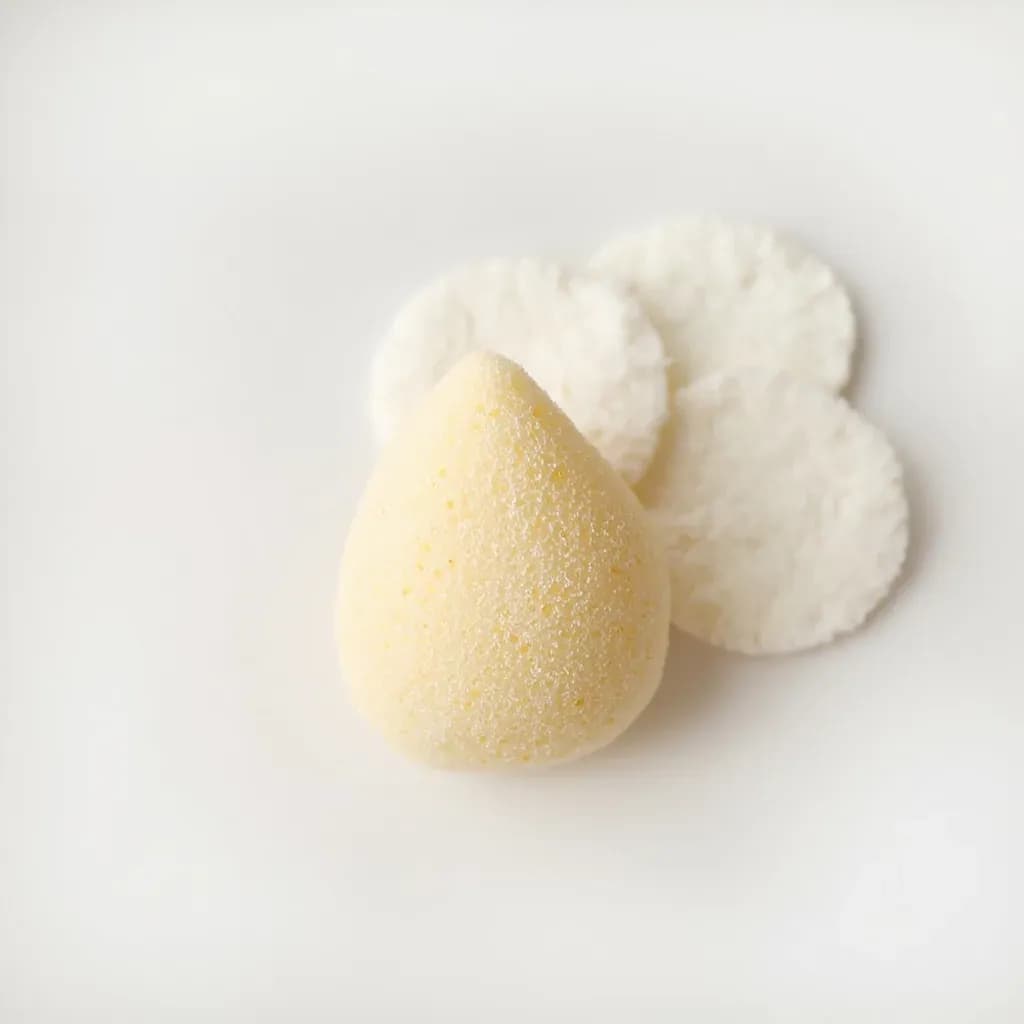
A cosmetic or makeup sponge is a soft foam or cotton pad borrowed from beauty kits for delicate food work. Pastry chefs and platers use clean ones to dab edible color, brush off excess powder, or apply thin glazes and dusts with a feather-light touch. Cotton pads and balls in this family also wipe rims and remove smudges from plates.
A cosmetic or makeup sponge is one of those quietly essential tools of the cake-decorating bench that almost no one catalogs as kitchen equipment. The foam — usually a soft, open-cell polyurethane — was designed to pick up face powder or foundation and release it in a controlled stipple onto skin. That same physical behavior, depositing a fine, even layer of dry pigment and blending it at the edges, is exactly what a baker needs when working with petal dust, lustre dust, edible glitter, or cocoa through a stencil. A piece of foam with a flat face, a sharp edge, and a bit of spring in the cell structure does in seconds what a brush can only approximate with a dozen careful passes, especially on curved fondant or gum-paste surfaces.
In practice the sponge behaves like a very small, very controllable stamp. Used dry, it lays down crisp, opaque color — the wide face of a wedge for filling in a petal, the corner for a vein line, the rounded belly of a beauty-blender-style sponge for soft stippling across a curved tier. A barely-damp sponge (a single mist from a spray bottle held at arm's length) softens the deposit so two colors can be blended into a gradient on a sugar-paste leaf. The trick is restraint: the foam should always look almost empty. Loading it up produces muddy buildup, fall-out, and the streaking that ruins fine work.
The main caveat is regulatory rather than functional. Cosmetic sponges are manufactured to cosmetics good-manufacturing-practice, not food-contact GMP, so a serious pastry shop will either buy the food-marketed equivalent (Wilton, PME, Sugar & Crumbs, and similar suppliers sell 'dusting sponges' of essentially identical construction) or keep a sealed, clearly labeled bag of cosmetic sponges that has never shared a drawer with makeup, nail polish, or bathroom cleaners. The foam itself is inert and tasteless; the concern is what might have lived in it before the cake ever sees it.
Alternatives
Types & varieties
The cake-decorating workhorse. The flat triangular face fills in a petal cleanly; the long edge draws sharp outlines; the corner handles fine vein work and stencil centers.
Domed, egg-shaped foam that excels at soft stippling and gradient blending on curved fondant surfaces and rounded tier edges.
Square or rectangular foam pad suited to broad coverage — lustre-dusting an entire tier or sweeping metallic color across a large plaque.
Choosing and dedicating a sponge stash
The single most important habit with cosmetic sponges is separation. If a sponge has ever touched foundation, blush, bronzer, nail-polish remover, or a bathroom counter, it is no longer a food tool. The practical solution is one of two:
- Buy sponges sold specifically for cake decorating from bakery-supply catalogs. The foam is essentially the same open-cell polyurethane; the difference is marketing, batch traceability, and peace of mind for the customer.
- Or set aside a fresh, sealed bag of cosmetic sponges on the day you bring them home. Label the bag, store it with decorating tools rather than in a bathroom drawer, and never return a used sponge to the bag.
Dry vs. damp: matching the sponge's moisture to the job
Moisture is the main control you have over how a sponge deposits color. Get it wrong in either direction and the work shows it.
- Dry sponge — crisp, opaque deposit. Use for outlining petal tips, applying lustre dust to raised lace, and any place you want a defined edge.
- Barely damp (a single mist from across the room) — softer, semi-translucent deposit that blends at the edges. Use for gradients on sugar-paste leaves, for watercolor effects on fondant, and for merging two dust colors on a petal.
- Soaked — avoid. Water dissolves petal dust unevenly, can bloom fat in chocolate decorations, and turns the foam gummy and useless.
Common uses
Tips & pitfalls
- Use the sponge dry when you want a crisp, defined edge; mist it once from a distance only when you want a soft, blended look.
- Tap or swirl the loaded sponge on a paper towel before touching the cake — excess powder on the foam is what causes muddy buildup and fall-out onto clean areas.
- Assign one sponge per color and label or color-code them; once pigment lodges in the open cells it will ghost into the next job no matter how hard you tap it out.
- Work in thin layers. Several light passes always look cleaner than one heavy pass, which streaks and cakes in the crevices of lace molds and royal-icing piping.
- Use the corner of a wedge for fine work such as vein lines on petals or the centers of stencil cutouts; reserve the broad face for filling in larger areas.
- Replace the sponge as soon as the foam looks spent, hardened, or permanently stained — old foam sheds tiny fragments onto the work and ruins the finish.
- For stenciling, hold the sponge flat and tap straight down; dragging sideways pushes powder under the stencil edge and blurs the design.
- If a customer is uneasy about cosmetic-grade foam on a cake, switch to a sponge sold specifically for cake decorating — the construction is essentially identical and the labeling answers the question before it is asked.
Good to know
- Material
- Open-cell polyurethane foam; typically latex-free; cosmetic-grade, not formally food-grade
- Common shapes
- Triangular wedge, round/egg (beauty-blender style), and flat paddle
- Typical sizes
- Wedge roughly 1.5–2 in. across the wide face; round about 1–1.5 in. diameter
- Working medium
- Dry petal or lustre dust, edible powder color, edible glitter, cocoa, or powdered sugar
- Color discipline
- One sponge per color; pigments lodge in the open cells and ghost into the next job
- Disposability
- Single-use or very limited reuse; foam hardens and sheds fragments once spent
- Storage
- Sealed, labeled bag kept apart from cosmetics, fragrances, and cleaning products
- Cost
- Bulk cosmetic wedges are inexpensive, commonly sold in 12–24 count packs
Also called
Cosmetic Sponges · Cosmetic Sponge · Cotton Pad · Cotton Pads/Balls · Makeup Sponge
Related

Paper Towels
Disposable sheets for spills, drying, and patting dry

Kitchen Towels
Reusable cloths for drying, gripping, and wiping

Oven Mitts
Heatproof gloves to handle hot pans and trays safely

Disposable Gloves
Single-use gloves for safe, mess-free handling

Cleaning Cloths
Reusable cloths for wiping counters and spills

Tortilla Warmer
Insulated holder that keeps tortillas warm and soft

Trivet
Heatproof stand that shields surfaces from hot pots

Ice Bath Setup
Bowl of ice water that halts cooking and sets color