Storage & Containers
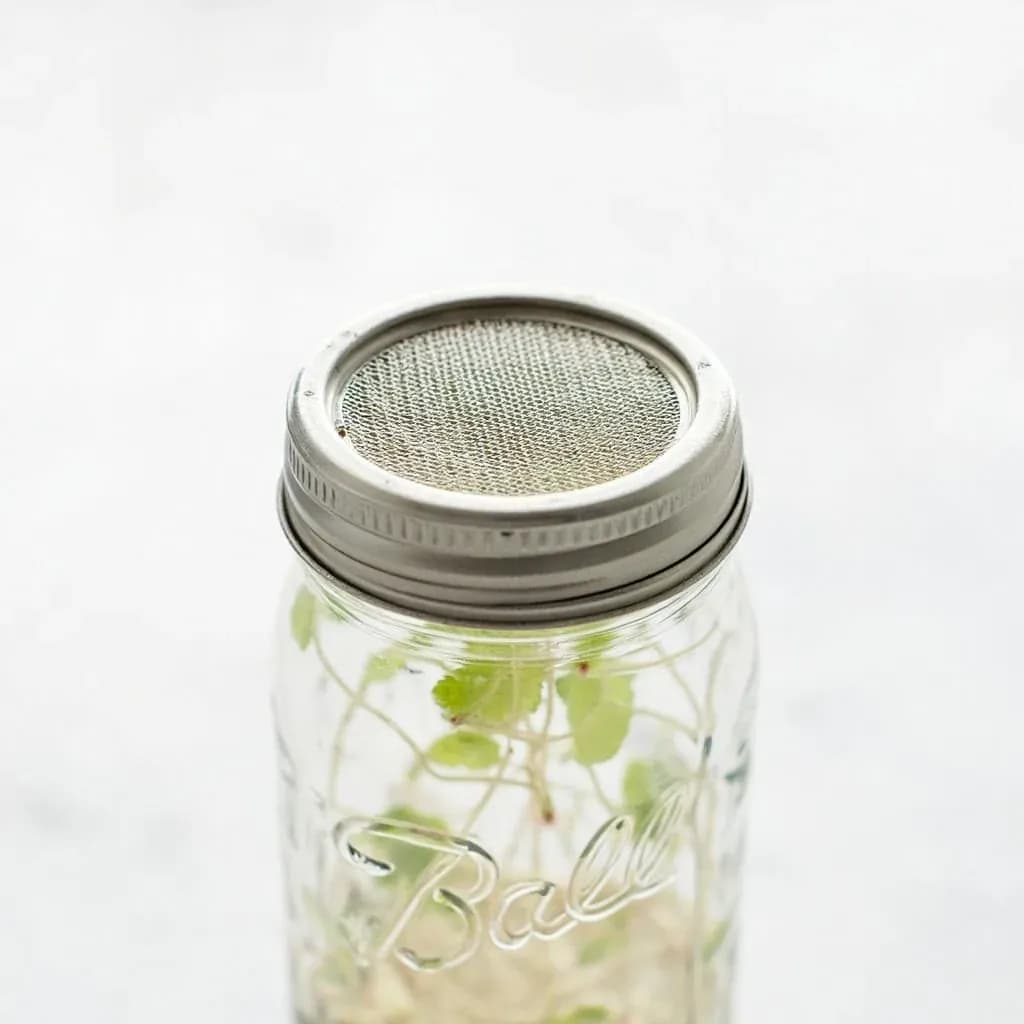
Sprouting Jar Lid
Mesh or slotted lid that turns a jar into a draining sprouter for seeds and beans.
A sprouting jar lid is a mesh, screen, or slotted cap that screws onto a standard wide-mouth jar to let water drain and air circulate while seeds germinate. Cooks rinse and tilt the jar daily to grow alfalfa, mung bean, broccoli, or lentil sprouts at home. The fine mesh holds tiny seeds inside while pouring off rinse water without removing the lid.
A sprouting jar lid is a perforated disc — almost always food-grade stainless steel mesh, occasionally BPA-free plastic — that replaces the flat inner lid of a two-piece Mason canning band, turning a standard glass jar into a passive draining sprouter in seconds. Water poured in passes straight through the screen; the jar is then inverted at an angle so gravity does the rest of the work, leaving seeds damp but never sitting in water. That single piece of hardware is what makes home sprouting cheap, compact, and almost effortless for anyone who already keeps canning jars on a shelf.
Mesh grade is the defining specification, and it is worth understanding before you buy. Fine mesh (around 80–100 openings per inch) is sized for tiny mucilaginous seeds like alfalfa, broccoli, and radish. Medium mesh (roughly 30–40 openings per inch) handles most grains and lentils, and wide mesh (about 10–20) is built for large legumes and peas. Stainless steel is strongly preferred for longevity, off-flavor neutrality, and resistance to warping or staining; plastic lids fog, scratch, and tend to be replaced every year or two. A useful rule from veteran sprouters is to choose one mesh size coarser than you think you need, because wet small seeds slip through screens that look too tight and the bed appears empty at harvest.
The technique paired with the lid is the soak-rinse-drain cycle: an 8–12 hour initial soak in cool water, then two to three rinses per day with the jar held at a 30–45° angle between rinses so air circulates and no water pools at the mouth. Nearly every failure — mold, rot, sour smell — traces back to standing water, overcrowding, or contaminated seed, not the lid itself. A quart wide-mouth jar paired with a fine-mesh stainless lid is the most versatile starter setup, and for cooks who already can or ferment, the lids stack neatly with existing Mason jar inventory.
Alternatives
Types & varieties
Replaces the flat inner lid of a two-piece Mason canning lid; the most durable and widely available style.
Lightweight and inexpensive starter option; tends to stain, scratch, and is generally less durable than stainless.
Same mesh-in-band design sized for wide-mouth jars; the easiest to load, harvest, and clean with a fork.
Bundles fine, medium, and wide mesh lids so one set handles seeds of any size.
Stretch-style screen held by a silicone ring; fits jars slightly off-standard and removes for thorough cleaning.
Lids made for purpose-built sprouting jars (such as Easy Sprout or Bio-Snacky); not cross-compatible with Mason threads.
Choosing the Right Mesh
Mesh is the only specification that meaningfully changes how a sprouting lid performs, and matching it to the seed avoids both lost yield and clogged screens.
- Fine mesh: alfalfa, broccoli, radish, red clover, fenugreek, and other tiny seeds. Also the right choice for rinsing soaked cashew pulp or rice.
- Medium mesh: lentil, wheat berry, barley, kamut, quinoa, amaranth, and most seed mixes.
- Wide mesh: mung bean, chickpea, adzuki, black bean (sprouted short), and whole peas.
- If you only want one lid, a fine-mesh stainless disc on a wide-mouth quart jar is the most flexible general-purpose choice.
The Soak-Rinse-Drain Cycle
The lid is just hardware; the routine is what actually grows sprouts. Keep the cycle simple, keep the jar angled, and the work is almost entirely hands-off.
- Measure dry seed into the jar, fit the sprouting lid, and cover with 3–4× cool water for an 8–12 hour soak.
- Drain thoroughly, then rinse with cool water and drain again. Invert the jar at a 30–45° angle in a bowl or dish rack so air flows in and water cannot pool at the mouth.
- Repeat 2–3 rinses per day for the duration of the sprouting period.
- On the last day, give a final long rinse, drain extremely well, and refrigerate in a sealed container; use within 5–7 days.
Common uses
Tips & pitfalls
- Always invert the jar at a 30–45° angle after every rinse so air circulates and water cannot pool at the mouth — pooled water is the single most common cause of mold and sour smell.
- Sterilize the jar and lid between batches with hot water or a run through the dishwasher; residual slime harbors bacteria that spoil the next batch.
- Use only 1–2 tablespoons of small seed per quart jar — seeds expand 6–10×, and overcrowding suffocates the bed and breeds mold.
- Keep jars out of direct sunlight for the first 3–4 days, then move into indirect light on the final day to develop chlorophyll and color in green sprouts.
- If you smell anything sour, musty, or ammonia-like, discard the batch; a healthy batch smells faintly bean-like or grassy.
- Choose mesh one size coarser than you think you need — small seeds slip through fine mesh when wet and the bed looks empty at harvest.
- Wide-mouth jars are far easier to load, rinse, and remove sprouts from with a fork or tongs; reserve regular-mouth jars for very small seeds only.
- Run a final long rinse before refrigerating and shake out excess water thoroughly; surface moisture shortens shelf life dramatically.
- Buy seed labeled for sprouting — garden seed is often treated with fungicides and is not intended for human consumption raw.
Good to know
- Primary material
- 304 food-grade stainless steel mesh; some versions are BPA-free plastic
- Standard jar fit
- Regular mouth (~70 mm) and wide mouth (~86 mm) Ball, Mason, and Kerr canning jars
- Mesh grades
- Fine (~80–100 openings/in) for small seeds; medium (~30–40) for grains and lentils; wide (~10–20) for large legumes and peas
- Typical price
- $5–20 per lid; mixed multi-packs of three sizes commonly $15–25
- Care
- Stainless lids are dishwasher-safe and last years; plastic lids may stain or warp and are usually replaced every 1–2 years
- Sprouting time
- Small seeds 3–5 days; legumes 2–4 days; grains 1–3 days, after an 8–12 hour initial soak
- Rinse cadence
- 2–3 drain-and-rinse cycles per day once soaking is complete
- Capacity guide
- 1–2 tablespoons of small seed per quart jar yields roughly 1.5–2.5 cups of finished sprouts
- Storage of finished sprouts
- Refrigerate at 34–40°F in a sealed container; use within 5–7 days after a final rinse and thorough drain
Also called
sprouting lid · sprout jar lid · mesh sprouting lid
Related

Freezer Bags
Thick, sealable bags built to fight freezer burn

Storage Bags
Resealable bags for fridge storage and marinating

Storage Container
Lidded container for leftovers, prep, and meal kits

Glass Container
Oven-to-fridge glass that won't stain or hold odors

Plastic Container
Lightweight, stackable storage for everyday leftovers

Vacuum Sealer Bags
Airtight bags for long freezing and sous-vide

Reusable Bags
Washable silicone bags that replace single-use plastic

Mason Jar
Sealed glass jar for preserves, pickles, and storage