Wraps & Liners
Eating Cloth / Tablecloth (Sufra)
Floor-spread cloth on which communal meals are laid out and shared.
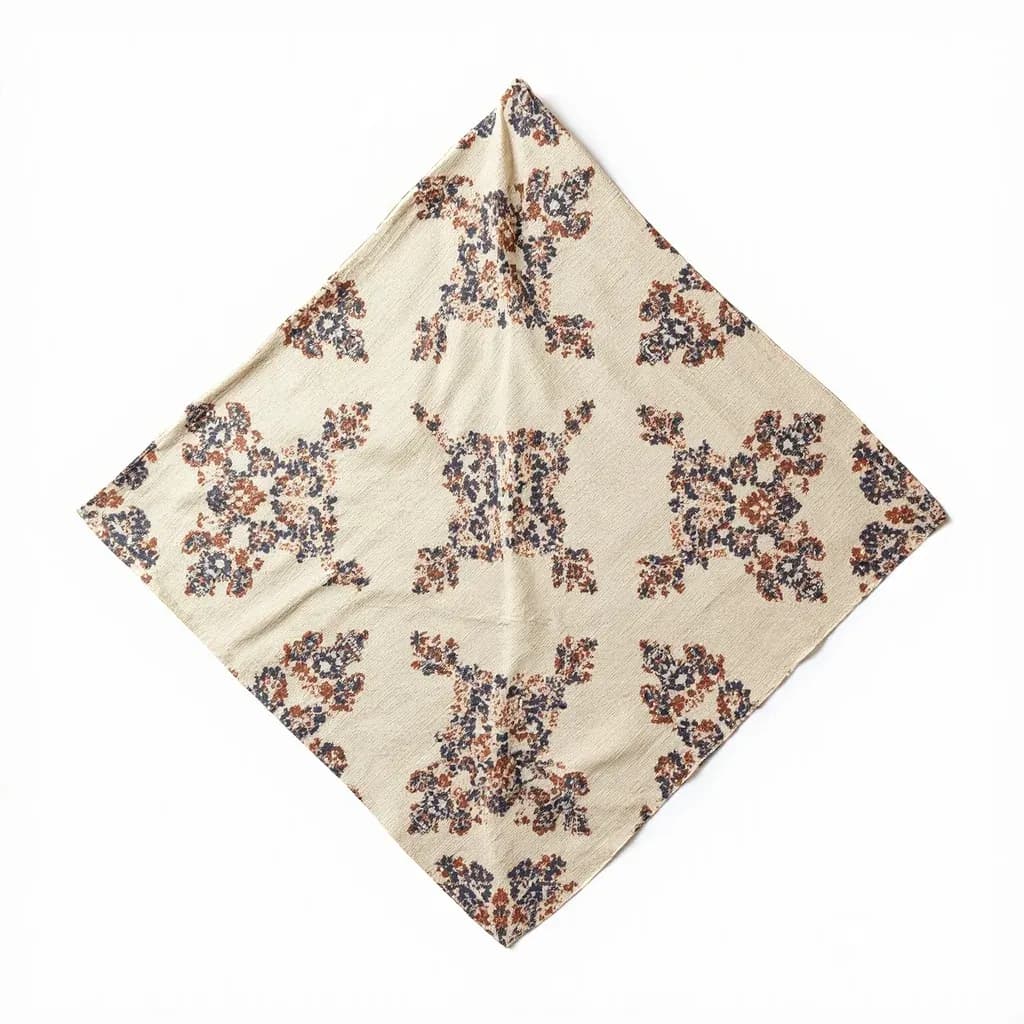
A large cloth or mat spread on the floor or ground as the surface for a shared meal across Middle Eastern, Central, and South Asian traditions. Dishes, bread, and rice are arranged directly on it for communal eating, and it catches crumbs for easy cleanup. The sufra (or dastarkhan) defines the dining space and is shaken out and folded away after the meal.
The sufra is the cloth that defines the eating space in dining traditions stretching from Morocco to Central Asia, and by extension the meal set upon it. In its most recognizable form it is a square or rectangular textile — cotton, linen, or wool — spread on the floor, on a low table, or across a rug, with communal dishes placed in the center and diners gathered around the edges. Spreading the sufra is itself a gesture of welcome: the moment the cloth goes down, the meal has formally begun, and everyone within its borders shares equally in the food. The right hand only, shoes off, bread kept to one side — these are not affectations but practical rules that keep the shared surface clean and the dining orderly.
In practical terms, the sufra behaves like a heavy, absorbent tablecloth, but it is designed for low, communal eating rather than a Western-style seated table. It gives the meal a defined surface, catches crumbs and spills, and visually anchors the gathering. Its size, weave, and decoration shift by region and occasion: a small individual mat in the Gulf, a hand-embroidered heirloom in Palestine or rural Iran, a wipeable vinyl sheet in a kebab house, or a feast-sized dastarkhwan for a wedding. For a cook or host, choosing and laying the sufra well is the first step in setting a meal in this tradition — before a single dish is brought out.
Alternatives
Types & varieties
The everyday term across the Arab world for a dining cloth, ranging from a small individual mat to a large family spread.
The Iranian equivalent, often more elaborately decorated; sofreh-ye Nowruz is a specific ceremonial variant laid at the New Year table with the seven symbolic items of the Haft-sin.
Turkish form of the word; used both for the cloth and, by extension, the meal set upon it.
Persian and South Asian term, often reserved for a larger, more formal feast cloth spread over a sheet on the floor and loaded with platters.
Hand-embroidered regional versions from Palestine, Egypt, Jordan, and rural Iran, often made as dowry pieces and reserved for honored guests.
Modern, wipeable version common in Gulf homes, kebab houses, and outdoor or picnic use; practical and inexpensive.
In parts of the Arabian Peninsula and North Africa the same role is filled by a woven palm-frond mat rather than a textile cloth.
Setting the sufra
How the cloth is laid affects the whole meal. Spread it taut and flat, with the edges squared to the room; wrinkles telegraph informality and can tip shallow bowls. For a formal meal, iron the cloth and, when dining outdoors or on rough ground, place a thin ground sheet, rug, or plastic underneath — the sufra is for dining, not insulation from dirt. Dishes go in the center, bread to one side, and diners arrange themselves around the edges.
- Lay the sufra before any food is brought to the room; an empty spread cloth is the visual cue that the meal has begun.
- Center large platters and main dishes; place bread, dips, and small bowls in a ring around them so every diner can reach.
- For floor dining, use a firmer ground cloth (an old sheet or plastic tarp) beneath the sufra to keep it clean and stop it sliding.
- Align embroidered or printed borders so they face the honored seat or the doorway, depending on local custom.
The sufra and related objects
Several nearby objects share the sufra's dining role or appear alongside it, and knowing the difference helps when reading recipes or setting a meal. The dastarkhwan is essentially a feast-sized sufra, the sahn or sinia is a round metal tray for tea or sweets sometimes set on the cloth, and the hasira is a palm-frond mat that fills the same function where no textile is used. The korsi — a low heated table with a draped cloth, common in Iranian winters — is related in form but not in function.
- Dastarkhwan: a Persian and South Asian feast cloth, larger and more formal than a household sufra.
- Sahn / sinia: a round tray (often brass or silver) used to serve tea, pastries, or fruit, sometimes placed directly on the sufra.
- Hasira: a woven palm mat that serves as a floor cloth in Arabia and North Africa, used the same way as a textile sufra.
- Korsi: a low table with a heater under a draped cloth, used in Iran for winter meals — shaped like a sufra but built around the heat source.
Common uses
Tips & pitfalls
- Wash and fully dry the sufra before first use to remove factory sizing and any storage mustiness.
- Spread it taut and flat — wrinkles look informal and can tip shallow bowls; iron the cloth and align its edges with the room for formal meals.
- Place a thin ground sheet or rug underneath when dining outdoors or on a rough surface; the sufra is for dining, not insulation from dirt.
- Set oily, heavily spiced, or strongly colored foods (saffron rice, sumac-dressed salads, beet dishes) on a tray or in bowls rather than directly on the cloth to prevent permanent staining.
- Reserve one side or corner of the sufra for bread so it does not absorb sauce or grease from shared dishes.
- Refold the sufra the same way each time so the edges stay square and any embroidered border keeps its orientation.
- For travel, fold a clean sufra around a stack of flatbread or fruit — it acts as both wrapping and tablecloth on arrival.
- Avoid plastic-backed vinyl indoors in warm weather; it traps heat and can slide on smooth floors. Save it for picnics and kebab-house style service, and use cotton or linen for seated, slow meals.
- Replace dedicated dining sufras every few years if used daily; keep embroidered heirloom versions for honored guests and occasions, not everyday meals.
Good to know
- Origin of term
- From Arabic sufra (سفرة), 'the cloth spread for a meal'; cognate with Persian sofreh, Turkish sofra, and South Asian dastarkhwan, all from a root meaning 'spread' or 'dining.'
- Cultural region
- Used across the Arab world, Iran, Turkey, Afghanistan, and parts of Central Asia; pre-Islamic in origin and formalized through Islamic dining culture.
- Material
- Traditionally hand-woven cotton, linen, or wool; modern versions include printed cotton, polyester blends, and wipeable vinyl.
- Typical shape
- Square or rectangular; cut edge or hemmed, often finished with tassels, fringe, or simple overlocked edges.
- Typical size
- Highly variable — small individual mats around 60 cm square up to family spreads of 2–3 m on a side; feast versions can be larger.
- Common colors
- White, undyed natural, red-and-white check, blue-and-white, or richly embroidered or printed in regional patterns.
- Etiquette
- Right hand only when eating directly from the sufra; shoes off; diners sit around the edges; communal dishes placed in the center.
- Symbolic role
- Signals hospitality, equality among diners, and the formal start of a meal; the act of spreading it is itself a gesture of welcome.
- Care
- Most cotton and linen versions are machine-washable; line-dry in sun when possible; ironed edges are preferred for formal use.
Also called
dastarkhan · dastarkhan-tablecloth · Dastarkhan · Sufra
Related

Aluminum Foil
Wraps, covers, and tents food for the oven and grill

Parchment Paper
Nonstick liner for clean, even baking and easy release

Wax Paper
Moisture-resistant sheet for wrapping and counter prep

Plastic Wrap
Clings tight to cover bowls and wrap leftovers

Silicone Baking Mat
Reusable nonstick liner that replaces parchment

Cheesecloth
Loose-woven cloth for straining stock and bundling herbs

Beeswax Food Wrap
Reusable wax wrap that molds around bowls and produce

Piping Tips
Shaped nozzles that turn frosting into stars and rosettes