Wraps & Liners
Taro Leaf (Wrapping)
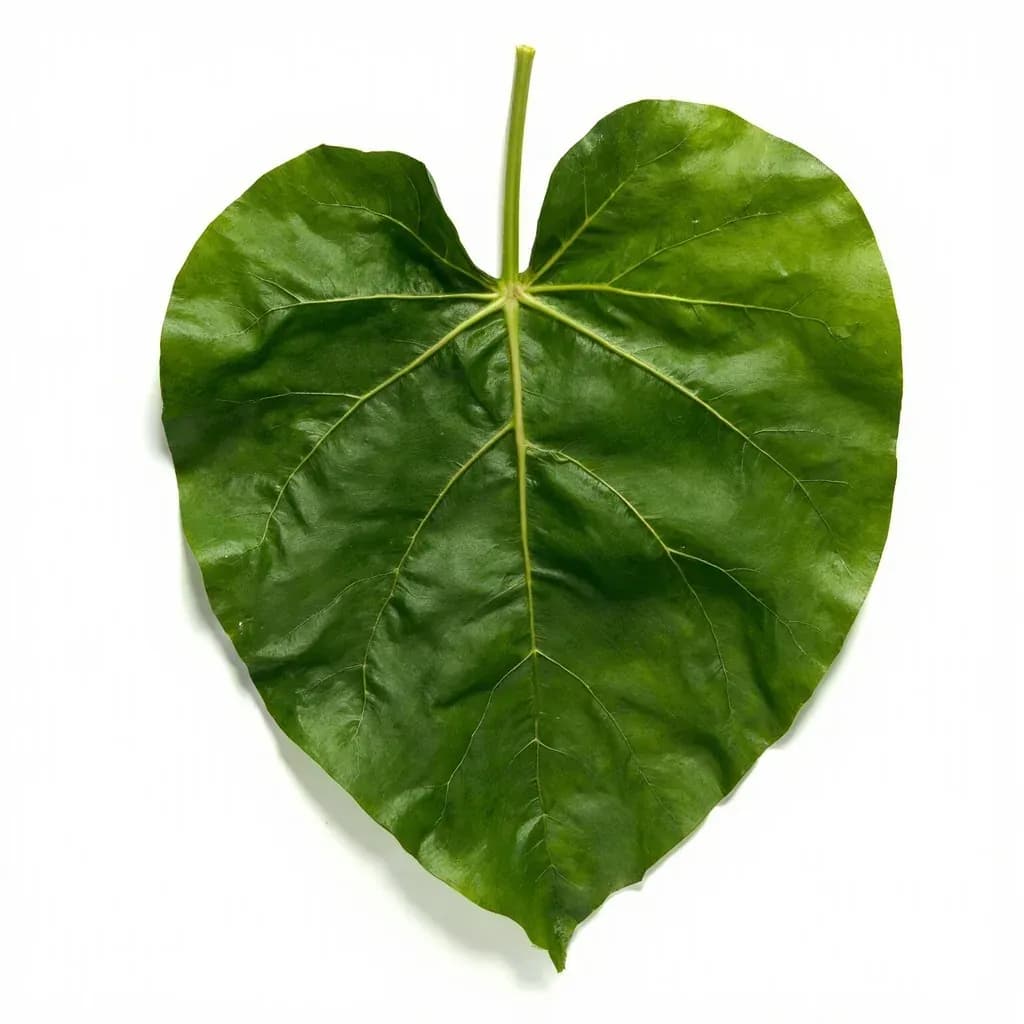
Large heart-shaped taro leaf used to wrap and cook meats and coconut dishes when fully cooked.
A taro leaf is a broad heart-shaped leaf used to wrap food for long, moist cooking. In Pacific and African dishes it parcels meats and coconut-cream mixtures for baking in an earth oven or steaming, as in laplap and palusami. The leaf must be cooked thoroughly because raw taro leaves contain calcium oxalate, which long cooking breaks down.
Taro leaf is the large, sagittate (heart- or arrow-shaped) blade of Colocasia esculenta, the same plant whose corm gives us poi and table taro. In the kitchens of Hawaiʻi, Sāmoa, Tonga, Fiji, and across wider Oceania, it is treated as a wrapping green and a vegetable at the same time — the leaf is layered into a parcel with pork, fish, or coconut cream, then slow-cooked for hours until soft enough to eat alongside the filling. That dual role is what sets it apart from banana leaf or corn husk: you do not unwrap and discard it, you plate it and share it.
Cooked properly, the leaf has a mild, earthy, faintly mineral flavor that soaks up coconut, pork fat, and cured fish the way a starchy tortilla soaks up beans. Mishandled, it is genuinely unpleasant: raw and even briefly steamed leaves contain calcium oxalate raphides that prick the mouth and throat. Every recipe calling for taro leaf is, by definition, a long-cook preparation, and the leaf is the cook's gauge as much as the cook's wrapper — when it turns a uniform deep olive-brown and tears with no resistance, the parcel is ready.
Alternatives
Types & varieties
The standard wrapping leaf across Hawaiian, Samoan, Tongan, and Fijian cooking; many leaf-color cultivars exist (lauloa, mana 'ele'ele, mana uli)
Much larger, thicker leaf used similarly in Hawaiian and some Filipino dishes; even higher oxalate content, so it needs longer cooking
Tender, smaller leaves preferred for Samoan palusami, where the leaf is the main green of the dish, not just a wrapper
Safety and the Oxalate Question
Taro leaf is one of the few wrapping greens that can hurt you if the cook is careless. The plant defends itself with raphides — microscopic, needle-shaped calcium oxalate crystals — concentrated in the leaf and petiole. Chewing raw or undercooked tissue drives these needles into the mucous membranes of the mouth and throat, producing an immediate itch, swelling, and a feeling that the tongue has been scalded. In severe cases the airway is affected.
Heat breaks the crystals down, but only sustained heat does. A quick dip in boiling water or a brief steam is not enough on its own; the leaf must be cooked for hours as part of the wrapped dish. Color change is a reliable visual cue: the leaf turns from bright green to a uniform deep olive-brown and becomes soft enough to tear with no resistance. Any bright green or rubbery patches in a finished parcel mean it needs more time, even if the filling is piping hot.
- Never taste the leaf raw, even as a test for seasoning
- Treat any recipe calling for taro leaf as a multi-hour cook, not a quick steam
- Wear kitchen gloves if your skin is sensitive — raphides irritate hands as well as mouths
Common uses
Tips & pitfalls
- Wilt whole leaves for 20–30 seconds in steam or near-boiling water before wrapping; this makes them pliable and prevents cracking at the stem
- Use at least three leaves per parcel, overlapping at the seams — a single leaf almost always tears during long cooks
- Wrap the dull (underside) inward against the food so the glossy cuticle faces the heat and resists drying
- Tie bundles snugly with ti leaf strips, banana leaf fiber, or natural twine; loose wraps admit steam and dry out the filling
- Layer older, tougher leaves on the outside and young tender leaves inside when the leaf itself will be eaten, as in palusami
- If using frozen leaves, thaw fully in the refrigerator and pat dry before wrapping to prevent soggy, tearing sheets
- Reserve any leftover cooking liquid for soup or rice — it carries the leaf's mineral flavor and pairs naturally with coconut
- Never shorten the cook to save time; the difference between an elegant lau lau and an unpleasant one is almost always an extra hour
Good to know
- Botanical name
- Colocasia esculenta (Araceae family); Alocasia macrorrhizos ('ape / giant taro) is used similarly
- Typical leaf size
- 30–60 cm (12–24 in) long on mature plants; 'ape leaves can exceed 1 m
- Active compounds
- Calcium oxalate raphides (needle-shaped crystals); destroyed only by sustained heat
- Safety
- Raw or undercooked leaves cause intense oral itching, swelling, and throat irritation; gloves help when handling large quantities
- Typical layering
- 3–6 leaves per parcel to prevent tearing and add insulation
- Cook time
- 3–8 hours steaming, 2–4 hours in an earth oven, or 1–2 hours pressure-cooked
- Storage (fresh)
- Refrigerate wrapped in a damp paper towel inside a loose bag, 3–5 days
- Storage (long term)
- Blanch 1–2 minutes, drain, and freeze flat in bags for up to 6 months
Also called
taro-leaf-wrap · cocoyam-leaf-wrap · laplap-leaf · luau leaf · dasheen leaf
Related

Aluminum Foil
Wraps, covers, and tents food for the oven and grill

Parchment Paper
Nonstick liner for clean, even baking and easy release

Wax Paper
Moisture-resistant sheet for wrapping and counter prep

Plastic Wrap
Clings tight to cover bowls and wrap leftovers

Silicone Baking Mat
Reusable nonstick liner that replaces parchment

Cheesecloth
Loose-woven cloth for straining stock and bundling herbs

Beeswax Food Wrap
Reusable wax wrap that molds around bowls and produce

Piping Tips
Shaped nozzles that turn frosting into stars and rosettes