Storage & Containers
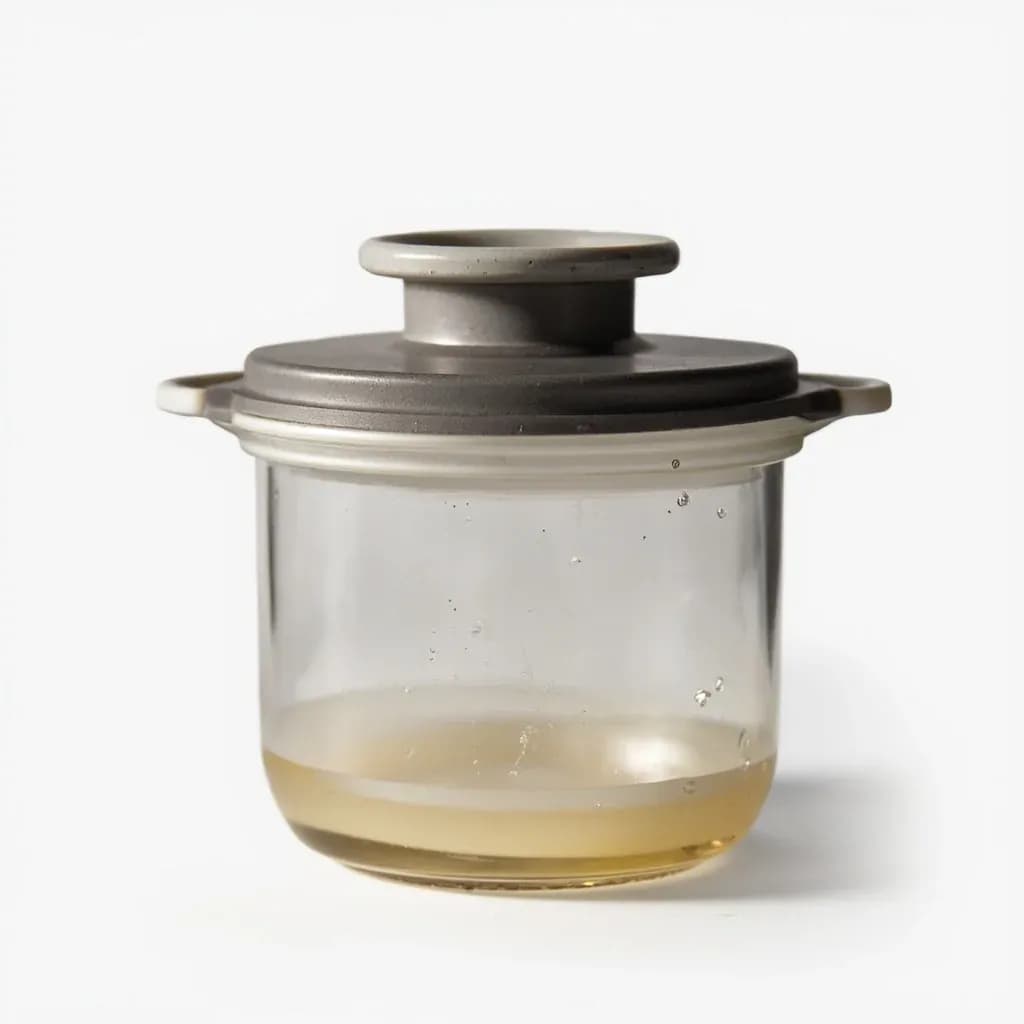
Vacuum Storage Canister
Sealable canister that pumps out air to keep dry and quick-marinating foods fresher.
A vacuum storage canister is a rigid container with a valved lid that lets a hand or electric pump remove air after sealing. Removing oxygen slows staling and oxidation, keeping coffee, flour, nuts, and snacks fresh, and it also speeds marinating by drawing liquid into the food. The lid reseals each time, so the same canister is vacuumed and opened repeatedly.
A vacuum storage canister is a rigid, lidded container fitted with a silicone gasket, a one-way valve, and a small pump — either a hand plunger or an electric motor — that pulls air out through the lid. Close the lid, attach or activate the pump, and you evacuate a substantial portion of the air inside. What remains is a partial vacuum: most consumer canisters reach roughly 0.7–0.8 atmospheres, not the deep, near-zero environment of a chamber vacuum sealer, but a low-oxygen, low-humidity space that dramatically slows the chemistry of staleness.
For the cook, that translates into three concrete payoffs. First, dry goods — coffee, nuts, crackers, flour, dried chiles — keep their flavor and texture roughly two to five times longer than in an ordinary sealed container, because both oxygen-driven oxidation and humidity-driven sogginess are slowed at once. Second, the pressure difference actively drives liquid into solid food, so a steak or a slab of tofu marinates in minutes rather than hours, and a neutral oil pulls herb or citrus flavor in a fraction of the usual steeping time. Third, it locks aromas in and keeps competing smells out, which makes a vacuum canister genuinely useful in a shared fridge or a small pantry where, say, smoked paprika and vanilla would otherwise ghost-flavor everything around them.
The honest limits matter as much as the benefits. These canisters will not preserve raw meat at room temperature, will not stop an active fermentation, and will ruin themselves if you pump out liquids unless the model is rated for them. Treated as a pantry and prep upgrade — a meaningful step up from a clip-top jar, well short of a chamber sealer — a vacuum canister earns its counter or shelf space.
Alternatives
Types & varieties
The most common form: copolyester body with a small manual plunger that screws or clips onto the lid valve. Cheapest, no batteries, slightly slower to peak vacuum.
Battery- or rechargeable-motor lid that evacuates at the push of a button. Faster and more consistent vacuum; pricier and dependent on power.
Borosilicate jar with the same vacuum lid. Resists staining from tomatoes or turmeric and is microwave-safe without the lid.
Opaque metal body that blocks light, ideal for coffee, tea, and spice storage; usually paired with a hand pump.
Pantry-friendly footprint that nests vertically; often sold in matched sets with one shared pump.
Sub-1 L size for opened wine, leftover sauces, or a single portion of nuts or berries.
Programmable electric lid that alternates vacuum and release cycles to repeatedly drive marinade into the food — the closest consumer analog to a chamber sealer for this one task.
Marinating and infusing in a vacuum canister
A vacuum canister is the cheapest and most approachable way to do chamber-style rapid marination at home. The mechanics matter: when you evacuate the air inside, the pressure outside the food is higher than the pressure inside its cells, and liquid is physically forced inward. When you release the vacuum, the food relaxes and pulls even more marinade deep into the structure. Alternating those two phases — vacuum, hold, release, repeat — moves flavor into a thick steak or a dense beet in a fraction of the time a flat soak would take.
- Cut protein no thicker than about 2.5 cm; very thick pieces still benefit from a short final rest in the marinade after vacuuming.
- Keep the food fully submerged or, at minimum, in contact with the marinade; vacuum will not push liquid uphill against gravity.
- For infusions (oils, vinegars, spirits), 15–30 minutes of vacuum pulsing replaces 24–48 hours of cold steeping and produces a cleaner, brighter flavor.
- Salt-heavy marinades draw moisture out first, then pull it (and the salt) back in during release — so salt early in the cycle, not at the end.
- Always marinate in the canister cold (refrigerated); the mechanical advantage is the same, and you avoid the food safety risk of time at room temperature.
Common uses
Tips & pitfalls
- Leave at least 1–2 cm of headspace; the lid needs room to seat and the pump needs air to evacuate.
- Wipe the gasket and the rim of the canister dry before sealing — a single drop of water breaks the seal.
- Most consumer canisters are not rated for liquids; if yours is, stop pumping the instant you see the liquid bulge toward the lid.
- Cool food to room temperature before pumping, or condensation will fog the interior and pool under the gasket.
- For marinating, pulse rather than pump continuously: evacuate, wait 30 seconds, release, repeat 3–4 times for deeper flavor penetration.
- Pre-chill coffee and roasted nuts before sealing — you remove the residual heat that drives staling even in a low-oxygen environment.
- Replace the silicone gasket every 12–18 months; it hardens, micro-cracks, and loses grip well before the canister itself fails.
- Don't trust a vacuum canister to keep raw meat safe at room temperature; it slows spoilage, it does not prevent it.
- Hand-pump models are quieter, cheaper, and never run out of battery; electric models are faster and hit a more consistent peak vacuum.
Good to know
- Typical construction
- Rigid body (plastic, glass, or stainless steel) with a tight-fitting lid, food-grade silicone gasket, one-way valve, and either a hand pump or electric pump port.
- Air removal method
- Hand plunger or electric pump evacuates air through a valve in the lid; lid locks into the depressed position as pressure drops.
- Vacuum level achieved
- Roughly 0.7–0.8 atm (about 20–30% of air removed); partial vacuum, not the near-zero environment of a chamber sealer.
- Common capacities
- From about 0.3 L (single-serve) to 5 L (large pantry); 1–2 L is the sweet spot for everyday use.
- Body materials
- BPA-free copolyester (lightweight, most common), borosilicate glass (microwave- and stain-resistant), or stainless steel (most durable, opaque to light).
- Gasket material
- Food-grade silicone; replaceable on most models and the part that wears out first.
- Pump type
- Hand plunger (no power, quieter, slower), electric pump built into the lid (faster, more consistent), or electric plug-in base with hose.
- Re-seal cycles
- Lids can typically be removed and re-sealed hundreds of times; the silicone gasket is the wear part, usually rated 12–18 months of daily use.
Also called
vacuum canister · vacuum storage canister · vacuum food container
Related

Freezer Bags
Thick, sealable bags built to fight freezer burn

Storage Bags
Resealable bags for fridge storage and marinating

Storage Container
Lidded container for leftovers, prep, and meal kits

Glass Container
Oven-to-fridge glass that won't stain or hold odors

Plastic Container
Lightweight, stackable storage for everyday leftovers

Vacuum Sealer Bags
Airtight bags for long freezing and sous-vide

Reusable Bags
Washable silicone bags that replace single-use plastic

Mason Jar
Sealed glass jar for preserves, pickles, and storage