Baking & Pastry
Æbleskiver Pan
A cast-iron pan with hemispherical wells for cooking round Danish pancake puffs.
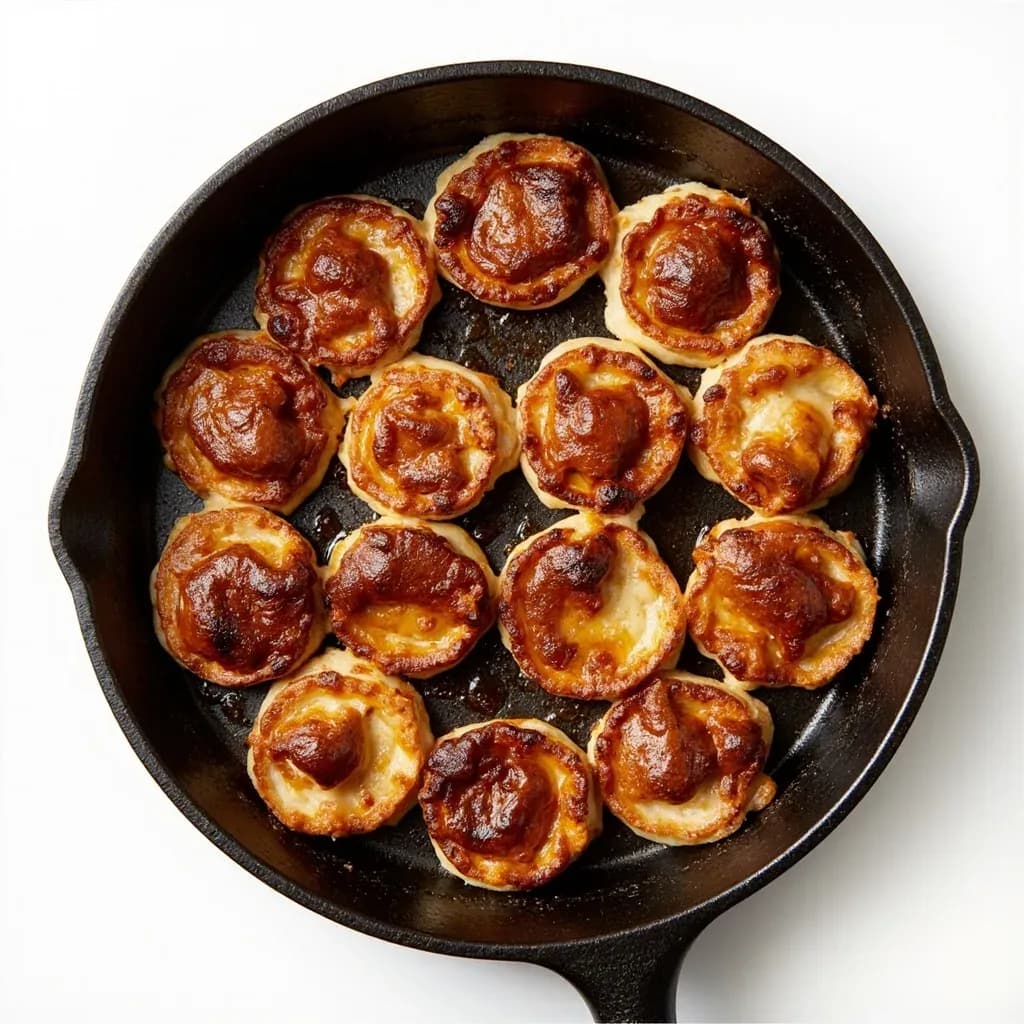
An æbleskiver pan is a heavy cast-iron pan dotted with rounded half-sphere cavities, used to make the Danish spherical pancakes. Batter is poured into each hot greased well and, as it sets, turned with a skewer or knitting needle to form a golden ball cooked through the center. The puffs are served dusted with sugar and jam, traditionally around the winter holidays.
The æbleskiver pan is one of those rare pieces of cookware built for a single, specific job: producing the round, golden pancake puffs that Danish families eat by the dozen through Advent. Each well is a deep hemisphere about 5 cm across, cast into a heavy slab of metal so that heat pours into the cup walls as well as the bottom. That geometry is what makes the dish possible — the batter is poured in, begins to set, and is then rotated a quarter turn at a time with a long skewer so a fresh layer of batter touches the hot iron each time. The result, after four rotations, is a sealed sphere with a tender, lightly tangy interior and a crisp, buttery shell.
Cast iron is the traditional choice because it stores enough heat to keep all the wells at a steady temperature even when cool batter hits them, and because a properly seasoned surface releases the puffs cleanly once they have formed a crust. Thin stamped steel, by contrast, cools down too quickly once cold batter hits the wells and the batter seizes before you can turn it. A seven-well pan has become the standard for the same reason: large enough to feed a family in three or four batches, yet small enough that a single burner can heat every well evenly without shifting the pan to compensate for hot spots.
Although designed for Danish pancakes, the same hemispherical-well shape has been adopted in Japan for takoyaki, and the wells work equally well for any small, round, batter-based bite — cheese-filled dough balls, mashed-potato puffs, browned meatballs. In practice the dedicated pan is a one-purpose tool that does its purpose exceptionally well, and most cooks who own one reach for it more often than they expect.
Alternatives
Types & varieties
Heavy, holds heat evenly, develops a non-stick patina with seasoning; the most authentic and most common form
Lighter than cast iron with similar heat retention; often pre-seasoned or coated
Easier release for beginners, lower heat tolerance, less durable surface
No seasoning required, resists rust, more expensive; less traditional but easy care
Countertop appliance with built-in heating element and thermostat; useful for parties but lacks the searing quality of stovetop cast iron
Same hemispherical-well design, usually with more wells and lighter gauge metal; works for æbleskiver though heat retention differs
Dutch shallow-well pan for mini pancakes; the wells are flatter and smaller, not interchangeable with æbleskiver pans
Choosing your first pan
For most home cooks a 7-well cast iron pan is the right starting point. It is heavy enough to hold steady heat, fits comfortably on a standard burner, and produces enough puffs per batch to feed four people in three rounds. Enameled cast iron is a worthy second choice if you do not want to maintain seasoning. Avoid thin stamped steel — it cools too quickly once cold batter hits and produces pale, stuck-on results. Non-stick pans are the easiest for a beginner but will not develop the same crisp, browned crust that cast iron does.
The turning technique
The quarter-turn rotation is what distinguishes æbleskiver from any other molded batter. You are not flipping the puff over; you are rotating it inside its own well so the wet, uncooked top of the batter drapes down against the hot iron and forms the next layer of the sphere. Add a small dab of fresh batter before each turn and the layers build up over four rotations. A wooden skewer, a long fondue fork, or even a chopstick works; a knitting needle is the traditional Danish choice. Spatulas, spoons, and forks tear the soft batter and produce lopsided, leaking results.
Common uses
Tips & pitfalls
- Preheat the pan thoroughly over medium heat before adding batter — too cool and the batter will not seal when you turn it; too hot and it scorches before the center cooks through.
- Grease every well generously with melted butter, using a brush or a piece of folded paper towel held in tongs; butter (not oil) gives the classic crisp, golden exterior and richer flavor.
- Fill each well only about two-thirds full — the batter expands as steam builds inside, and an overfilled well will overflow and weld adjacent puffs together.
- Use a long skewer to turn each puff roughly one-quarter turn every 30–45 seconds, rotating it around the well so all sides cook into a sphere — never use a spoon or fork, which tear the soft batter.
- Add a small dab of fresh batter to the well each time you turn; this is how the layers build and the sphere grows.
- Cast iron needs to be hot and well-seasoned for puffs to release cleanly; aggressive sticking means under-heating, under-greasing, or under-seasoning.
- Cook over medium, not medium-high — the wells concentrate heat and run hotter than a flat skillet of the same gauge.
Good to know
- Origin
- Denmark; the pan evolved alongside the spherical pancake puffs called æbleskiver (literally 'apple slices')
- Material
- Traditionally cast iron; modern versions also made in cast aluminum, stamped steel, or non-stick coated
- Standard well count
- 7 hemispherical wells; smaller 4-well and larger 9-well pans also exist
- Well diameter
- Approximately 5 cm (about 2 inches)
- Required turning tool
- A long thin skewer — traditionally a knitting needle, today a wooden or metal skewer, fondue fork, or chopstick
- Seasoning
- Bare cast iron requires seasoning like any cast iron cookware; enameled and non-stick versions do not
- Yield per batch
- 7 æbleskiver per batch, typically 3–5 minutes per batch
- Weight
- A 7-well cast iron pan typically weighs 1.5–2.5 kg (3.5–5.5 lb)
Also called
aebleskiver-pan · Ableskiver Pan · Danish Pancake Pan · Ebelskiver Pan
Related

Muffin Pan
Multi-cup pan for muffins, cupcakes, and egg bites

Bundt Pan
Fluted ring mold for showstopping cakes with a center hole

Springform Pan
Latch-release pan that frees delicate cakes without flipping

Pie Dish
Sloped round dish for crisp-bottomed pies and quiches

Tart Pan
Fluted pan with a pop-out base for clean-edged tarts

Rolling Pin
Rolls dough into even sheets for pastry and bread

Pastry Brush
Brushes on egg wash, glaze, butter, and marinades

Bench Scraper
Flat blade that divides dough and clears your work surface