Prep Tools
Analytical Balance
A precision scale that weighs ingredients to a hundredth of a gram for exacting recipes.
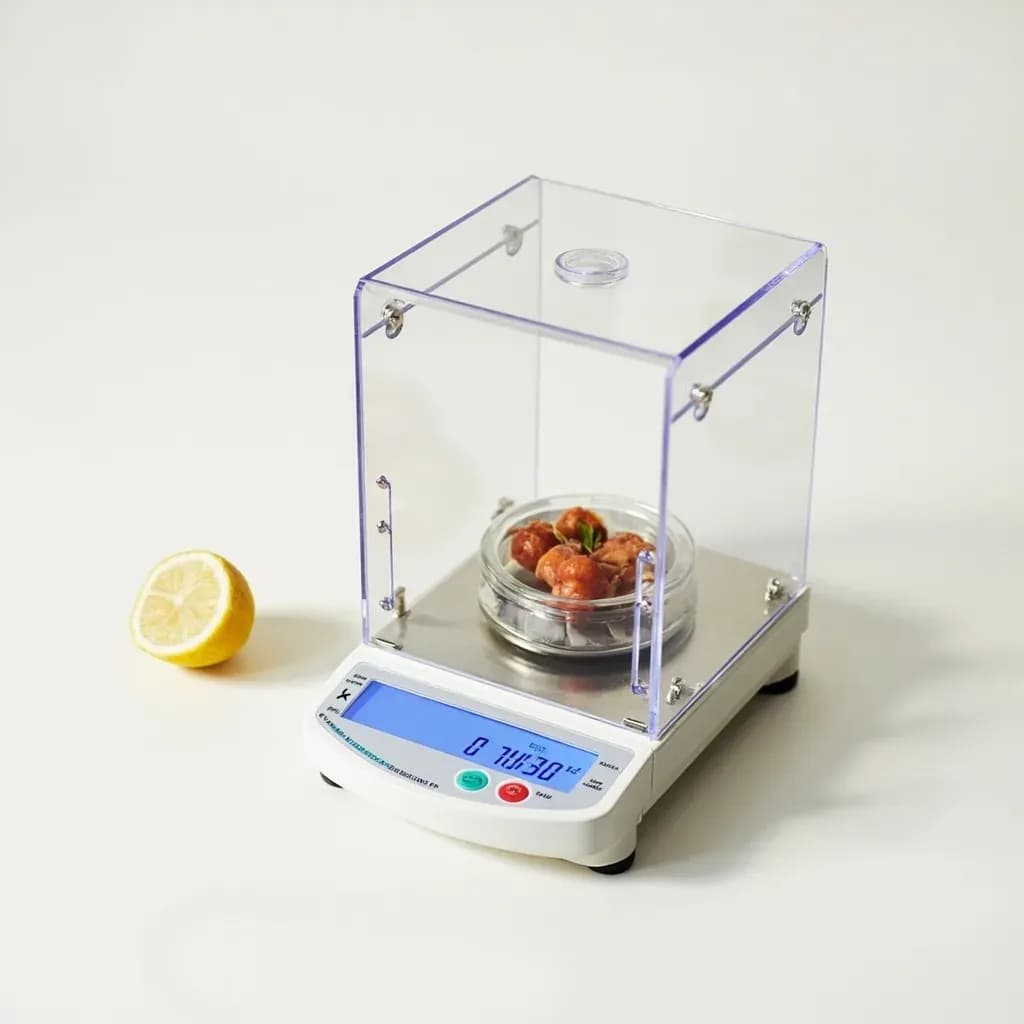
An analytical balance is a high-precision scale, accurate to 0.01 gram or finer, used to weigh small, sensitive amounts such as additives, leaveners, hydrocolloids and curing salts. Pastry and modernist cooks rely on it where ordinary kitchen scales are too coarse. A draft shield around the pan keeps air currents from disturbing the tiny readings.
An analytical balance is a laboratory-grade electronic scale that resolves weight to 0.1 mg (0.0001 g), about a thousand times finer than the digital kitchen scale on most counters. It works on the principle of electromagnetic force restoration: a coil suspended in a permanent magnet carries the weighing pan, and the current needed to return the coil to its null position is directly proportional to the mass on the pan. A glass draft shield surrounds the pan because air currents of even a few centimeters per second will push the reading around at this resolution. The instrument is overkill for nearly all home cooking, but in a pastry R&D kitchen, a modernist lab, or a chocolate workshop it becomes the difference between a recipe that reproduces and one that drifts by enough to ruin a gel, a cure, or a couverture.
The reason precision at this level matters in food is not nostalgia for exactness — it is that some functional thresholds in cooking are very narrow. Gellan gum sets a firm gel near 0.5% of liquid weight and a brittle gel near 1.0%; the gap between the two textures is 0.5 g per 100 g of water. Sodium nitrite for charcuterie must land inside 120–200 ppm, a window that disappears if your scale reads only to the gram. Cocoa butter percentages in chocolate formulation shift viscosity, snap, and gloss across tenths of a percent. In each of these cases, the analytical balance is being used because the cooking process itself is sensitive to milligram-level dosing.
Used well, an analytical balance also makes a kitchen more reproducible. Weights feed directly into a recipe database, every cook at every station can be told "800.00 g water, 0.40 g iota carrageenan," and the result is the same pot of gel regardless of who is cooking. The instrument is unforgiving of sloppiness — thermal convection, static, vibration, and a warm electronics package all push the reading around — so the cook who adopts one is also adopting a more deliberate way of measuring.
Alternatives
Types & varieties
The strict definition: 0.0001 g readability, glass draft shield, 100–220 g capacity. The benchmark for serious pastry and modernist work.
Five-figure precision; used when measuring trace additives such as enzymes, transglutaminase, or specific ions.
Often sold as 'analytical' but a different class — no draft shield, cheaper, fine for baker's percentages in bread work.
Combines a halogen dryer with a balance; useful for measuring flour moisture content and tracking water activity in chocolate work.
Brands such as MyWeigh, Jennings, and Breville sell 0.01–0.1 g scales aimed at chefs; not laboratory-certified but adequate for many pastry tasks.
When analytical precision actually matters in a kitchen
Most culinary weighing decisions do not need sub-milligram resolution. A 0.1 g scale reads accurately enough for bread hydration, pastry yield calculations, portioning, and plating. Analytical balances enter the picture when the functional effect of an ingredient changes meaningfully with a few milligrams of difference. Hydrocolloid gels are the clearest example: gellan gum sets a firm gel at roughly 0.5% of liquid weight and a brittle gel at 1.0% — the gap between the two textures is 0.5 g per 100 g of water. Sodium alginate for spherification behaves similarly; an extra 0.2 g per liter turns a delicate burst into a rubber ball. In charcuterie, sodium nitrite is dosed at 120–200 ppm — outside that window is either ineffective or unsafe, and the absolute mass involved is small enough that small measurement errors matter proportionally. Chocolate work also benefits: cocoa butter, lecithin, and cocoa solids are routinely measured to ±0.1 g when developing or replicating a couverture formulation.
Setting up a weighing station
A reliable analytical balance needs a dedicated spot. The bench should be rigid — a marble or granite slab on a lower shelf isolates vibration from foot traffic. The room should not share a wall with a kitchen line, dishwasher, or HVAC plenum; air pressure pulses and steam both disturb the reading. Ambient temperature should be stable: many units specify ±1 °C per hour drift tolerance. The balance should sit level, with the bubble centered, before each session. Power it on at the start of the day and let it warm up; cold electronics drift. Keep the area around the balance clean and dry — flour dust and cocoa accumulate and absorb moisture, which throws off both the pan and any static charges. A small anti-static brush, weighing paper, a pair of tweezers for calibration weights, and a notebook or tablet for logging are the practical accessories.
Reading the manufacturer's specifications
Three numbers on the data sheet tell you almost everything: readability (the smallest increment displayed, e.g. 0.1 mg), repeatability (the standard deviation of repeated measurements of the same mass, e.g. ±0.1 mg), and linearity (the maximum deviation across the weighing range, e.g. ±0.2 mg). Readability is the marketing number; repeatability and linearity determine whether the balance is actually trustworthy at a given mass. A unit with 0.1 mg readability but ±0.5 mg repeatability is not really an analytical balance — it is a precision balance with extra decimal places. Look for units where repeatability and linearity are both at or below the readability claim.
Common uses
Tips & pitfalls
- Weigh in the middle third of the balance's capacity — accuracy degrades near zero and at the top of the range.
- Never place hot or cold samples directly on the pan; thermal convection creates air currents that destabilize the reading.
- Use weighing paper, a small beaker, or a watch glass and tare before adding the ingredient — direct contact can contaminate the pan and scratch the cell.
- Keep the draft shield doors closed during measurement; even breathing on the pan shifts the value at 0.1 mg resolution.
- Calibrate daily in professional use, or at minimum weekly; temperature changes between day and night drift the internal standard.
- Avoid placing the balance near ovens, dishwashers, or HVAC vents — vibration and airflow are the two biggest enemies.
- Use anti-static measures (ionizer or grounded mat) when weighing fine powders like flour or cocoa; static charge can deflect the reading by several milligrams.
- Don't confuse precision with accuracy — a balance that consistently reads 0.02 g high is precise but wrong; verify against a certified check weight.
- For recipe development, log every weight to software; the value of an analytical balance is in repeatability, not single measurements.
- Clean spills immediately with a soft brush — many balances use electromagnetic force restoration, and ferrous contamination skews the cell.
Good to know
- Readability
- 0.1 mg (0.0001 g) for a true analytical balance; semi-micro models reach 0.01 mg
- Capacity
- Typically 100–220 g, occasionally up to 300 g — small relative to kitchen needs
- Draft shield
- Glass enclosure with sliding doors is standard; required for sub-milligram stability
- Warm-up time
- 15–60 minutes after power-on before readings stabilize
- Calibration
- Internal motorized self-calibration on premium units; cheaper models use external certified weights
- Environment
- Must be on a rigid, vibration-free surface away from HVAC vents, ovens, and dishwashers
- Output
- RS-232 or USB on modern units for logging weights into recipe software
- Price class
- Laboratory-grade units start in the low four figures USD; semi-micro models run significantly higher
Also called
Analytical Balance (0.01g) · Precision Scale · Lab Balance
Related

Peeler
Swift blade for stripping skin off fruit and vegetables

Grater
Sharp-toothed surface for shredding cheese and vegetables

Microplane
Ultra-fine rasp for citrus zest, garlic, and hard cheese

Mixing Bowl
All-purpose bowl for combining, whisking, and tossing

Whisk
Looped wires that beat air into eggs, cream, and sauces

Spatula
Flat blade for flipping, lifting, and scraping

Slotted Spoon
Pierced spoon that lifts solids and drains the liquid behind

Wooden Spoon
Gentle, heat-friendly spoon for stirring anything