Prep Tools
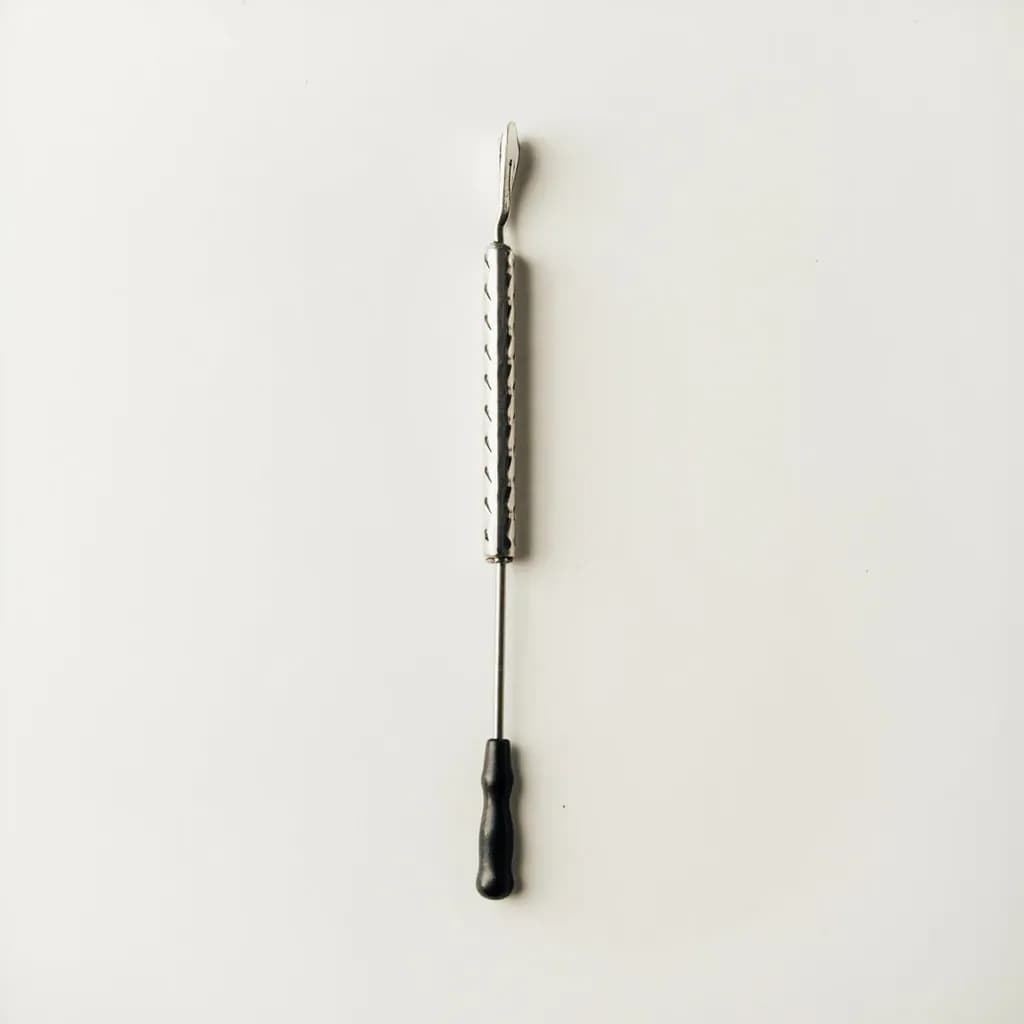
Apple Corer
A cylindrical tool that punches the core and seeds out of apples in one push.
An apple corer is a hand tool with a sharp-edged tube that bores straight through an apple to remove the core and seeds while leaving the fruit whole. Cooks use it to prep apples for baking whole, stuffing, or slicing into clean rings, and it works on pears too. Some models add a divider so a single press cores and wedges the fruit at once.
An apple corer is one of the most deceptively simple tools in the kitchen: a short, hollow cylinder with a sharpened rim designed to drive straight through an apple and lift out the stem, seeds, and tough core fibers in a single plug. Pressed from stem-end to blossom-end with a slight twist, it shears a clean channel through the flesh and leaves a neat cylindrical hole that the cook can then peel, slice, or stuff as the recipe demands. A paring knife can core an apple, but it does so by cutting away a conical wedge of good flesh along with the seeds, throwing away significantly more of the fruit than a corer does — that precision is the tool's quiet genius.
Because the action is a single downward push rather than a series of cuts, the corer is also a speed tool. In a kitchen prepping ten or twenty apples for a pie, a tart, or a canning run, the difference between coring with a knife and coring with a corer is roughly the difference between five minutes and one. That economy of motion is why handheld corers of nearly this exact shape appear in European kitchen inventories from the 18th century, and why clamp-on mechanical versions became fixtures in 19th-century orchard kitchens during preserved-fruit season.
The right corer for a given job depends on the apple and the recipe. A simple push tube is enough for sauce, butter, or pie filling; a multi-blade slicer saves a second step when uniform wedges are wanted for a tart or lunchbox; a clamp-style peeler-corer-slicer earns its keep in volume work. All of them share the same principle: align the tool with the stem, push straight down, and let the geometry do the cutting.
Alternatives
Types & varieties
Single open-ended tube with a flared handle; the original and most common form, pushed straight down through the apple.
A looped or coiled wire handle attached to a short ring; inexpensive, often plastic or thin metal, and the everyday choice for casual kitchens.
Multi-blade tool (typically 8 wedges) that cores and slices the apple simultaneously as you press down; the design popularized in the 1990s and now the most recognized shape in the category.
Saw-toothed rim that bites through waxy or very tough apple skins more easily than a smooth edge.
Counter- or wall-mounted rotary device that peels, cores, and slices in one turn of the handle; common in orchards and canning kitchens for volume work.
Taller cylindrical tube with a closed or capped end, used in volume prep so the core plug pushes cleanly out onto a board rather than falling through.
A short history
Handheld corers of nearly the same shape as today's models appear in European kitchen inventories from the 18th century, listed alongside peelers and skewers as small, dedicated fruit tools. The clamp-on mechanical peeler-corer-slicer was patented in the United States in the mid-19th century and became a fixture in orchard and commercial canning kitchens, where bushels of apples needed to be peeled and cored by hand one at a time. The modern 8-blade wedge corer was popularized as a consumer product in the 1990s and is now the most recognized visual icon of the category — its silhouette is essentially shorthand for apple prep.
Beyond the apple
A corer is built for apples, but the geometry is forgiving enough to handle a few other fruits and vegetables in a pinch. Use it as a starting point and finish with a knife or melon baller where needed.
- Pears (Fuji, Bosc, Bartlett, Anjou): core straight through from stem end; the shape lines up well, though very ripe pears may crush and need a gentle hand.
- Tomatoes, especially firm paste and beefsteak types: a quick push cleans out the seed cavity for stuffing; do not use on soft ripe salad tomatoes, which collapse.
- Potatoes for twice-baked or stuffed preparations: removes the dense center cleanly so the shell can be scooped and refilled.
- Round fruits and vegetables for decorative garnishes, where a clean central hole reads better than a knife-cut cavity.
Common uses
Tips & pitfalls
- Set the apple on a wooden or plastic cutting board — never push the corer through into your palm, since most tubes are longer than the apple is tall and will exit the other side.
- Aim the tool at the stem-end dimple so the stem and the seed cluster line up in one plug rather than getting half-cored.
- Twist gently as you push; the slight rotation shears fibers for a cleaner cut and less tear-out around the rim.
- Use firm, crisp apples such as Granny Smith, Honeycrisp, Fuji, or Pink Lady; soft, mealy apples like overripe McIntosh crush instead of cutting cleanly.
- If the apple resists, do not force the corer sideways — straighten it and press straight down, or the rim can bend and the tool will never cut cleanly again.
- For a multi-blade slicer, apply even, flat palm pressure; rocking the tool can split the apple unevenly and let a blade slip toward your fingers.
- Rinse the corer immediately after use; apple juice left to dry on stainless steel can pit the surface over time.
- Sharpen the rim occasionally with a honing rod or fine file to keep it slicing rather than tearing, especially on tools that have been through the dishwasher for years.
- Match corer diameter to fruit size: a 1-inch corer on a small Lady apple removes too much good flesh, while a small corer on a large Fuji leaves seeds behind.
Good to know
- Tool type
- Handheld cylindrical borer with a sharpened rim, used to punch out the core and seed cavity of an apple in a single push.
- Typical material
- Stainless steel; also made in plastic, cast aluminum, or wood-handled versions.
- Core diameter removed
- Roughly 3/4 to 1 inch (about 2–2.5 cm), depending on the model.
- Time per apple
- 2–4 seconds with a standard push corer; slightly longer for a multi-blade slicer-type corer.
- Typical length
- 4–6 inches (10–15 cm) overall for handheld models.
- Dishwasher safe
- Most stainless steel corers are; thin or coated edges may dull faster in a dishwasher.
- Pairs with
- Vegetable peeler, paring knife, melon baller, and apple peeler-corer-slicer clamp tools.
Also called
Corer
Related

Peeler
Swift blade for stripping skin off fruit and vegetables

Grater
Sharp-toothed surface for shredding cheese and vegetables

Microplane
Ultra-fine rasp for citrus zest, garlic, and hard cheese

Mixing Bowl
All-purpose bowl for combining, whisking, and tossing

Whisk
Looped wires that beat air into eggs, cream, and sauces

Spatula
Flat blade for flipping, lifting, and scraping

Slotted Spoon
Pierced spoon that lifts solids and drains the liquid behind

Wooden Spoon
Gentle, heat-friendly spoon for stirring anything