Prep Tools
Armudu Tea Glass
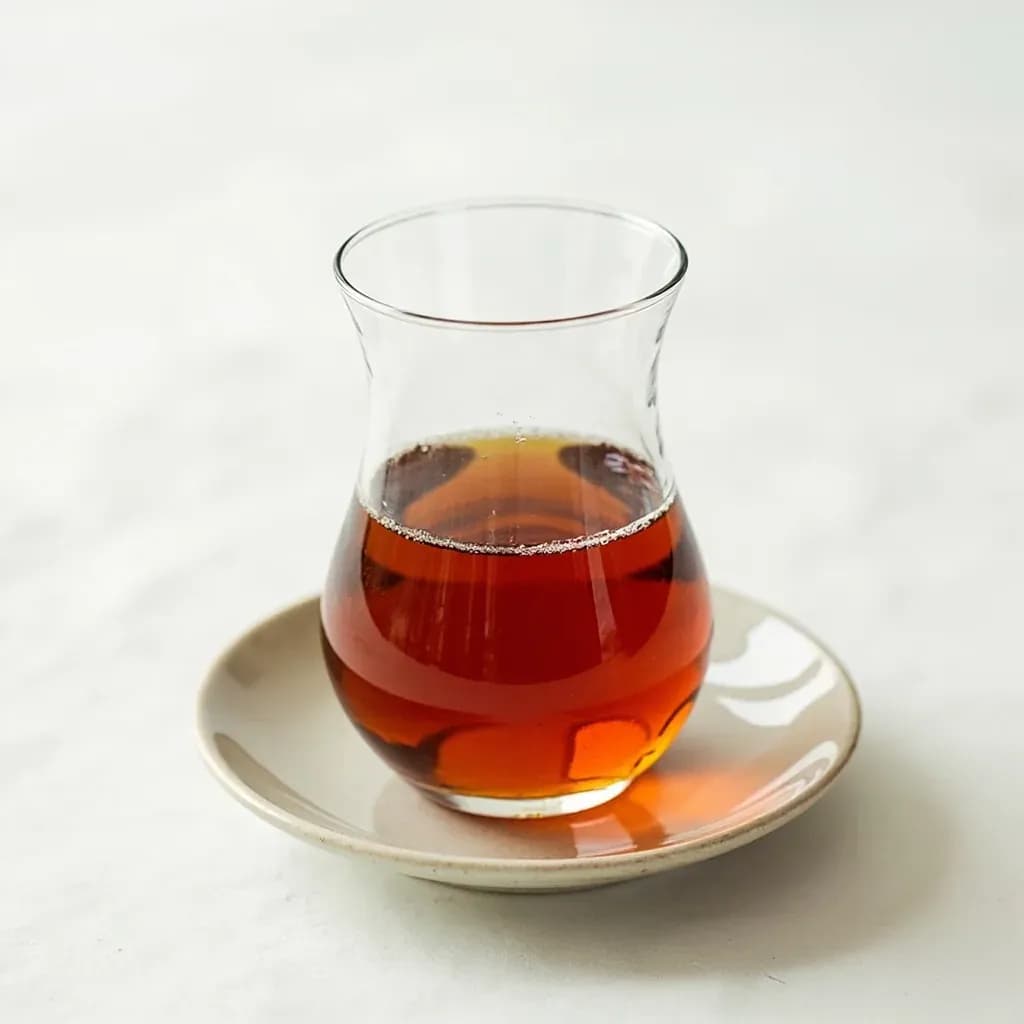
A pear-shaped Azerbaijani glass that keeps tea hot and is held by its narrow waist.
An armudu is a small pear-shaped (bardak) glass used across Azerbaijan and the Caucasus to serve strong black tea. The pinched waist lets the drinker hold the cool middle while the wide bowl keeps the tea hot longer, and the shape encourages sipping the brew while it is fresh. It is typically served on a saucer with sugar and lemon.
The armudu — from the Azerbaijani armud (pear) — is a thin-walled, pear-shaped drinking glass with no foot, no handle, and a distinctive pinch-waist between a wide upper bulb and a flared circular base. It is the defining vessel of Azerbaijani çay, the strong black tea that anchors hospitality from family kitchens to village çayxanas. The shape is not decorative; it is an engineering solution to a specific problem: how to hold a glass of near-boiling tea comfortably in your fingers. The narrow waist stays relatively cool because the hot liquid sits above and below it, so the drinker pinches the glass at its thinnest point and the fingers stay clear of both the hot bulb and the warm base. No saucer is required and no metalwork conducts heat — the geometry does the insulating work on its own.
The bulb does more than look pretty. Because its surface area is greater, the tea pooled in the upper portion loses heat to the air faster than the liquid trapped in the narrow neck and flared base below, creating a deliberate temperature gradient as the glass is drunk. The first sip from the rim is at a drinkable temperature even when the tea has just been poured from a samovar; as the drinker works downward toward the base, each mouthful is a degree or two hotter, the narrow neck keeping the last of the tea close to boiling. The wide opening also concentrates the volatile aromatics of strong black tea just under the nose, so the glass is meant to be sniffed before it is sipped. Standard capacity is 100–150 ml, with demitasse versions around 60–80 ml for concentrated brews and larger banquet sizes above that. A flat saucer is conventional beneath the glass in formal service — not because the glass needs it, but because the base will mark an unprotected wooden table.
The armudu is inseparable from a particular way of pouring and drinking. Tea is brewed very strong in a çaydan (small pot) or the top of a samovar, then poured about a third of the way up the glass as a concentrate, and topped up with hot water drawn from the samovar's lower chamber. The guest adjusts strength and temperature to taste in the glass itself. A lump of nabat (rock sugar) or a sugar cube is held between the front teeth, and the tea is sipped through it — a signature Azerbaijani style. The glass is small by Western standards and refilled often; serving is a continuous social act rather than a single pour.
Alternatives
Types & varieties
Thin-walled, perfectly transparent; the everyday glass in Azerbaijani homes and tea houses.
Heavier, more durable version used in busy çayxanas and restaurants; retains heat longer and survives rough handling.
Etched or wheel-cut decorative patterns; common as gifts and for special-occasion table service.
Amber, green, or blue glass — modern or souvenir interpretations, sometimes paired with a metal holder.
A smaller 60–80 ml version used for concentrated strong brews, herbal infusions, and mountain-tea blends.
Russian and Central Asian variant: the armudu drops into a filigreed metal holder that grips the waist.
The thermal logic of the shape
The armudu's bulb-and-waist profile solves three problems at once. First, ergonomics: the waist is the only part of the glass a hand should touch, and the liquid sits on both sides of the fingers rather than around them, so heat transfers sideways through thin glass only at that narrow band. Second, temperature staging: the larger surface area of the bulb sheds heat to the air faster than the smaller volume trapped in the neck and base, so the tea in the bulb cools to sipping temperature while the tea in the neck and base stays close to boiling. The result is a gradient that works in the drinker's favour — each mouthful is a degree or two hotter as the glass is drunk down. Third, aroma concentration: the wide opening funnels volatile compounds from strong black tea up toward the nose, which is why the glass is customarily sniffed before the first sip — a step that is wasted on a straight-sided tumbler.
Regional cousins
The same thermal-and-grip logic appears in neighbouring tea cultures, sometimes with a different name. The Turkish ince belli ('thin-waisted') çay bardağı is a direct functional relative, as is the Iranian estekân and the tulip-shaped glasses used across the former Soviet Union. The Armenian armedi stakan is essentially the same object in a different language. None of these glasses has a foot, and all are designed to be picked up by the waist and held close to the face.
The Azerbaijani tea service
An armudu is rarely served alone. The traditional setup places the glass on a small saucer, beside a çaydan or samovar, with a side plate holding nabat (rock sugar) or sugar cubes, a small spoon, and several spoons of fruit preserve — sour cherry, apricot, white cherry, or feijoa — plus sweets such as pakhlava, badambura, or shorgoghal. Guests dilute the strong concentrate in their own glass with hot water from the samovar and adjust sweetness by sucking brewed tea through a lump of sugar held between the teeth, a distinctive local custom. The full assembly is arranged on a sini (round metal tray) and refilled continuously by the host.
Common uses
Tips & pitfalls
- Always grip the narrow waist — the bulb becomes too hot to hold directly within seconds of pouring, and the base is warm enough to mark unprotected wood.
- Pre-warm the empty glass with a splash of hot water, swirl, and tip it out before pouring; cold glass straight from a cupboard can crack from thermal shock when boiling tea hits it.
- Do not fill to the brim — leave a finger's width at the top so the aroma collects in the bulb and the rim does not scald your lip.
- Sip from the rim with the glass held upright; tilting it sideways defeats the thermal-gradient design and splashes tea through the narrow neck.
- Brew tea strong and dilute with hot water from the samovar or kettle directly in the glass — the armudu is calibrated for a concentrate-to-water ratio, not a single pre-mixed pour.
- Avoid carbonated, iced, or creamy drinks — the narrow waist and flat base make the glass unstable for those, and the form is wasted on anything served cold.
- Hand-wash rather than running through a commercial glasswasher; the pinch-waist chips easily where the wall thickness changes.
- Store stacked with a cloth or paper liner between glasses; bulb-on-bulb contact chips rims over time.
Good to know
- Origin
- Azerbaijan, central to the tea cultures of the South Caucasus and adjacent regions (Turkey, Iran, Russia, Central Asia)
- Etymology
- From Azerbaijani armud (pear) + stakan (glass) — literally 'pear glass'
- Material
- Clear soda-lime glass, thin-walled, mouth- or machine-blown; engraved, tinted, and thicker-walled variants exist
- Shape
- Pear-shaped: wide upper bulb, narrow pinch-waist, flared circular base; no foot, no handle
- Capacity
- Standard serving 100–150 ml; demitasse 60–80 ml; larger banquet sizes also produced
- Grip point
- The narrow waist — fingers stay clear of the hot bulb above and the warm base below
- Thermal behaviour
- Wide bulb sheds heat and cools to a sip-friendly temperature, while the narrow neck and base keep the remaining tea near boiling
- Also called
- Armud stakan, armud şüşəsi, armudi stakan
Also called
Pear-Shaped Tea Glass (Armudu) · Armudu · Bardak
Related

Peeler
Swift blade for stripping skin off fruit and vegetables

Grater
Sharp-toothed surface for shredding cheese and vegetables

Microplane
Ultra-fine rasp for citrus zest, garlic, and hard cheese

Mixing Bowl
All-purpose bowl for combining, whisking, and tossing

Whisk
Looped wires that beat air into eggs, cream, and sauces

Spatula
Flat blade for flipping, lifting, and scraping

Slotted Spoon
Pierced spoon that lifts solids and drains the liquid behind

Wooden Spoon
Gentle, heat-friendly spoon for stirring anything