Prep Tools
ATP Luminometer
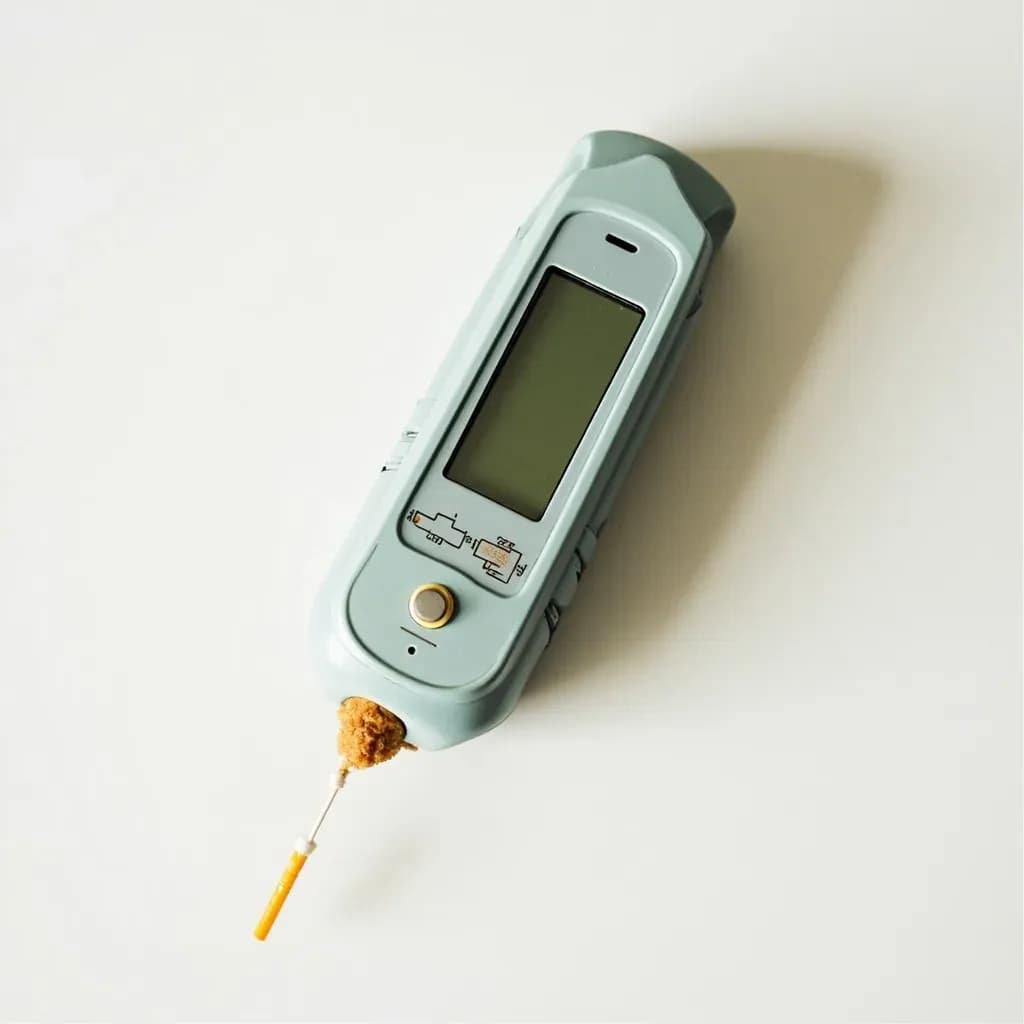
A handheld meter that swabs a surface and reads residual ATP to verify cleaning and food-safety.
An ATP luminometer is a portable device that measures adenosine triphosphate, a molecule present in living cells and food residue, to gauge how clean a surface is. A swab is wiped on a cutting board or equipment, inserted into the meter, and a glow reaction produces a number indicating contamination. Commercial kitchens and food producers use it to verify sanitation after cleaning rather than relying on visual inspection.
An ATP luminometer is a handheld photometric meter paired with single-use swab cartridges that quantifies how much organic residue remains on a food-contact surface. The chemistry is borrowed from fireflies: adenosine triphosphate collected on the swab reacts with the enzyme luciferase and its substrate luciferin to produce light, which the meter reads in Relative Light Units (RLU). The whole assay runs in 5 to 15 seconds, which is why the device has displaced older visual-cleanliness checklists in operations that take sanitation seriously.
A serious kitchen cares about an ATP luminometer because it converts the squishy question "is this really clean?" into a number an owner, chef, or health inspector can act on. Pre-shift swabs of cutting boards, slicers, and prep tables give a documented baseline; re-swabbing after a corrective clean confirms the fix worked. Used routinely, the readings expose creeping lapses — a slicer that trends from 4 RLU to 9 RLU over a month tells you something the eye has stopped noticing.
The most important thing to understand about ATP testing is what it does and does not measure. It detects all ATP — microbial cells, food residue, biofilm, and bodily fluids — which makes it an excellent cleanliness indicator. It is not a pathogen test, and it is not a substitute for microbiological plating or ELISA allergen work. Think of it as a fast, sensitive proxy for whether your cleaning step actually removed the organic load it was supposed to remove.
Alternatives
Types & varieties
Touchscreen luminometer that pairs with Hygiena's full swab line and ships with software for trending and HACCP reporting.
Earlier-generation two-line LCD unit still common in mid-size operations; uses the same swabs as the Touch.
3M's luminometer line, now under Neogen; pairs with Clean-Trace surface and water swabs.
Benchtop-leaning unit popular in food processing; supports both surface and water ATP tests.
Standard food-contact surface test, ~10 RLU pass threshold; the workhorse swab for daily verification.
High-sensitivity swabs for allergen-prone lines and hard-to-clean equipment; pass threshold around 4–5 RLU.
Liquid/water test for CIP rinse water, condensate, and product-release water samples.
Dry-swab system where the reagent sits in the cap, reducing shelf-life concerns in hot kitchens.
Protein/residue swab for allergen-line changeovers; detects residual protein as a proxy for allergen carryover, but is not a substitute for ELISA allergen testing.
ATP vs. Other Verification Methods
ATP luminometry sits between visual inspection and laboratory microbiology, and knowing where it falls in that spectrum matters for how you deploy it.
- Visual inspection catches the obvious — visible food, films, scale — but misses the protein films, biofilms, and microscopic residue responsible for most cross-contamination events.
- ATP catches residue and live microbial ATP within seconds, on the floor, with documented numbers. It is the only verification method that gives same-shift feedback and a number you can trend.
- Microbiological swab plates (aerobic plate counts, coliforms, Listeria, Salmonella) remain the gold standard for confirming pathogen absence or sanitizer efficacy. They require 24–72 hours of incubation and a lab.
- ELISA and lateral-flow allergen tests detect specific proteins (peanut, gluten, milk) at low ppm levels. They are slower and more expensive than ATP and are not interchangeable — a surface can pass ATP and still harbor a specific allergen residue.
- The right program uses ATP for routine shift-to-shift verification, plate counts (or a sanitizing-rinse ATP test) when commissioning new equipment or sanitizer chemistries, and ELISA on allergen-prone lines during changeovers.
Setting Pass Thresholds for Your Operation
Manufacturer thresholds are starting points, not gospel. The 10 RLU pass limit on a Hygiena UltraSnap works well for a smooth stainless prep table in a cold pantry, but the same swab on a well-seasoned flat-top griddle or char broiler will routinely read well above that limit even when the surface is hygienically clean — seasoning, polymerized oil, and micro-pitting all hold ATP. The professional move is a four-to-six-week baseline period: swab every key surface at pre-op after your standard cleaning routine, log the results, and then set your own pass/fail limits at roughly the 90th–95th percentile of those baseline readings. Anything above that band triggers a re-clean; anything at or below is your new "clean." This is also the data set an SQF, BRC, or FSSC 22000 auditor will want to see — they will read your custom limits as evidence that you understand your process, not that you copied a number off a swab box.
Common uses
Tips & pitfalls
- Swab a fixed 10 × 10 cm template every time, in two perpendicular passes, with consistent pressure. Inconsistent technique is the single biggest source of RLU variation in field use.
- Let sanitized surfaces air-dry fully before swabbing; quat ammonia or chlorine residue can react with the reagent and either suppress the signal (false negative) or spike it (false positive) depending on the chemistry.
- Run the positive control swab at the start of every shift, not just once a week. A dead control is your first warning that the device or reagent has failed.
- Store swabs refrigerated, let them warm to room temperature for 10 minutes before use, and never touch the swab tip or the inside of the collection tube — skin ATP alone will set the meter off.
- Don't substitute ATP readings for microbiological swab plates (aerobic plate counts, coliforms, Listeria). ATP tells you cleanliness; it does not tell you whether pathogens are present.
- Avoid swabbing rough, pitted, or heavily scratched surfaces where organic matter is trapped below the contact plane; the swab will read clean while biofilm remains in the texture.
- Document the date, time, surface, RLU reading, and who performed the test. The number without a paper trail does not satisfy an auditor and cannot be trended over time.
- If a reading is unexpectedly high, re-swab the same spot after re-cleaning before writing it up — operator error on the first swab (skipped template, touched tip, wet surface) is far more common than a true sanitation failure.
Good to know
- Measurement principle
- Bioluminescence — ATP from a swabbed surface reacts with the firefly enzyme luciferase and substrate luciferin to produce light, quantified in Relative Light Units (RLU).
- Typical pass threshold
- ≤10 RLU for routine food-contact surfaces (Hygiena UltraSnap); ≤15–30 RLU for other swab types and programs. Allergen-targeted protocols may use 4–5 RLU.
- Read time
- 5–15 seconds per test after the swab is activated.
- Sample area
- Standard 10 × 10 cm (4 × 4 in) template, swabbed in a tight back-and-forth pattern in two perpendicular directions.
- Test kit storage
- Refrigerated at 2–8 °C (35–46 °F); bring swabs to room temperature 10 minutes before use; do not freeze. Shelf life 12–15 months from manufacture.
- Power
- Rechargeable lithium-ion or AA batteries; typical charge lasts 8–12 hours of intermittent testing.
- What it detects
- All ATP — microbial cells, food residue, biofilm, and bodily fluids. It is a cleanliness indicator, not a pathogen test or a specific allergen test.
- Calibration
- Positive control swabs (known ATP) ship with the kit and are run daily to verify device and reagent performance; the device itself is calibrated annually or per the manufacturer's schedule, with the certificate kept on file for auditors.
- Cost range
- Handheld units roughly $1,500–$3,500 USD; per-test swabs about $2–$4 each at list price.
Also called
ATP Surface Swab · Environmental Sampling Swab · hygiene monitor
Related

Peeler
Swift blade for stripping skin off fruit and vegetables

Grater
Sharp-toothed surface for shredding cheese and vegetables

Microplane
Ultra-fine rasp for citrus zest, garlic, and hard cheese

Mixing Bowl
All-purpose bowl for combining, whisking, and tossing

Whisk
Looped wires that beat air into eggs, cream, and sauces

Spatula
Flat blade for flipping, lifting, and scraping

Slotted Spoon
Pierced spoon that lifts solids and drains the liquid behind

Wooden Spoon
Gentle, heat-friendly spoon for stirring anything