Prep Tools
Balloon Whisk
A rounded wire whisk that beats air into eggs and cream and blends batters and sauces smooth.
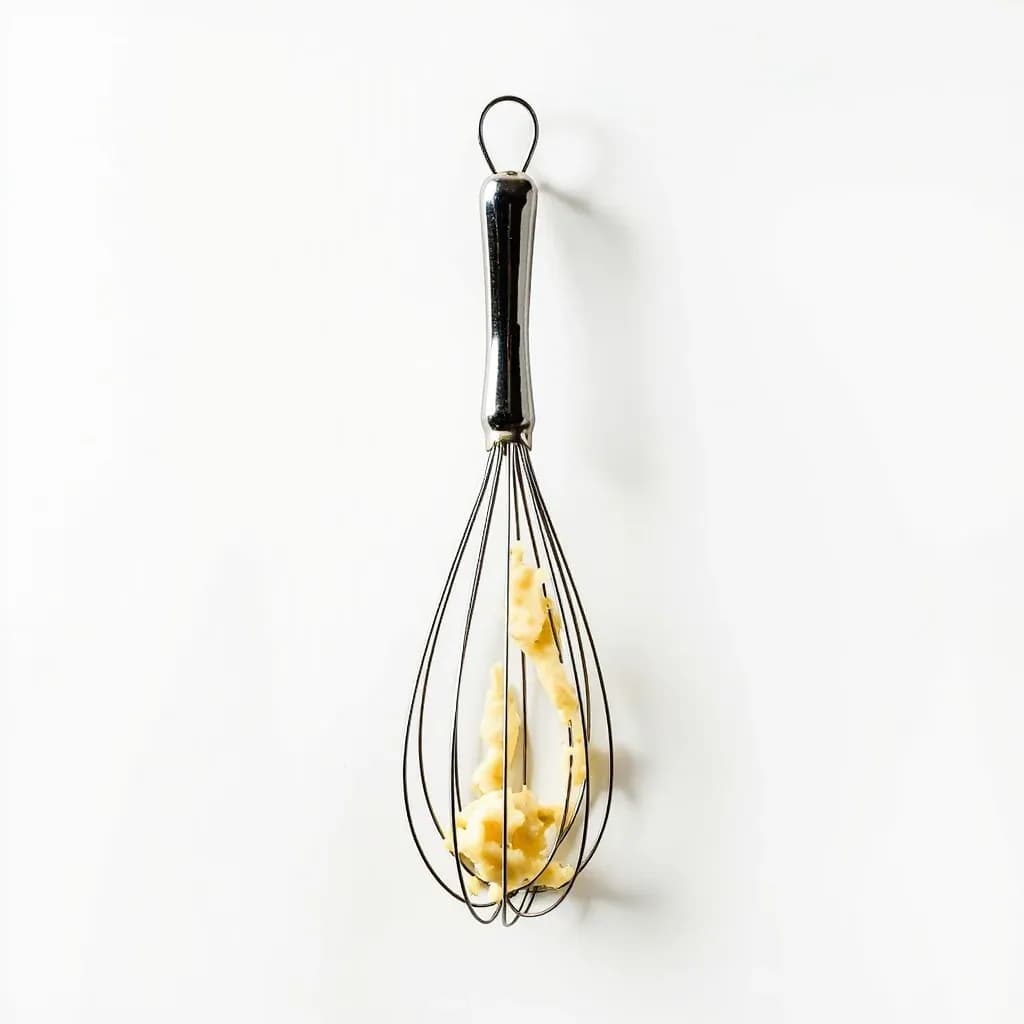
A balloon whisk has many flexible wire loops forming a bulbous head that traps and incorporates air efficiently. Cooks use it to whip egg whites and cream, emulsify dressings and hollandaise, and smooth out lumps in batters and sauces. The wide bulb is built for aeration in a bowl, whereas a narrower whisk works better for stirring in a pan.
The balloon whisk is a teardrop-shaped cage of curved metal wires mounted on a handle, designed so that each stroke drags a generous pocket of air down into whatever it is mixing. That bell silhouette is the whole point: where a flat whisk or a fork only agitates a thin layer of liquid, the rounded crown traps a large volume of air against the wires and folds it into the mixture with every pass. It is, first and foremost, an aeration tool — the implement you reach for when you want a mixture to grow lighter, fluffier, or smoother through the incorporation of air and the gentle disruption of lumps.
In practice it is also a fine emulsifier. The same wires that whip cream will break fat droplets into a vinaigrette or aioli and suspend them evenly through vinegar or egg yolk, producing a stable, glossy emulsion without the brute force of a blender. For thin batters — pancakes, crêpes, waffles, cake — it is the fastest way to a smooth, lump-free consistency because the cage's reach lets it sweep the bottom and sides of a bowl in a way a spoon cannot.
The balloon whisk is not, however, a heavy-duty mixing tool. Its construction is not built to push through bread dough, thick cookie batters, or pastry. For those jobs, reach for a wooden spoon, a sturdy spatula, or a Danish dough whisk. A balloon whisk earns its place in the drawer by being the best at what it does: putting air into things.
Alternatives
Types & varieties
The standard teardrop cage of stainless wires on a straight handle — the versatile everyday workhorse.
Carries more, thinner wires (often 10–18) for whipping maximum air into egg whites and cream; delicate and easier to bend.
Wires wrapped in food-grade silicone; safe for nonstick, ceramic, and enameled cookware, and tolerates higher heat.
Short 6–8 in version for small bowls, vinaigrettes, single eggs, and cocktail foams.
Contoured handle, sometimes internally weighted, that reduces wrist fatigue during extended whipping.
Counterbalanced head that pivots to stay in contact with the bowl walls — an ergonomic novelty rather than a traditional shape.
Handle and wires formed from a single piece of metal; hygienic, dishwasher-safe, with no crevices for food to lodge.
The mechanics of whisking
Understanding what a whisk actually does makes you a better whisker. The wires are not paddles — they are thin blades that slice through the liquid and drag air down with them. The more surface area of wire you can pass through the mixture per second, the more air gets in. That is why a brisk zig-zag motion at the surface beats a lazy circular stir: a circle only agitates a narrow ring, while a side-to-side stroke sweeps the whole bowl. A few practical corollaries follow:
- A balloon cage holds a large air pocket against the wires, so each stroke traps more air than a flat whisk or fork could.
- Tilting the bowl toward you lets gravity feed the mixture back into the whisk's path instead of letting it settle at the far side.
- Skimming the surface, rather than grinding into the bottom, preserves the foam you just built — pressing down breaks the bubbles you are trying to create.
- More wires mean more slicing action and finer bubbles, which is why a piano whisk produces stiffer, glossier peaks than a 6-wire model.
Choosing a balloon whisk
Three things separate a good balloon whisk from a flimsy one: wire thickness, wire count, and the integrity of the joint where the wires meet the handle. Heavier wires hold their shape under pressure and resist bending; finer wires whip more air but kink if abused. A sealed or one-piece construction — handle and head formed from a single piece of metal — is more sanitary and durable than wires crimped into a hollow tube, which can trap food and eventually work loose.
- Pick a 10–12 in all-purpose model for everyday prep; keep a 14 in+ whisk for tall pitchers, Dutch ovens, and stockpots.
- Match the wire count to the job: 6–8 sturdy wires for batters and sauces, 10+ thin wires for egg whites and cream.
- Choose silicone-coated wires whenever you work in nonstick, ceramic, or enameled pans.
- Keep a small 6–8 in whisk on hand for dressings, single eggs, and shaking cocktails.
Common uses
Tips & pitfalls
- Use a brisk back-and-forth (zig-zag) motion at the surface of the mixture to capture air; circular stirring blends but does not aerate.
- Chill the bowl and whisk in the freezer for 10–15 minutes before whipping egg whites or cream — a cold whisk whips faster and to greater volume.
- Do not press the whisk into the bottom of the bowl; let the wires skim the surface so you do not break the foam you just built.
- Tap excess foam off the side of the bowl rather than wiping the whisk — wiping deflates what you just worked to create.
- Wash with hot, soapy water and a brush that passes through the wires; even a trace of fat or egg yolk residue will prevent the next batch of whites from whipping to peaks.
- Dry the whisk head-up or upside down so water does not pool at the wire-handle joint and cause rust or mildew.
- Use a silicone-coated whisk whenever working in nonstick, ceramic, or enameled cookware to avoid scratching the surface.
- Reserve a dedicated whisk for eggs and cream and a separate one for sauces; trace fats from oil-based dressings will deflate whipped whites on the next use.
- If a wire bends out of shape, gently reshape it with pliers — a deformed cage will not whip evenly.
Good to know
- Also called
- French whisk
- Origin
- Wire whisks became standard in 19th-century European kitchens; the rounded balloon form is rooted in the French fouet tradition
- Head shape
- Bulbous, teardrop-shaped cage of curved wires that tapers to a point at the tip
- Wire material
- Stainless steel (most common); also nickel-plated or coated with food-grade silicone for nonstick cookware
- Wire count
- Typically 6–12 wires; piano or fine whisks carry 10–18 thinner wires for maximum air incorporation
- Handle material
- Stainless steel, wood, plastic, or heat-resistant silicone
- Total length
- About 8 in (20 cm) for prep work, 10–12 in (25–30 cm) all-purpose, 14 in+ (35 cm+) for deep pots
- Cleaning
- Stainless models are dishwasher-safe; hand-wash wooden handles; dry head-up to prevent rust at the wire joint
- Not ideal for
- Heavy bread doughs, very hot pans (unless silicone-coated), or reaching into corners of square dishes
Also called
Schneebesen · Wire Whisk · Whisk
Related

Peeler
Swift blade for stripping skin off fruit and vegetables

Grater
Sharp-toothed surface for shredding cheese and vegetables

Microplane
Ultra-fine rasp for citrus zest, garlic, and hard cheese

Mixing Bowl
All-purpose bowl for combining, whisking, and tossing

Whisk
Looped wires that beat air into eggs, cream, and sauces

Spatula
Flat blade for flipping, lifting, and scraping

Slotted Spoon
Pierced spoon that lifts solids and drains the liquid behind

Wooden Spoon
Gentle, heat-friendly spoon for stirring anything