Prep Tools
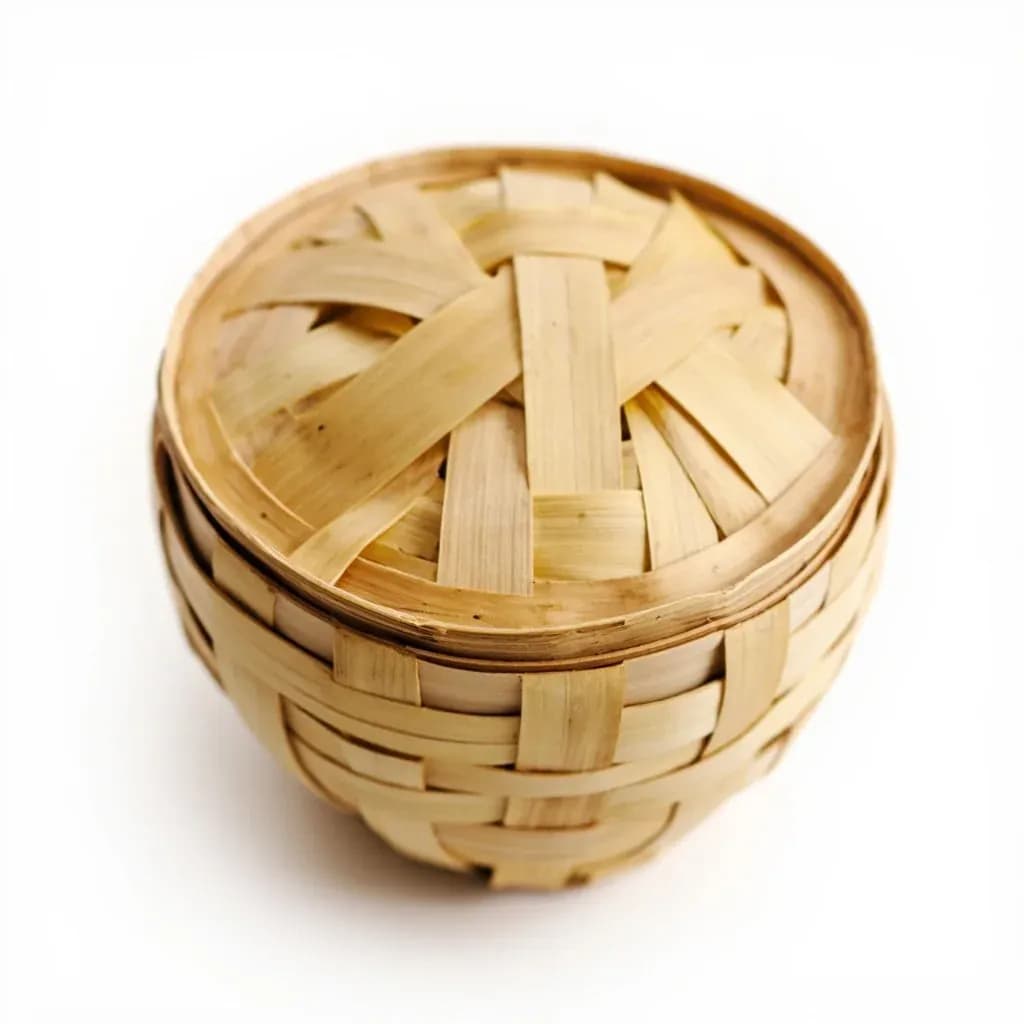
Bamboo Rice Basket
A woven bamboo basket used to steam and serve sticky rice.
A bamboo rice basket is a tightly woven container used across Laos and Thailand to steam, hold, and serve glutinous sticky rice. A conical version sits over a pot of boiling water to steam soaked rice, while the lidded round version (tip khao) keeps cooked sticky rice warm and at the right moisture at the table. The breathable bamboo lets excess steam escape so the rice stays sticky but not soggy.
A bamboo rice basket is a woven, lidded steamer made from split-bamboo strips bound with rattan or raphia, designed to sit over boiling water in a wok or pot. It has been a workhorse of Chinese cookware for more than two thousand years — Han-dynasty bamboo steamers have been recovered from archaeological sites, and the basic construction has remained standard Chinese kitchenware ever since — and it is still the preferred steaming vessel across East and Southeast Asia, from Cantonese tea houses to Laotian market stalls. In much of its range, the basket doubles as tableware, so presentation and heat retention are baked into its design rather than bolted on as an afterthought.
The reason bamboo has never been replaced by metal is functional as much as cultural. The woven walls absorb excess condensation from rising steam and re-release it gently, rather than letting droplets fall back onto the food and waterlog it — the classic complaint with a tightly lidded metal steamer. Bamboo also stays cooler to the touch than stainless steel, imparts a faint, clean, almost hay-like aroma, and tolerates the long, high-heat steaming that sticky rice, char siu bao, and whole fish demand. After a few years of use, the basket darkens and seasons, which cooks generally prize rather than discard.
The basket's forms vary by region and task — banquet-sized stacked tiers for dim sum, modest single-tier steamers for weeknight vegetables, and small individual serving bowls for sticky rice that travel from stove to table — but the common thread is that all of them steam, breathe, and serve, and that a little care extends their life for many years.
Alternatives
Types & varieties
The classic round Cantonese model, typically 10–14 in across, sold as 1–3 stacked tiers; the workhorse for siu mai, har gow, char siu bao, and steamed fish.
One level only, often 10 in, sized for home use to steam rice, vegetables, or reheat bao without firing up a full stack.
A small 4–6 in open-topped bowl from Laos, northern Thailand, and Isan; used to portion, drain, and serve khao niao (glutinous rice) at the table.
A shallow woven tray without a lid, used for rinsing, draining, and cooling rice rather than steaming.
A lidded cone- or bucket-shaped basket from southwestern China, used for steamed rice and rice-pudding cakes.
A tightly woven small bowl, often lidded, used to press and serve xôi and similar sticky-rice preparations.
Why bamboo beats metal
Stainless-steel steamers heat quickly and are nearly indestructible, but they have one persistent flaw: condensation pools on the inside of the lid and rains back down onto the food, leaving steamed buns damp on top and rice gummy underneath. A bamboo basket solves this almost by accident — the woven walls and lid are hygroscopic, soaking up stray moisture and re-releasing it as gentle steam. The result is drier, fluffier rice and pastry with a proper skin. The trade-off is maintenance: bamboo must be hand-washed, never soaked, and dried in open air, or it will swell, crack, and eventually mold. Treat it like a wooden spoon and it will outlast several metal alternatives.
- Absorbs and re-releases condensation instead of dripping it back
- Imparts a faint, clean aroma that complements sticky rice and dim sum
- Stays cooler to the touch than metal, so the lid is easier to lift mid-steam
- Darkens and seasons with use — older baskets are usually the prized ones
Choosing the right basket
Match the basket to the job. A 10–12 in stackable tier is the most versatile home purchase and handles most dim sum, whole fish, and vegetable dishes. A single-tier basket is enough if you only steam rice or reheat buns. For sticky rice served in the traditional manner, the small 4–6 in individual baskets are the right scale and double as the serving dish. Flat woven trays (zaru) are not steamers at all — they are for rinsing, draining, and cooling grains.
- Buy two 10 in tiers rather than one 12 in tier if you cook for two; stacking lets you rotate and cook more at once
- Add a third tier only when you regularly cook for a crowd
- Keep at least one small (4–6 in) basket on hand for sticky rice and individual fish portions
- Reserve the darkest, most-seasoned basket for strongly flavored dishes like char siu bao or lo mai gai
Common uses
Tips & pitfalls
- Line the basket with napa cabbage leaves, banana leaves, parchment rounds, or cheesecloth to prevent sticking and add a subtle aroma — essential for sticky rice and delicate dumplings.
- Crack the lid for the first minute of steaming to vent cold air; otherwise condensation can pool and drip back onto the food, leaving it soggy.
- Never let the basket sit in boiling water and never put it in the dishwasher — the bamboo will swell, warp, crack, and eventually mold.
- Wash with hot water and a soft brush only; skip detergent when you can. A brief scrub with baking soda removes lingering odors without stripping the bamboo.
- Dry the basket upright in open air after every use, ideally in sunlight, to prevent the musty smell that signals mildew starting.
- Don't overfill — steam needs to circulate around the food, so fill each tier no more than two-thirds full and swap tier order halfway through cooking if stacking.
- If the binding rattan loosens, rewrap with kitchen twine or food-safe wire; the woven body is almost always still sound.
Good to know
- Also known as
- Bamboo steamer; zhēng lóng (蒸笼) in Chinese; seiro (蒸篭) in Japanese; tip khao in Lao and northern Thai sticky-rice contexts
- Material
- Woven split-bamboo strips with a matching woven lid, bound with rattan, raphia, or thin wire
- Origin
- China; archaeological examples date to the Han dynasty (~206 BCE–220 CE) and the form has remained largely unchanged
- Common diameters
- 10 in (25 cm) and 12 in (30 cm) for dim sum; 4–6 in (10–15 cm) for individual sticky-rice baskets; up to 14 in (36 cm) or more for banquet service
- Tiers
- Sold as 1, 2, or 3 stackable tiers; lids rest loosely on top to vent steam
- Heat source
- Steaming only — suspended over boiling water in a wok or stockpot; never in contact with water and never on direct flame
- Cleaning
- Hand wash with hot water and a soft brush; never dishwasher, never soak; towel-dry then air-dry fully upright
- Lifespan
- Several years of regular use with reasonable care; the bamboo darkens and seasons with age, which is normal and desirable
Also called
Sticky-Rice Serving Basket (Tip Khao) · Woven Sticky-Rice Serving Basket · Tip Khao · Sticky Rice Basket
Related

Peeler
Swift blade for stripping skin off fruit and vegetables

Grater
Sharp-toothed surface for shredding cheese and vegetables

Microplane
Ultra-fine rasp for citrus zest, garlic, and hard cheese

Mixing Bowl
All-purpose bowl for combining, whisking, and tossing

Whisk
Looped wires that beat air into eggs, cream, and sauces

Spatula
Flat blade for flipping, lifting, and scraping

Slotted Spoon
Pierced spoon that lifts solids and drains the liquid behind

Wooden Spoon
Gentle, heat-friendly spoon for stirring anything