Prep Tools
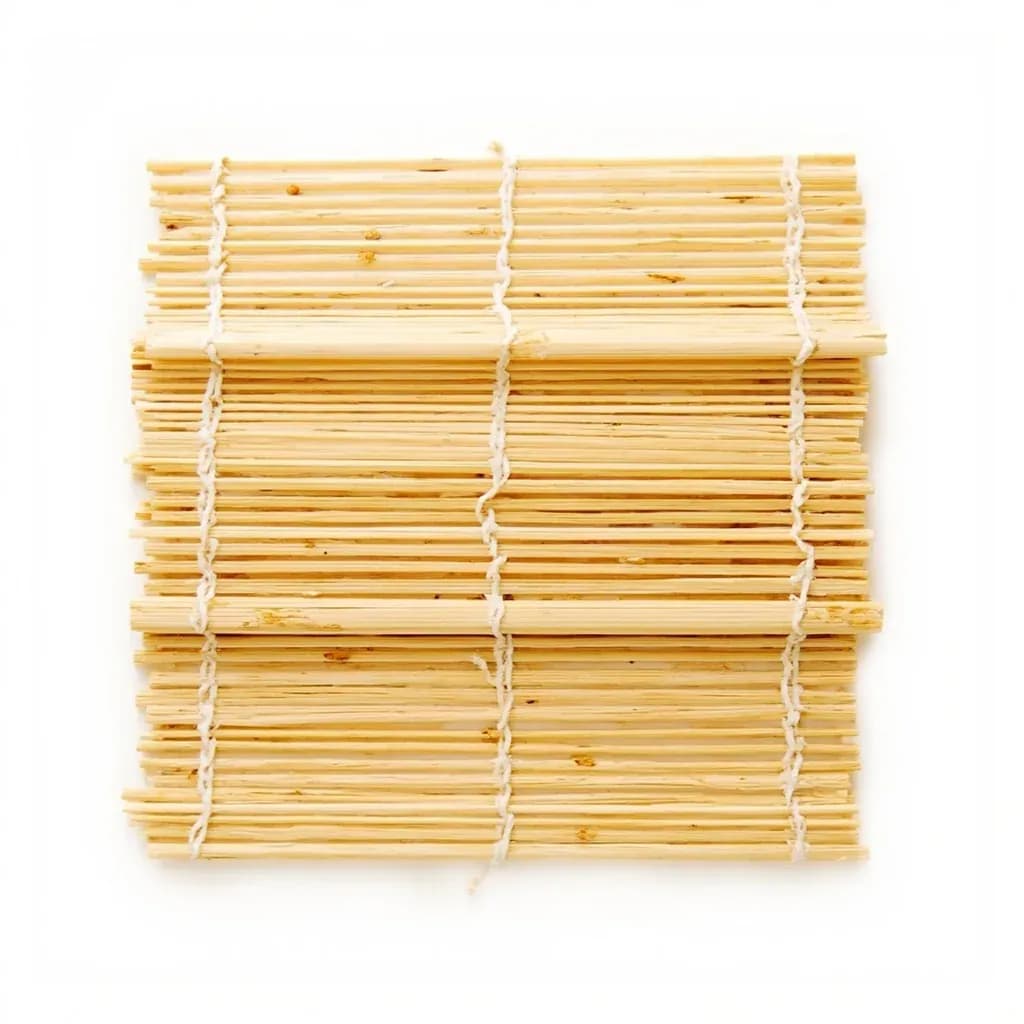
Bamboo Rolling Mat (Makisu)
A flexible mat of thin bamboo slats for rolling sushi and shaping foods into tight cylinders.
A makisu is a mat woven from thin bamboo sticks tied with cotton string, used most famously to roll maki sushi. The cook lays nori, rice, and fillings on the mat, then rolls and presses to form an even, firm cylinder. It also shapes rolled omelets and helps squeeze excess liquid from blanched greens.
The makisu is a flat, bound mat of thin bamboo slats laced together with cotton or nylon cord, designed to be folded around food and squeezed into a tight, even cylinder. Each slat is roughly 1–2 mm thick — enough to give the mat real compressive force, but thin enough that the finished roll takes on a smooth, rounded shape rather than a faceted one. The Japanese name 巻き簾 literally means "rolling curtain," a reference to the way the slats lift and fold like a flexible screen under the cook's hands. In practice it is one of the simplest tools in a Japanese kitchen: nothing moves, nothing spins, yet with a small amount of pressure and a practiced lift-and-tuck motion it produces a uniform sushi roll in under a minute.
The mat converts the cook's downward and forward pressure into radial compression. When the leading edge of the mat is folded over the filling and tucked beneath the roll, every subsequent squeeze pushes the filling inward from all sides at once, which is why a bamboo-rolled maki is denser and more even than a hand-rolled one. The slats grip the nori just enough to keep it from sliding, but are smooth enough that the mat releases cleanly when the roll is complete. That balance of friction and release is what makes bamboo hard to substitute: a cloth is too grippy, a silicone mat too slick, and a sheet of parchment too floppy to press a tight cylinder.
Although it is built around sushi, the makisu is a general-purpose shaping tool. It presses moisture from grated vegetables, forms even terrines inside a sheet of nori, sets onigirazu, and will even portion a sponge roll for a Swiss-style cake. In a home kitchen it earns its drawer space the moment a cook realizes how many otherwise floppy fillings can be coaxed into a neat, sliceable log with nothing more than a folded mat and a steady hand.
Alternatives
Types & varieties
Flat 24 × 24 cm mat with parallel slats; the everyday workhorse for hosomaki, uramaki, and standard maki rolls.
Larger format, often 27 × 27 cm, sized for thick multi-filling rolls.
Smaller mat, around 21 × 21 cm, suited to thin single-filling rolls and quick hand-rolls.
Bamboo slats laminated with food-safe plastic; wipes clean, resists mold, and suits kitchens that roll often.
Same bamboo slats but bound with nylon instead of cotton; more durable and quicker to dry than the traditional cotton version.
Two parallel wooden bars with connecting cross-strings; forms long, very even cylinders and is a traditional Japanese tool used for decorative sushi rolls.
Plasticized bamboo with nylon string (e.g., Benriner-brand) that tolerates machine washing on a top rack.
Choosing a mat
For most home cooks, a 24 × 24 cm mat with nylon string is the right first purchase. It handles every common roll size, dries fast, and forgives the occasional missed rinse. Cotton-string mats are traditional and feel slightly softer in the hand, but they absorb water, hold onto rice starch, and are the version most prone to mildew; they reward a careful owner. Plastic-lined mats sit in the middle: the bamboo still gives the roll its shape, but the wipe-clean surface means rice and fillings cannot work their way into the slats.
- Pick 24 × 24 cm unless you regularly make futomaki or single-filling hosomaki.
- Choose nylon string over cotton for low-maintenance daily use.
- Choose a plastic-lined mat if you roll more than once a week.
Care and longevity
A makisu is a consumable tool: even with good care the binding loosens and the slats darken over time. The goal is to slow that process down. A 30-second rinse under running water is plenty — there is no benefit to soaking, and standing water is the fastest route to moldy, swollen slats. Towel off, then prop the mat open on a rack or over a chopstick so air reaches both faces. Replace the mat when slats crack, the binding frays, or the mat stops lying flat; a warped mat will not roll a tight cylinder no matter how careful the cook is.
- Rinse, do not soak — bamboo absorbs water and swells.
- Towel-dry before air-drying to cut drying time in half.
- Store fully open or hung, never rolled up while damp.
Common uses
Tips & pitfalls
- Wrap the mat in plastic wrap or slip it inside a large zip-top bag before each rolling session — rice starch glues itself to bare bamboo and dramatically shortens the mat's life.
- Wet your fingertips, not the nori, when spreading sushi rice so the grains cling to the seaweed instead of to your hands.
- Pull the near edge of the mat over the filling and tuck it under before pressing; rolling the filling inside the mat (rather than pushing it forward) keeps the cylinder tight without crushing the rice.
- Keep a bowl of water and a clean cloth nearby and wipe the blade between cuts — a damp, sharp knife is the difference between clean coins and ragged, dragged edges.
- Press the finished roll once or twice in the mat before unrolling to set the shape (Japanese cooks call this shikkari — "firmly" or "with structure").
- Never soak a makisu in standing water; a quick rinse and immediate towel-dry prevents the slats from swelling, splitting, and harboring mold.
- If the nori cracks mid-roll, mist it lightly with water from a spray bottle and wait 30 seconds — it will flex again without tearing.
Good to know
- Japanese name
- Makisu (巻き簾), literally "rolling curtain"
- Origin
- Japan
- Material
- Thin moso bamboo slats (Phyllostachys edulis) bound with cotton or nylon thread
- Slat thickness
- Approximately 1–2 mm
- Standard size
- 24 × 24 cm (9.5 × 9.5 in); also commonly sold in 21 × 21 cm and 27 × 27 cm
- Thread
- Cotton on traditional mats; nylon on modern easy-care versions
- Typical lifespan
- 6–24 months with regular home use; longer if towel-dried and stored open
- Care
- Rinse briefly, towel-dry, then air-dry fully open — never store damp
Also called
makisu · sushi rolling mat · bamboo mat
Related

Peeler
Swift blade for stripping skin off fruit and vegetables

Grater
Sharp-toothed surface for shredding cheese and vegetables

Microplane
Ultra-fine rasp for citrus zest, garlic, and hard cheese

Mixing Bowl
All-purpose bowl for combining, whisking, and tossing

Whisk
Looped wires that beat air into eggs, cream, and sauces

Spatula
Flat blade for flipping, lifting, and scraping

Slotted Spoon
Pierced spoon that lifts solids and drains the liquid behind

Wooden Spoon
Gentle, heat-friendly spoon for stirring anything