Prep Tools
Banku Turning Stick
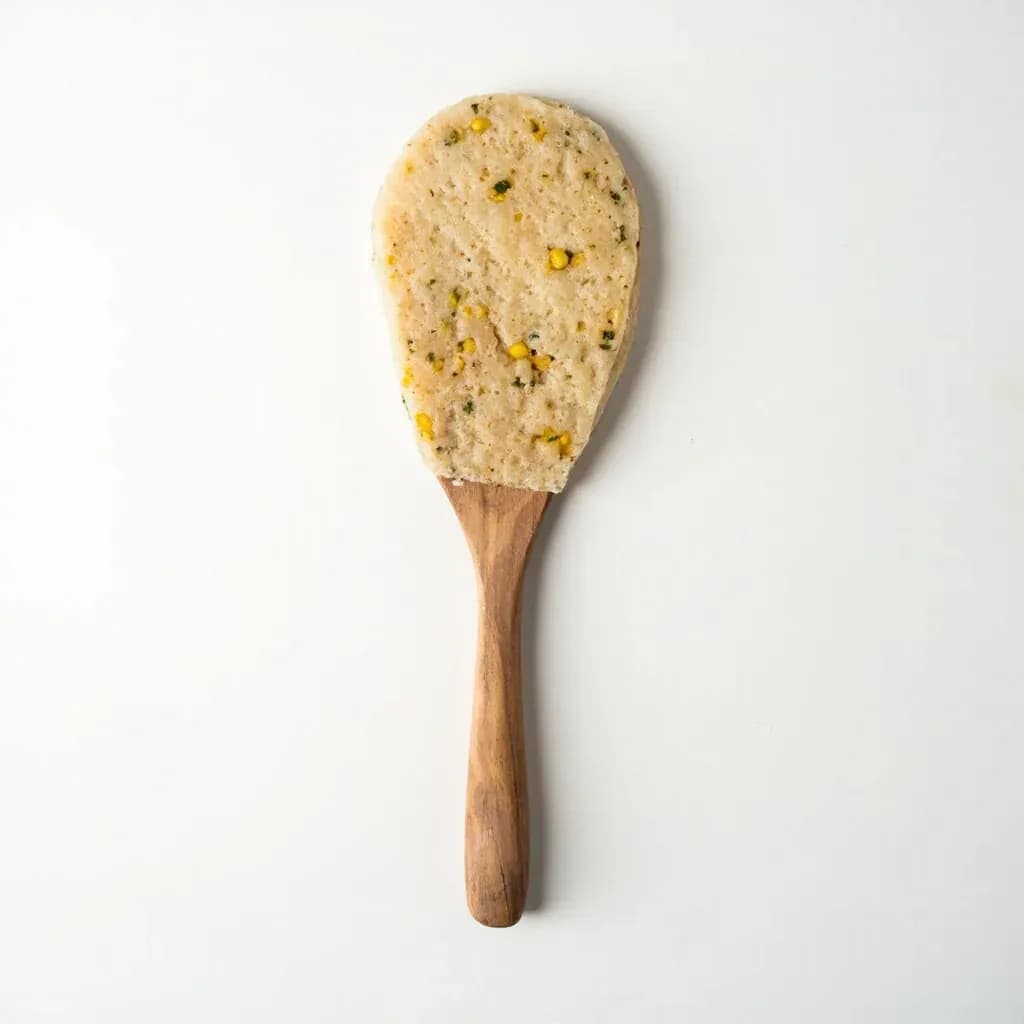
A flat wooden paddle used to stir and turn stiff fermented corn-and-cassava dough into banku.
A banku turning stick is a sturdy flat wooden paddle used in Ghanaian kitchens to work fermented corn and cassava dough over heat until it becomes the smooth, stretchy mass called banku. The cook continually folds and presses the thick dough against the pot, which takes real strength and a broad, strong stick. The same tool is used for related dishes like kenkey and tuo zaafi.
The banku turning stick (also called a banku paddle or Ga banku stick) is a long, flat-ended hardwood paddle used to stir, fold, and pound fermented corn-and-cassava dough as it cooks down into banku. Its length — typically 30–45 cm — and broad, thinned paddle end let the cook reach the bottom of a deep, heavy pot and drive the dough against the metal with real force, the motion that gives banku its smooth, elastic, gelatinized texture. The stick is essentially a one-job tool, but the job is one of the most physically demanding in West African home cooking, which is why no ordinary spoon will do.
Alternatives
Types & varieties
Hand-carved from a single piece of local hardwood with a broad, flat paddle — the classic, most common form.
Flat paddle on one end and a slightly rounded or blunt edge on the other, useful for breaking up early lumps before the dough sets.
Thicker, blunt-end style used more for pounding and compressing the dough than for fine stirring.
Food-safe plastic versions sold in Ghanaian markets; mimic the flat paddle shape, are easier to clean, and won't split, though purists prefer seasoned wood.
Anatomy of a banku stick
A good banku stick is shaped to do three things at once: reach the bottom of a deep pot, scrape it clean, and apply downward pressure without bending. The handle is slim enough to grip with a full fist, the neck is short and stout, and the paddle end is broad and flat, with edges that are deliberately thinned to a wedge so they bite into scorched starch on the pot base. Weight matters as much as shape — a heavy stick does the pounding for you, while a light one forces the cook to muscle the dough and tire quickly.
- Handle: round or oval in cross-section, comfortable for a full-hand grip under load.
- Neck: thick, short, and continuous with the paddle; this is the joint most likely to snap on a poorly chosen piece of wood.
- Paddle: broad, flat, and slightly thinner at the edges than at the center, so the edges scrape while the body presses.
- Overall balance: a skilled cook learns where their stick balances on the wrist and chooses one that feels like an extension of the forearm.
Why wood, and which wood
Banku dough is hot, wet, and extremely stiff by the time it is finished — gelatinized starch that puts up real resistance under the paddle — and it gets worked continuously for roughly 20 to 30 minutes. Softwoods (pine, obeche, common construction timber) absorb water, swell, and split along the grain within a few uses. The traditional choices — odum (iroko), sese, tweneboa — are dense tropical hardwoods with tight grain that resist splitting and don't impart flavor to the food. A well-used banku stick darkens and becomes almost polished from years of starch and oil, and many cooks say an old, seasoned stick is the best kind to cook with because the surface is no longer thirsty for moisture.
- Good woods: odum/iroko, sese, tweneboa, and other dense, tight-grained tropical hardwoods.
- Avoid: softwoods, plywood, and any wood with visible glue lines or knots in the paddle area.
- Plastic/composite paddles are a legitimate modern alternative; they won't crack and clean up faster, but they lack the heft that seasoned cooks prefer.
Seasoning and day-to-day care
Care is simple and worth doing, because a banku stick is bought or carved to last decades. The rules are: no soap, no long soaks, dry fast, and feed the wood occasionally with oil. Soap leaves a taste in the porous grain; soaking causes the dense wood to swell unevenly and split along the handle. A quick rinse under running water, an immediate wipe-down, and upright air-drying is enough. A light rub of refined coconut or palm oil once in a while keeps the wood from drying out and sheds the fine dust that otherwise collects in the grain.
- Wash with water only, never dish soap.
- Dry immediately and stand upright so water runs out of the handle end.
- Oil sparingly with food-safe oil (refined coconut or palm) when the wood looks dry or pale.
- Store in open air, not sealed in a drawer where residual moisture can cause mildew.
Common uses
Tips & pitfalls
- Choose a dense hardwood — softwood paddles will split under the force needed for stiff banku dough.
- Oil the paddle occasionally with a light food-safe oil (refined coconut or palm) to keep the wood from drying and splintering.
- Never soak the stick in water for long periods; wash quickly, dry upright, and store in open air — long soaks are the single most common cause of cracks.
- Wet or lightly oil the paddle before each cooking session to keep the sticky dough from clinging and tearing the wood's surface.
- Keep a dedicated stick for banku; the residual starch seasoning is desirable but can transfer flavor to lighter dishes if you share paddles.
- Replace the stick once the paddle edge becomes too rounded or splintered — a worn edge can't scrape the pot base effectively and is the likeliest source of splinters in the food.
- Stir with a folding, pressing motion rather than a whisking motion; the pressing action drives heat out of the bottom of the pot and builds banku's elastic texture.
Good to know
- Origin
- Ghana, associated with the Ga people of the Greater Accra region; also used across southeastern Ghana and into Togo
- Also known as
- Banku paddle, banku stick, ga banku turning stick
- Material
- Dense tropical hardwood — commonly odum/iroko, sese, or tweneboa; occasionally a shaped hardwood offcut
- Dimensions
- Roughly 30–45 cm (12–18 in) long, with a flat paddle end about 5–8 cm wide
- Shape
- Long handle terminating in a flattened, paddle- or spatula-like working end with thinned scraping edges
- Companion cookware
- A thick-walled aluminum pot on a charcoal or gas stove
- Primary function
- Vigorous stirring, folding, and pounding of stiff fermented corn-and-cassava dough on direct heat
- Care
- Hand-washed in water only (no soap), dried immediately, and occasionally rubbed with food-safe oil to prevent cracking
Also called
Banku Paddle · Wooden Turning Stick
Related

Peeler
Swift blade for stripping skin off fruit and vegetables

Grater
Sharp-toothed surface for shredding cheese and vegetables

Microplane
Ultra-fine rasp for citrus zest, garlic, and hard cheese

Mixing Bowl
All-purpose bowl for combining, whisking, and tossing

Whisk
Looped wires that beat air into eggs, cream, and sauces

Spatula
Flat blade for flipping, lifting, and scraping

Slotted Spoon
Pierced spoon that lifts solids and drains the liquid behind

Wooden Spoon
Gentle, heat-friendly spoon for stirring anything