Prep Tools
Basket Press (Rack-and-Cloth)
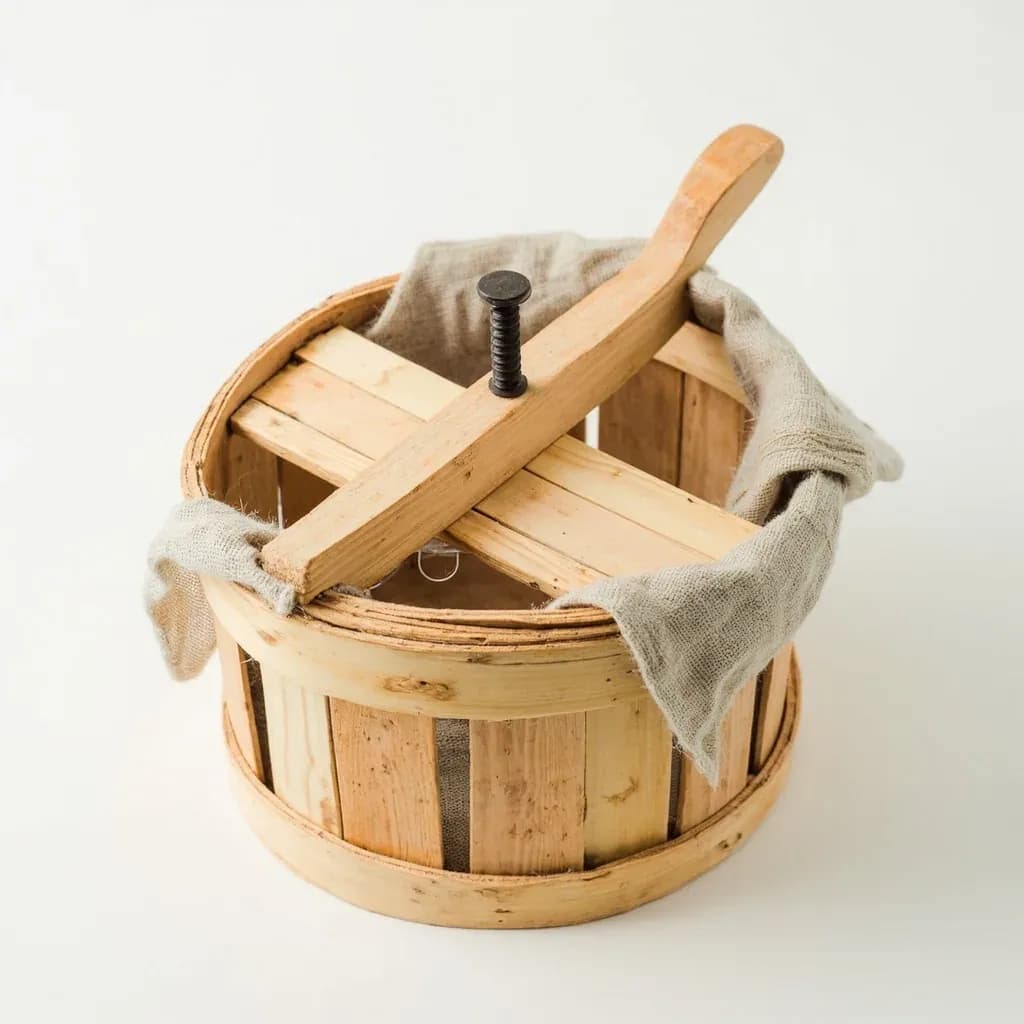
A slatted basket that presses pulp under a screw or hydraulic ram to extract juice, oil, or whey.
A basket press is a cylindrical slatted basket holding pulp, cloth-wrapped pomace, or curd that is compressed by a top plate driven by a screw or hydraulic ram. Juice or liquid runs out between the slats while solids stay inside. Used for pressing apples into cider, grapes into wine, fruit into oil, or cheese curds, it gives strong even pressure for high extraction.
A basket press is a slatted vessel—wooden staves bound by metal hoops into a cylinder, or a stainless steel cage—that holds a bed of milled fruit, cheese curd, or seed paste wrapped in heavy cloth, while a follower plate above applies gradual mechanical pressure. The liquid is forced out through the gaps between the slats; the cloth holds the solid back. The pressure source defines the family: a hand-turned threaded screw on traditional farm and hobby models, a hydraulic or pneumatic ram on modern prosumer and commercial units, or an inflatable rubber bladder on gentler wine presses. There is no spinning and no high-shear action—just steady, building force.
The basket press matters because it is a low-shear extractor. Because the solid stays whole inside its cloth envelope, the liquid that emerges is comparatively clear, and the source material is not subjected to the rapid separation a centrifuge applies. That is why it remains standard in cidermaking (Normandy, the West Country, the Hudson Valley), in small-lot winemaking, and in traditional olive-oil mills. It is also slow: a good pressing runs through several pressure ramps with rest periods in between, not one hard squeeze, and the technique of loading, folding, and racking the cloth is what separates a clean, high-yield pressing from a blow-out.
For a home cook, the basket press most often shows up as a tabletop hobby cider press, but the same principle—cloth-wrapped layers, even pressure, slow ramp—governs cheese pressing, tofu draining, and small-batch oil work. The craft is in the cloth, not the frame.
Alternatives
Types & varieties
Hand-operated threaded screw drives the follower plate; classic farm and home design, slow but precise.
Ram applies even, high pressure with little effort; common in prosumer and commercial cider and olive-oil work.
Multiple cloth-wrapped layers are pressed at once between slatted racks; high-volume use in wineries and cideries.
Inflatable rubber bladder inside the basket replaces a rigid follower; gentler, favored for delicate whites and fruit wines.
Compact 5–12 L stainless or wood units aimed at home cidermakers and small orchards.
Cloth technique: where the craft lives
The frame is forgiving; the cloth is not. A well-run pressing depends almost entirely on how the pomace is wrapped and stacked.
- Mill or chop the fruit finely first—whole pieces give poor yield and are the most common cause of burst seams.
- Pre-shape each layer into a 'cheese' by folding the corners of the cloth over the top so that, if it does fail, the pulp goes outward against the slats rather than through them.
- Build the stack in even, shallow tiers of roughly 5–8 cm rather than one deep mound; pressure distributes more evenly and liquid finds its way out faster.
- Rotate cloth seams so they do not all line up in the same direction on successive tiers—aligned seams are the single biggest cause of blow-outs.
- Retire cloths that have stained, thinned, or torn; a weak spot will always fail at the worst moment.
Pressure ramping
The other half of a good pressing is how the force is applied. Hard, fast squeezing is what shreds cloths and cracks wooden slats.
- Start light, hold, then increase—never jump straight to full force.
- Build in short rests ('breaks') between ramps; juice keeps flowing as internal channels re-open inside the cake.
- Keep a steady log on first presses: time, pressure setting, and volume recovered. Two or three pressings is enough to dial in the rhythm for a given fruit.
- For cider destined to ferment, press before the juice sits on the pulp for more than 12–24 hours to limit tannin extraction and oxidation.
Caring for a wooden basket
A traditional oak, beech, or maple basket will outlast the owner if it is kept dry and seasoned.
- Never soak a wooden basket—swelling will loosen the staves and warp the hoops.
- Wipe the interior once a season with a thin coat of food-grade mineral oil.
- Store cloths separately, flat or loosely rolled, and fully dry, to prevent mildew and rancid residue.
- Stainless steel models tolerate the dishwasher and are a better choice for oily seeds, where wood can absorb and turn rancid.
Common uses
Tips & pitfalls
- Mill or chop the fruit finely before pressing; whole pieces give poor yield and can burst the cloth.
- Layer cloth-wrapped pulp in even, shallow tiers (5–8 cm deep) rather than one deep mound—pressure distributes more evenly.
- Pre-shape the pulp into a 'cheese' by folding the corners of the cloth over the top so a blow-out sends pulp outward, not through the slats.
- Ramp pressure slowly—start light, hold, then increase—jumping straight to full force blows cloth seams and can crack wooden slats.
- Alternate pressing with short rests; juice keeps flowing as internal channels re-open inside the cake.
- Rotate cloth seams so they do not all line up in the same direction—this is the leading cause of blow-outs.
- Do not press a second dry batch on a re-wet cloth that was not fully cleaned; residual sugars and oils turn rancid fast.
Good to know
- Type
- Slatted-basket press with pressing cloths, driven by screw, hydraulic ram, or bladder
- Primary function
- Extracts liquid (juice, oil, or whey) from solid pulp by gradual mechanical pressure
- Pressure source
- Manual screw (traditional), hydraulic or pneumatic ram (modern prosumer/commercial), or inflatable bladder
- Typical home capacity
- 5–20 L of pomace per load; commercial stack presses handle several hundred liters
- Yield
- Recovers 60–75% of juice from milled apples under good technique—well above a fruit crusher alone or a small countertop juicer
- Historical use
- Standard in European cider, small-lot winemaking, and traditional olive-oil production for centuries
- Cleaning
- Slats and cloths disassemble; cloths are rinsed and fully dried to prevent mildew; wooden baskets must not be soaked
- Storage
- Cloths flat or loosely rolled and dry; wooden baskets wiped with food-grade mineral oil once a season
Also called
Hydraulic Apple Press · Belt Press · rack-and-cloth press · fruit press
Related

Peeler
Swift blade for stripping skin off fruit and vegetables

Grater
Sharp-toothed surface for shredding cheese and vegetables

Microplane
Ultra-fine rasp for citrus zest, garlic, and hard cheese

Mixing Bowl
All-purpose bowl for combining, whisking, and tossing

Whisk
Looped wires that beat air into eggs, cream, and sauces

Spatula
Flat blade for flipping, lifting, and scraping

Slotted Spoon
Pierced spoon that lifts solids and drains the liquid behind

Wooden Spoon
Gentle, heat-friendly spoon for stirring anything