Prep Tools
Basting Dome
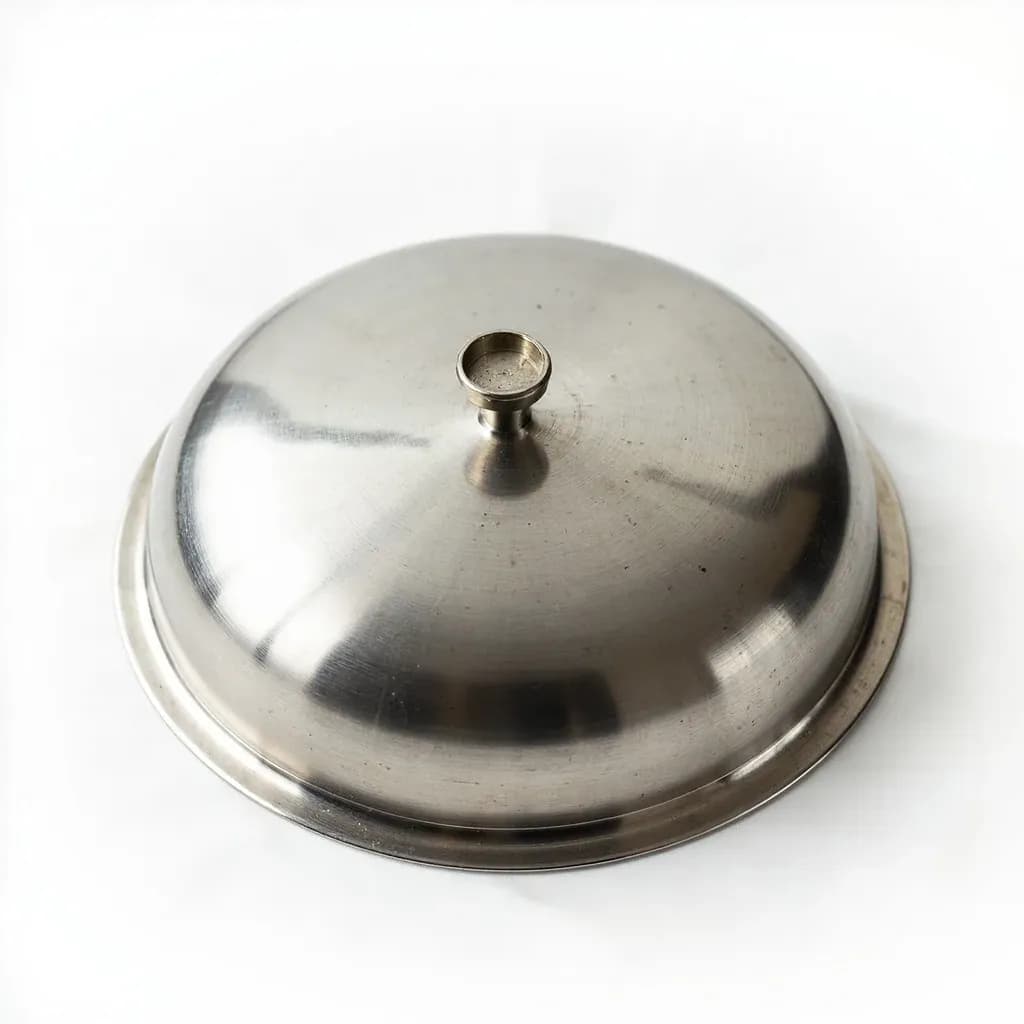
A small metal dome placed over food on a griddle to trap heat and steam, melting cheese fast.
A basting dome is a rounded metal cover set over food cooking on a flat-top or griddle. It traps rising heat and steam to melt cheese, cook smash burgers through, and finish vegetables quickly without flipping. A staple of diner and burger cooking, it speeds the melt while keeping the surface moist.
A basting dome is a shallow, lid-shaped piece of metal — almost always stainless steel — that drops directly onto the cooking surface of a flat-top griddle or wide cast-iron pan to create a small, intense chamber of trapped heat over a single portion of food. Inside that chamber, radiant heat from the griddle below and from the dome's own preheated walls bounces back down onto whatever is being cooked, while moisture from the food (or a few drops of water added on purpose) turns to steam. The combined effect is that a slice of cheese goes from solid to molten in 20–30 seconds, sliced onions soften in a fraction of their usual time, and a bun warms and toasts in the steam it's sitting in.
It is, in essence, a griddle-side tool for finishing food faster and more evenly without flipping, tossing, or moving items off the heat. A spatula can press, scrape, and turn, but it can't build that micro-environment; a saucepan lid is too tall and sits too far above the food to do the same job. The dome fills that gap, which is why it has become standard kit for anyone cooking smash burgers, patty melts, quesadillas, and breakfast sandwiches on a flat-top.
The dedicated stainless version went mainstream alongside the backyard griddle boom of the late 2010s and early 2020s, but improvised domes — foil-wrapped sauté pans, inverted heat-safe bowls, smaller sheet pans flipped over food — have been in short-order kitchens for decades. Buying the real tool is mostly about consistency, safety, and speed: a properly weighted dome sits flush against the griddle, holds heat, and frees your hand for the rest of the cook.
Alternatives
Types & varieties
The classic form; traps the most heat and steam for fast, aggressive melting.
Loop or knob handle for safer lifting; the most common retail design.
Smaller 5–6 in version for single burgers, eggs, or slider buns — useful when a full-size dome would smother too much griddle.
Covers multiple items or longer sandwiches at once, like a row of quesadillas or a full patty melt.
Small holes reduce condensation drip, useful for drier, browner finishes on bread and proteins.
Lighter than stainless; heats quickly but discolors over time and traps slightly less heat.
How a Basting Dome Works
A basting dome is essentially a small oven built directly on the griddle surface. When you set a preheated dome over a portion of food, three things happen at once: the griddle below keeps delivering direct conductive heat; the dome's inner walls, already hot from preheating, radiate heat back down onto the food; and moisture from the food — or a few added drops of water — turns to steam and circulates inside the chamber. That combination raises the effective cooking temperature around the food well above what the griddle is set to, which is why a slice of cheese can go from solid to molten in 20–30 seconds. The shallow profile matters: a saucepan lid is too tall, so most of the heat ends up far above the food and the steam has too much room to cool before it does useful work.
- Preheating the dome on the griddle for 30–60 seconds is what makes it work — a cold dome cools the food instead of finishing it.
- A few drops of water flicked onto the griddle just before covering creates an instant steam burst that accelerates cheese melt and vegetable softening.
- Vented domes trade a little heat retention for less condensation drip, which is the right call when you want a drier, browner finish on bread or seared protein.
Choosing the Right Dome
Most cooks only need one dome, but size and material choices are worth thinking through. An 8–10 in stainless dome is the all-purpose default — large enough to cover a single burger with cheese and a small pile of onions, heavy enough to hold heat, and small enough to maneuver around a busy griddle. Mini 5–6 in domes earn their keep for breakfast sandwiches, single eggs, and slider buns, where a full-size dome would smother too much griddle area and waste heat. Square or rectangular covers are the right call when you need to tent two or three items at once, like a row of quesadillas or a full patty melt.
- Pick stainless for daily use: it holds heat, shrugs off abuse, and is dishwasher safe.
- Add a mini dome (5–6 in) if you cook breakfast sandwiches or single eggs often — it finishes those jobs without steaming the surrounding griddle.
- Choose a vented dome for finishing bread or proteins where condensation would sog things out.
- Make sure the rim sits flat against your griddle — a warped or uneven rim leaks steam and slows the melt.
Common uses
Tips & pitfalls
- Preheat the dome on the griddle for 30–60 seconds before placing it over food; a cold dome stalls the melt and can actually cool what you're trying to finish.
- Flick a few drops of water on the griddle just before covering to create a burst of steam that speeds cheese melting and onion softening.
- Lift the dome straight up and away from your face — trapped steam escapes in a hot plume the moment the seal breaks.
- For burgers, dome only during the last 20–45 seconds of cook time so the bun or cheese melts but the patty doesn't steam itself into gray, sad meat.
- To melt cheese on a patty melt without soggy bread, tent the dome slightly open with a spatula so condensation can escape.
- Don't walk away — a dome can overcook thin items like sliced cheese or a single egg in well under 30 seconds.
- Clean while the dome is still warm with hot water and a scraper; burnt-on cheese wipes off far more easily before it fully carbonizes.
- Avoid using a dome on coated non-stick griddles at very high heat — the trapped heat can exceed safe non-stick temperatures.
- Store the dome dry so nested pieces don't trap moisture and rust-spot each other.
- If the handle is bare metal, slip on a high-heat silicone or wooden grip before lifting; metal handles on a hot dome will burn bare skin quickly.
Good to know
- Type
- Metal dome-shaped lid for griddles and flat-tops
- Common materials
- Stainless steel; occasionally hard-anodized aluminum
- Typical dimensions
- 8–10 in (20–25 cm) base diameter, 2–4 in (5–10 cm) tall
- Compatible surfaces
- Flat-top griddles, cast-iron pans, wide skillets; works best where the rim sits flush
- Heat tolerance
- Standard griddle range, 400–500°F (200–260°C)
- Also called
- Basting cover, griddle dome, cheese melter dome, steam dome
- Care
- Most stainless versions are dishwasher safe; hand-washing and thorough drying extend life
Also called
Basting Dome / Melting Cover · Basting Cover · Melting Dome · Cheese Melting Dome
Related

Peeler
Swift blade for stripping skin off fruit and vegetables

Grater
Sharp-toothed surface for shredding cheese and vegetables

Microplane
Ultra-fine rasp for citrus zest, garlic, and hard cheese

Mixing Bowl
All-purpose bowl for combining, whisking, and tossing

Whisk
Looped wires that beat air into eggs, cream, and sauces

Spatula
Flat blade for flipping, lifting, and scraping

Slotted Spoon
Pierced spoon that lifts solids and drains the liquid behind

Wooden Spoon
Gentle, heat-friendly spoon for stirring anything