Prep Tools
Bazin Stirring Stick
A strong wooden stick used to beat barley-flour dough into the stiff Libyan dish bazin.
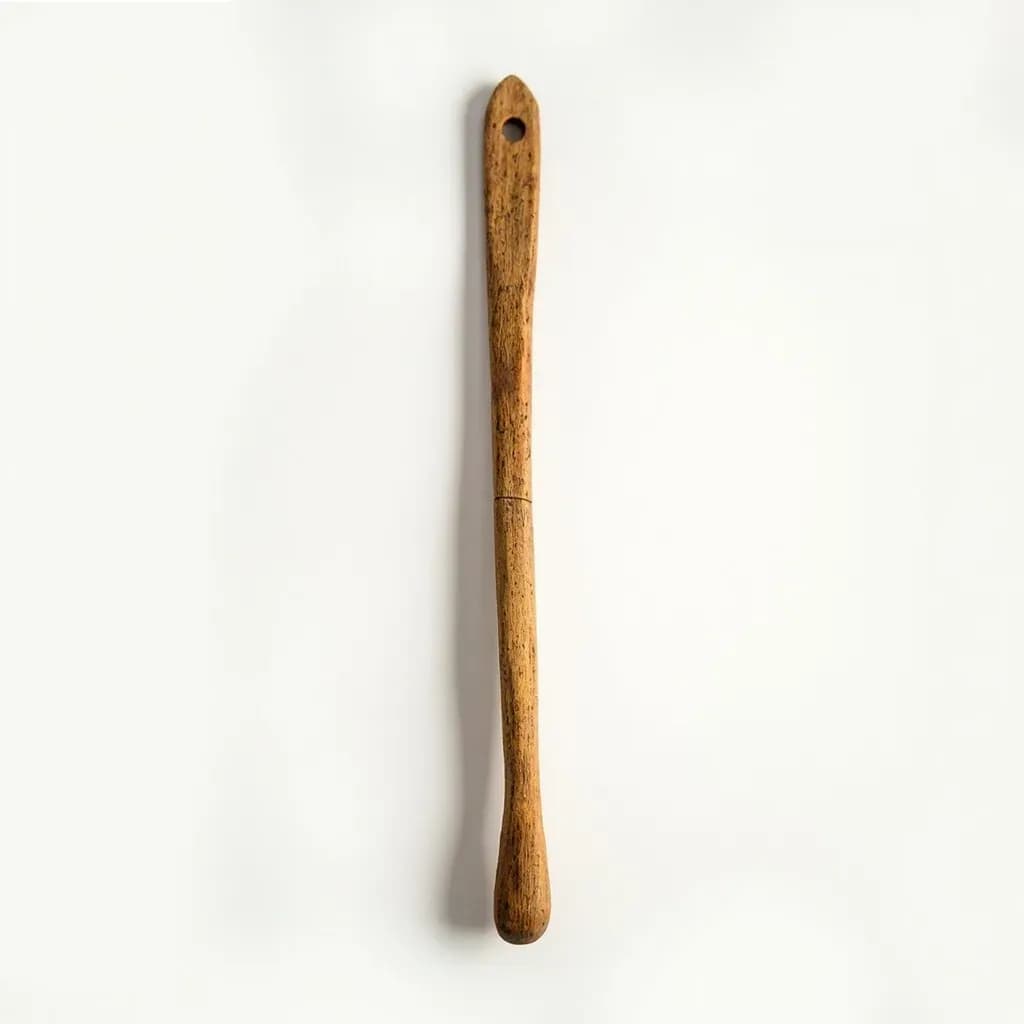
A bazin stirring stick, called a maghraf, is a robust wooden tool used in Libyan cooking to vigorously beat and fold a barley-flour-and-water dough as it cooks into a dense, smooth dome. Making bazin demands constant hard stirring against the side of the pot, so the stick must be thick and strong. The same kind of stick is used to shape the finished mound before it is topped with stew.
The bazin stirring stick is a purpose-built hardwood club from Libya, designed for one job: beating barley flour and boiling salted water into the extraordinarily stiff dough that becomes bazin. Where an ordinary wooden spoon meets its match, this forearm-length stick — gripped with both hands — delivers the heavy, rhythmic blows and folds that transform a pot of loose slurry into a smooth, near-solid mass. Its heft and unbroken grain are not aesthetic choices but functional necessities, because the dough reaches a resistance that will snap a spoon handle, clog a whisk, and dent a metal utensil.
A cook using the stick adds barley flour to the boiling water in small handfuls, beating continuously for 20 to 40 minutes. The motion is a combination of downward thrust and a folding stir, and the wood must be dense and crack-free or it will split under the repeated impact. The work is strenuous enough that bazin is traditionally considered one of the most labor-intensive tasks in Libyan home cooking, and in households where the dish is made often, the stick is a permanent kitchen fixture — frequently passed down rather than replaced.
Culturally, the stick is not just a tool but a signature of the dish. When the bazin is molded into its characteristic dome at the table, the stick is often left standing upright in the mound, signaling authenticity and serving as a visual cue for diners. The dish itself, a Tripolitanian staple usually accompanied by a saucy lamb or potato stew and a boiled egg, is very difficult to produce at home without the right stick, which is why the implement and the recipe travel together.
Alternatives
Types & varieties
The classic long, straight hardwood stick used in western Libya, paired with a wet, almost paste-like bazin that is poured or shaped into a shallow bowl
A shorter stick used in some southern preparations, paired with a drier, more crumbly bazin that is eaten with the fingers rather than spooned
Anatomy of a Bazin Stick
A traditional bazin stick is unshowy by design. The working end is blunt, the shaft is straight, and the handle end is sometimes lightly tapered so it can be gripped without slipping. The shaft is kept thick from end to end — a thinner stick concentrates the impact and is far more likely to snap — and length is set by the cook's reach: long enough to thrust downward with real force from shoulder height, short enough to control. The whole stick is one solid piece of wood, since any joined or fitted piece is the first place a heavy-beating tool of this kind will fail.
- Working end: blunt, with no sharp edges that would cut into the dough
- Shaft: straight, knot-free, and full thickness from end to end to spread impact forces
- Handle: may be lightly sanded to a smooth taper for grip, but not carved into a decorative shape
- Finish: usually left bare, sometimes rubbed with a little neutral oil
Why Standard Utensils Fail
Bazin's dough is the unusual case where physics, not preference, dictates the tool. As barley flour is beaten into boiling water, the starches gelatinize and the mixture thickens past the point a spoon can move. The resistance becomes so high that a wooden spoon's handle snaps under leverage, a whisk's wires bend and clog with paste, and a metal spoon dents the pot and chips at the edges. A solid hardwood club works because the impact energy is distributed along its length into the cook's body rather than focused at a thin handle, and because dense grain resists the splitting forces that would open up a knot or a weak spot in softer wood.
- Wooden spoon: handle snaps, ordinary spoons crack under the leverage
- Whisk: wires bend, wires clog, no leverage
- Metal spoon: dents the pot, can chip, transfers heat painfully to the hand
- Hardwood club: distributes force, resists splitting, stays cool in the hand
The Serving Tradition
In Tripolitanian homes, the bazin stick is part of the presentation. Once the cook has finished beating and the dough is smooth and stiff enough to hold its shape, it is turned out into a shallow bowl, hollowed in the center, and filled with a tomato-based stew — typically lamb, sometimes potato, almost always with a boiled egg set on top. The stick is then pressed back into the mound so that it stands upright. This is not decoration; it tells diners that the bazin was beaten by hand to the correct stiffness, and it gives the cook a way to lift and portion the dense dough at the table. Removing the stick before the bazin cools is part of the ritual as well — a stuck stick is a sign the cook waited too long.
- Stick embedded upright in the mound signals hand-beaten, properly stiff bazin
- Dinner guests use the stick to lift or portion the dense dough
- Stew is poured into a hollow pressed into the top of the dome
- A boiled egg is the conventional finishing touch on the stew
Common uses
Tips & pitfalls
- Choose a stick of dense, straight-grained hardwood with no knots; knots are weak points that will split under the heavy impact of beating.
- Soak the working end of the stick in warm water for 10–15 minutes before you start; this reduces splintering and stops the wood from drinking too much moisture out of the dough.
- Add the barley flour to the boiling salted water in small handfuls, beating constantly — dumping it in all at once produces lumps that no amount of subsequent beating will remove.
- Use a two-handed grip and beat with a combination of downward thrusts and a stirring or folding motion; pure stirring does not develop the smooth elasticity bazin needs.
- Do not substitute a regular wooden spoon: the dough becomes stiff enough to snap an ordinary spoon's handle within minutes.
- Avoid metal implements unless you are willing to work very carefully; the heavy impact and stiffness can dent cookware, and the metal can chip into the food.
- Pull the stick out of the bazin while the dish is still warm; once the dough cools and sets fully it grips the wood and becomes very difficult to remove cleanly.
- Hand-wash after use and dry the stick upright so water runs off the working end; storing it damp will eventually cause cracks along the grain.
Good to know
- Origin
- Libya, most strongly associated with the Tripolitania region in the west
- Material
- Dense, straight-grained hardwood, traditionally a local wood chosen for resistance to splitting under heavy impact
- Typical length
- Forearm-length, roughly 40–60 cm (16–24 in), long enough to be gripped with both hands
- Form
- A solid, thick, club-like stick, generally straight with a smooth or slightly tapered handle end
- Used for
- Beating barley-flour and water into the near-solid dough required for bazin
- Effort
- 20–40 minutes of continuous two-handed beating, traditionally considered one of the most strenuous tasks in Libyan home cooking
- Why a special stick is needed
- The finished dough is stiff enough to snap a wooden spoon, bend a whisk, and dent metal cookware
- Cleaning
- Hand-washed and dried upright; not oiled like a cutting board, and never left stored damp
Also called
Maghraf
Related

Peeler
Swift blade for stripping skin off fruit and vegetables

Grater
Sharp-toothed surface for shredding cheese and vegetables

Microplane
Ultra-fine rasp for citrus zest, garlic, and hard cheese

Mixing Bowl
All-purpose bowl for combining, whisking, and tossing

Whisk
Looped wires that beat air into eggs, cream, and sauces

Spatula
Flat blade for flipping, lifting, and scraping

Slotted Spoon
Pierced spoon that lifts solids and drains the liquid behind

Wooden Spoon
Gentle, heat-friendly spoon for stirring anything