Prep Tools
Belna Rolling Pin
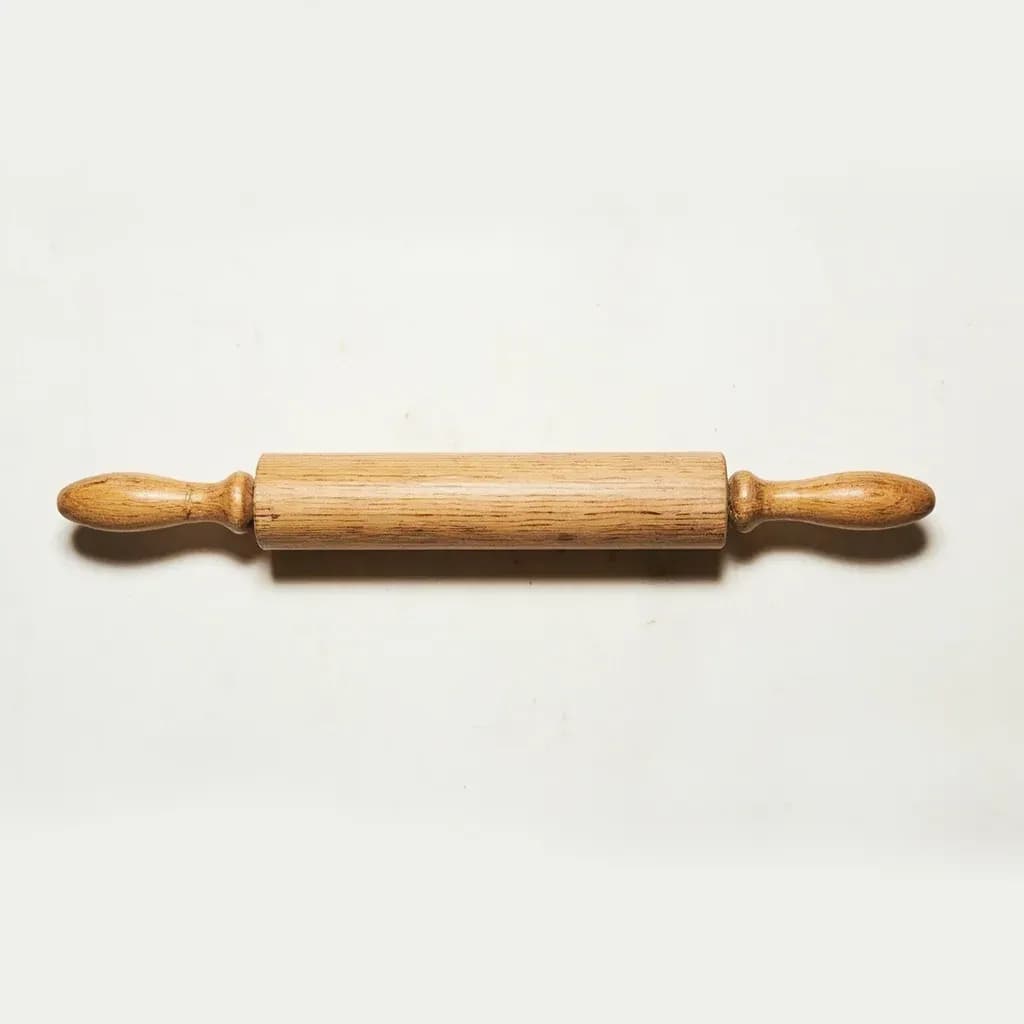
A slim, tapered South Asian rolling pin for rolling out chapati, roti, and puri dough.
A belna is a thin wooden rolling pin, often tapered toward the ends, used across South Asia to roll flatbread dough into thin, even rounds. It is paired with a circular board called a chakla to roll chapati, roti, puri, and paratha. Its slim profile and light weight give the fine control needed to spin dough into a perfect circle by hand.
The belna (also spelled belan) is a handle-less, tapered rolling pin from the South Asian kitchen, designed from the ground up for the kind of dough that defines the region's flatbreads: soft, hydrated wheat dough that is sheeted into thin, even rounds. Unlike a Western rolling pin, which the cook rolls back and forth across the dough, the belna is gripped in the middle with the thickest part of its taper centered in the palm and pushed outward from the center of the dough in short, wrist-driven strokes. That single mechanical difference — push from the middle, rotate the dough, push again — is what produces the characteristic round, evenly thin disc of a chapati or roti, and it is the reason the tool is so hard to swap out for a Western pin.
The pin almost always appears alongside its partner, the chakla, a round wooden board that provides the work surface. Together the chakla-belan set is one of the most recognizable tool pairings in South Asian cooking, traditionally hand-turned from dense hardwoods like sheesham, teak, or neem. The taper of the belna is not decorative: the thicker middle gives the cook momentum and pressure where it counts, while the slim tips let the pin glide off the edge of the dough without dragging it into an oval. With practice, an experienced hand can roll a uniform 6- to 7-inch chapati in well under thirty seconds, feeling the dough's thickness directly through the palms.
Most household belans run 18 to 24 inches long and weigh between 300 and 500 grams; heavier hardwoods and marble versions are favored when dough needs to be pressed paper-thin for rumali roti or layered paratha. The tool is forgiving for beginners but rewards a small handful of habits — a rested dough, a lightly floured board, a quarter-turn between strokes — that turn clumsy flatbreads into uniform ones. Care is simple but non-negotiable: wooden belans must never be soaked, and they last decades if oiled occasionally and dried standing upright.
Alternatives
Types & varieties
The premium standard; dense, smooth, long-wearing, with a warm reddish-brown color.
Naturally moisture-resistant; a smart choice in humid coastal kitchens where other woods might warp.
Traditional pick; neem wood is credited with natural antibacterial qualities and a mild, pleasant aroma.
Lighter and more affordable; a softer hardwood well suited to everyday home cooking.
Heavier than wood; the extra weight is prized for pressing dough paper-thin for rumali roti and paper paratha.
Modern, dishwasher-safe option; the smoother surface means slightly more dusting flour is needed.
Budget, lightweight variant common in hostels and starter kitchens, though it lacks the heft of wood.
Single-taper (one fat end, one slim) is the traditional chapati shape; double-taper is more forgiving for beginners because pressure balances either way.
The push-and-turn motion
A belna is meant to be pushed, not rolled. Grip it across the palm with the thickest part of the taper centered under your hand, place the dough ball at the center of a lightly floured chakla, and press outward in short strokes that travel from the dough's middle to just past its edge. The slim tips of the pin lift off the dough cleanly, so they don't drag the edge into an oval. After every one or two strokes, rotate the dough a quarter-turn on the board; this is what keeps the disc round and even in thickness. Long shoulder-driven strokes tire you out and stretch the dough unevenly — keep the work in the wrist. A rested dough ball (15–20 minutes after kneading) rolls out far thinner with much less spring-back, so the rotation and the rest together are what make the technique feel effortless.
- Grip the pin across the palm, thickest part of the taper under the hand — no fingers wrapped around the tips.
- Push outward from the center of the dough; do not roll back and forth.
- Rotate the dough a quarter-turn after every one or two strokes to keep it round.
- Keep the motion wrist-driven, not shoulder-driven, for control and stamina.
Care and longevity
Wooden belans outlast their owners when treated simply: oil them occasionally, never soak them, and let them dry standing on end. A new pin benefits from a single seasoning with food-grade mineral oil or mustard oil before first use, and any rough spot that develops can be knocked down with fine-grit sandpaper and re-oiled. The main failure mode is cracking along the grain, almost always caused by washing and leaving the pin wet — once the taper soaks up water, it splits as it dries.
- Season new wooden belans with a thin coat of food-grade mineral or mustard oil; wipe dry before use.
- Wipe clean with a dry or barely damp cloth; never soak or put in the dishwasher.
- Stand the pin upright to air-dry so the taper doesn't sit in pooled water.
- Smooth rough spots with 320+ grit sandpaper and re-oil.
Common uses
Tips & pitfalls
- Hold the belna across the palm with the thickest part centered under your hand; push outward from the dough's center rather than rolling back and forth like a Western pin.
- Rotate the dough a quarter-turn after every one or two strokes so it stays round and even in thickness.
- Dust the chakla and the dough very lightly with dry flour — too much flour toughens the chapati and causes it to puff unevenly on the tava.
- For stuffed parathas, roll the filled disc gently first, then dust lightly and roll outward; pressing hard pushes the filling to one side.
- Season a new wooden belna with a thin coat of food-grade mineral oil or mustard oil, let it sit overnight, then wipe dry before first use.
- Never soak a wooden belna in water — wipe it clean with a dry or barely damp cloth and stand it upright to air-dry so it doesn't crack or split at the taper.
- If a wooden belna develops a rough spot, sand it very lightly with fine-grit sandpaper (320+) and re-oil; avoid the dishwasher, which will warp the taper.
- Rest the dough ball for 15–20 minutes after kneading and dividing — a rested ball rolls out far thinner with less spring-back.
Good to know
- Origin
- South Asia, in daily use across North India, Pakistan, Bangladesh, Nepal, and Sri Lanka.
- Also called
- Belan (Hindi/Urdu masculine form), lathi belan, or simply 'the rolling pin' in many Indian kitchens; often sold as a chakla-belan set.
- Material
- Traditionally hand-turned hardwoods — sheesham, teak, neem, or mango wood; modern variants include marble, stainless steel, and food-grade plastic.
- Length
- Typically 18–24 in (45–60 cm); the most common household size is about 20 in (50 cm).
- Diameter
- Tapered profile, roughly 2 in (5 cm) thick in the middle and narrowing to about 0.5–1 in (1.5–2.5 cm) at the tips.
- Paired with
- Chakla — a flat, round wooden board 12–14 in (30–35 cm) across that serves as the work surface.
- Weight
- Wooden belans run 300–500 g; denser hardwoods (sheesham, teak) and marble versions give more momentum for stiff dough.
- Skill level
- Beginner-friendly, but the one-handed push-rolling motion takes a few sessions to feel natural.
Also called
Belna (Rolling Pin) · Belan · Chapati Rolling Pin
Related

Peeler
Swift blade for stripping skin off fruit and vegetables

Grater
Sharp-toothed surface for shredding cheese and vegetables

Microplane
Ultra-fine rasp for citrus zest, garlic, and hard cheese

Mixing Bowl
All-purpose bowl for combining, whisking, and tossing

Whisk
Looped wires that beat air into eggs, cream, and sauces

Spatula
Flat blade for flipping, lifting, and scraping

Slotted Spoon
Pierced spoon that lifts solids and drains the liquid behind

Wooden Spoon
Gentle, heat-friendly spoon for stirring anything