Baking & Pastry
Pastry / Dough Cutter Wheel
A handheld wheel for cutting and crimping rolled dough into clean strips, lattices, and pastry edges.
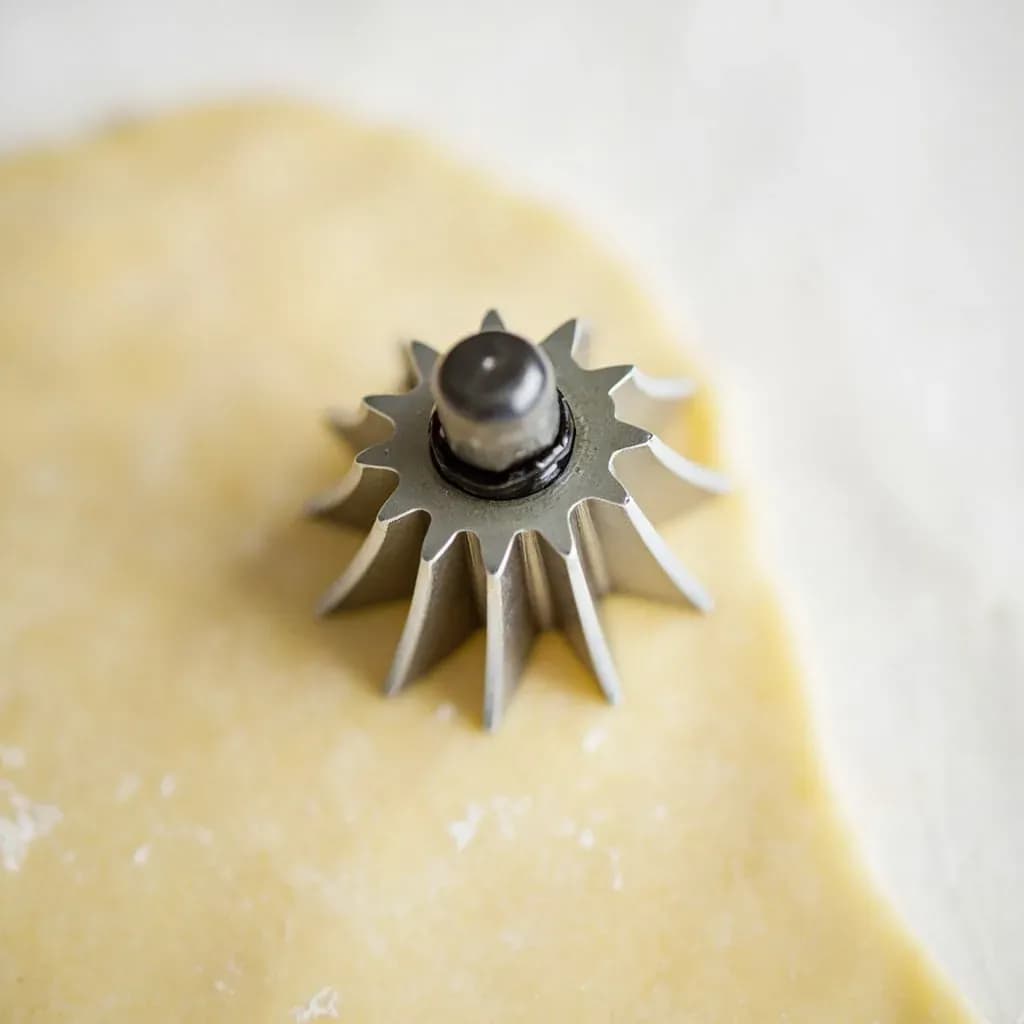
A pastry cutter wheel is a rolling disc on a handle, with either a smooth or fluted edge, that slices through rolled pie crust, pasta, or laminated dough. Drawn along a ruler it makes straight lattice strips and crimped, decorative borders, sealing edges as it cuts. The fluted version leaves the zigzag rim seen on filled pastries and ravioli.
The pastry wheel — also called a bench cutter or, when fluted, a pastry jagger — is a small, rotating circular blade mounted on a handle (or two) that rolls across rolled-out dough to produce clean, straight cuts in a single pass. Its defining advantage over a chef's knife is continuity: a long trim or a full row of lattice strips takes one forward motion rather than a sequence of slices, so the cut stays vertical, doesn't drag, and doesn't compress the layered structure of laminated doughs like puff or rough puff.
Where the tool earns its place in a baking drawer is on any task that calls for parallel, equal-width pieces of dough — pie-lattice tops, pastry braids, cookie bars, palmiers, even strips of marzipan or fondant. A fluted or patterned wheel goes a step further, cutting and decorating in the same pass, so the rim of a hand pie or the edge of a turnover ends up sealed and crimped without a separate fork step. The mechanism is simple, but the result hinges on three things: cold dough, a sharp blade, and a bench that is floured lightly enough to release but not so heavily that the dough toughens.
Alternatives
Types & varieties
Plain round blade for clean, squared cuts on dough strips and trims; the workhorse for everyday lattice and edge trimming.
Scalloped/wavy blade that cuts and crimps in one motion, leaving a decorative ruffled edge on strips and pie rims.
Wheel with raised patterns or notches that imprint a decorative edge — often used to seal and decorate the rim of hand pies and turnovers.
Two parallel blades set at a fixed width; guarantees uniform lattice strips without measuring, popular in professional pie work.
Twin blades on a sliding track so the gap can be set from roughly 1/2 in to 2 in; preferred for varied strip widths.
Several parallel blades in a frame that drops down to cut an entire lattice section in one pass; common in bakeries.
Serrated/zig-zag blade for crinkle-cut edges on cookies, brownies, and pastry strips.
Fluted or straight wheel mounted in a contoured or roller-style handle for downward pressure with less wrist strain.
A free-spinning wheel on a single handle; usable for dough though less precise than two-handled bench cutters; often not fluted.
Cutting a clean lattice
Lattice is the bench cutter's signature job, and the visual result is unforgiving — any wobble in strip width or angle shows. The work is faster and tidier when the dough and the workspace are both prepped before the wheel comes out.
- Roll the dough to an even thickness (usually 1/8 to 1/4 in) and chill it on the tray or slab it was rolled on; warm dough drags and smears its butter layers.
- Set a ruler, dough scraper, or the edge of a pastry mat as a side guide so each pass of the wheel runs truly parallel to the last.
- Make all cuts in one direction across the full sheet; backtracking over already-cut strips compresses the dough and blurs the cut line.
- Lift cut strips onto parchment and return them to the fridge while you weave — strips relax and stretch quickly at room temperature and won't lie flat on the filling.
Straight vs. fluted: when to reach for which
The choice comes down to whether the edge should be invisible or a feature. Both wheels cut the same strip widths, but they leave the dough looking like two different pastries.
- Choose a straight wheel for clean, modern trims — galette edges, slab-cookie portions, neat palmier strips, and any lattice where you want the focus on the weave rather than the rim.
- Choose a fluted wheel for traditional double-crust pies, hand pies, and turnovers, where the ruffled edge doubles as the seal and visual frame.
- For mixed work, a single fluted wheel on a two-handled frame is the most versatile home purchase: it trims, strips, and crimps rims without buying three tools.
- Reserve the crinkle wheel for sweet applications (shortbread, brownies, bar cookies); the pronounced edge can feel out of place on a savory tart.
Common uses
Tips & pitfalls
- Chill the dough thoroughly — warm dough drags, smears butter, and loses the cut line; a 15–20 minute rest in the fridge is the single biggest improvement you can make.
- Lightly dust the wheel with flour between cuts to prevent sticking; tap off excess so it doesn't dry out the dough.
- Press straight down with firm, even pressure; never saw back and forth, which distorts the cut edge and crushes the layers in laminated doughs.
- Use a ruler, dough scraper, or pastry mat as a side guide for perfectly straight, parallel strips — eyeballed cuts almost always wander.
- Keep the blade sharp — a dull wheel tears puff and rough puff instead of slicing cleanly, and the damage shows on every strip.
- Flour the bench lightly but evenly; too much toughens the dough, too little causes drag and sticking under the wheel.
- Wipe the blade with a dry towel between cuts on sticky fillings (fig, date, mincemeat, marmalade) to prevent buildup that would smear the next strip.
- Cut twice as many lattice strips as you think you'll need — they shrink during baking and trimming, and a few spares beat an interrupted weave.
- Fluted wheels double as a crimping tool: run them around an overhanging edge to seal and decorate in one step.
- Replaceable-blade models let you swap a dull wheel for a fresh one instead of buying a new tool.
- Hand-wash wooden-handled models and oil the handle occasionally; never soak, and never put them in the dishwasher or the handle will split.
Good to know
- Also known as
- Pastry wheel, bench cutter, pastry jagger (fluted), rolling pastry cutter
- Primary wheel material
- Stainless steel
- Handle material
- Hardwood (beech, maple), plastic, or stainless steel
- Typical wheel diameter
- 1.5–3 in (3.5–7.5 cm)
- Typical strip widths
- 1/2–1 in with double-wheel models; up to 2.5 in with single wheels
- Best dough state
- Well-chilled, rested dough that holds its shape when cut
- Working surface
- Marble, wood, or silicone-lined bench; lightly floured
- Price range
- Roughly $6–$40 for home models; professional versions run higher
Also called
pastry wheel · fluted pastry cutter · dough cutter wheel · jagger
Related

Muffin Pan
Multi-cup pan for muffins, cupcakes, and egg bites

Bundt Pan
Fluted ring mold for showstopping cakes with a center hole

Springform Pan
Latch-release pan that frees delicate cakes without flipping

Pie Dish
Sloped round dish for crisp-bottomed pies and quiches

Tart Pan
Fluted pan with a pop-out base for clean-edged tarts

Rolling Pin
Rolls dough into even sheets for pastry and bread

Pastry Brush
Brushes on egg wash, glaze, butter, and marinades

Bench Scraper
Flat blade that divides dough and clears your work surface