Prep Tools
Berry Picker
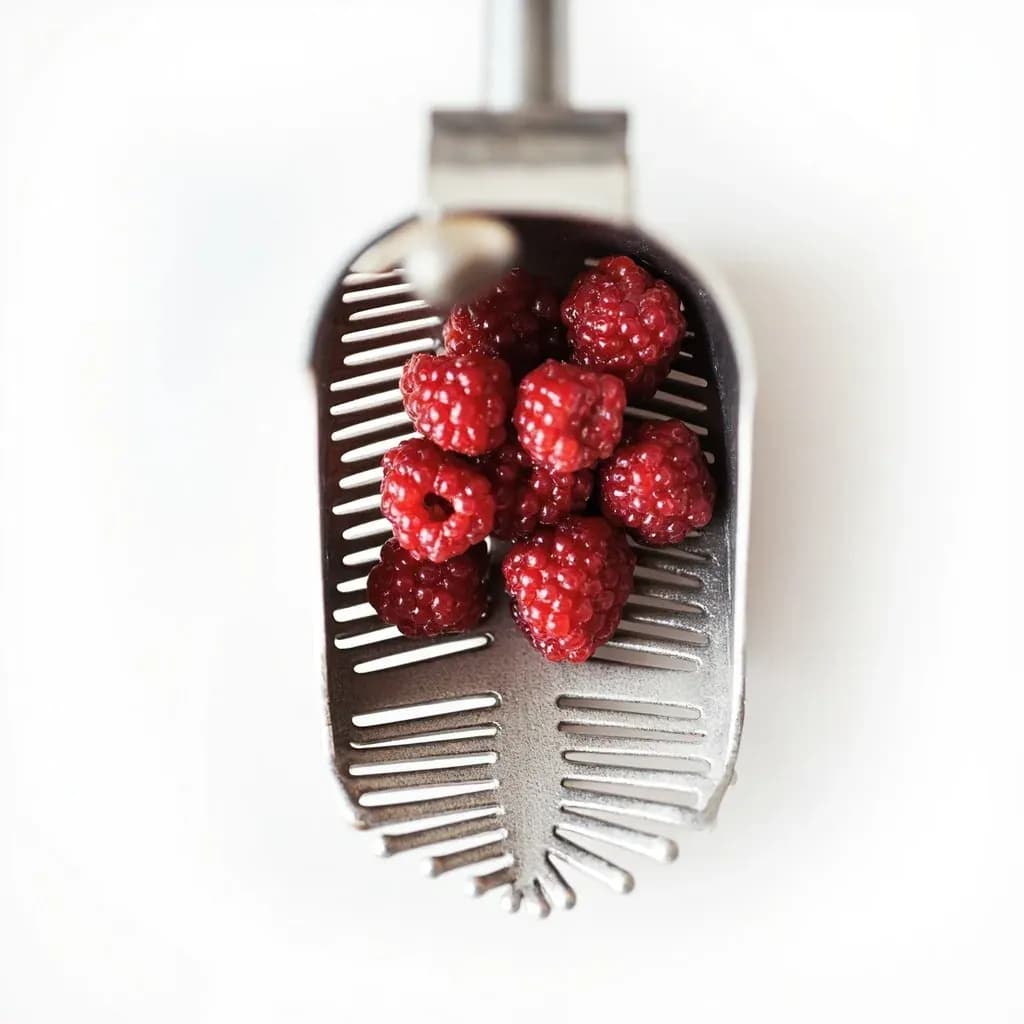
A scoop with comb-like tines that rakes berries off low bushes quickly without crushing them.
A berry picker is a handheld scoop fitted with a row of long teeth or tines that comb through low shrubs to strip ripe berries into the attached basin. It is widely used in the Nordic countries to harvest lingonberries, blueberries and bilberries far faster than picking by hand. The tine spacing lets leaves and unripe fruit slip past while pulling free the ripe berries.
A berry picker is a one-handed harvesting tool built around a row of rigid, evenly spaced tines mounted on the leading edge of an open scoop or comb. The user draws the tines through a laden branch; ripe berries, which detach from their stems under gentle lateral force, fall into the container behind the comb while leaves, stems, and unripe fruit stay largely on the bush. The result is a dramatically faster harvest than finger-picking — a practiced user can fill a quart of wild blueberries in 10 to 25 minutes — but at the cost of more incidental leaves and twigs in the bucket and a touch more surface bruising, since some fruit is compressed between tines and scoop.
The design descends from Scandinavian open combs used for centuries in Sweden and Finland to gather lingonberries and bilberries from low scrub. In the 1920s–1940s American and Canadian inventors enclosed the comb in a wooden or tin scoop, creating the form most cooks picture today: a small trough with a metal rake along the front lip. That enclosed scoop became standard across the wild-blueberry barrens of Maine, the Canadian Maritimes, and Michigan, where it is still used for a meaningful share of the commercial lowbush harvest.
For a cooking encyclopedia the picker matters less as a kitchen implement than as a forager's tool that shapes the ingredient arriving in the kitchen. Raked berries almost always carry stems, leaves, and the occasional insect, and they soften faster than hand-picked fruit, so they are best routed toward jam, sauce, compote, baked goods, and syrup rather than pristine fresh-fruit presentation. Knowing how the berries were harvested tells you how aggressively to sort and how quickly to use them.
Alternatives
Types & varieties
Enclosed scoop — often wood or molded plastic — with a row of metal tines; the standard U.S. design for wild/lowbush blueberries and the one most home foragers encounter.
Deeper tin or steel scoop with a comb edge; the form most associated with lingonberry and bilberry foraging in boreal forests.
Just the tined head on a handle; berries fall into a separate bucket the user carries. Lighter and cheaper, but slower because each pass requires a separate catch.
Movable spacers widen or narrow the tine gaps to suit different berry sizes, from small lingonberries up to large highbush blueberries.
Handheld or push-style version with a rotating tined drum; mostly commercial or used in dense plantings, rarely a home tool.
Padded or contoured grips sold for extended picking sessions; harvesting performance is essentially the same as basic models.
Why raked berries behave differently in the kitchen
The speed of a berry rake comes with three predictable consequences for the cook. First, the bucket will contain leaves, small twigs, stem fragments, and sometimes whole unripe berries; plan on a sorting step before any recipe. Second, fruit that gets pinched between tines or piled at the bottom of a full scoop develops soft, bruised spots within hours, so raked berries have a noticeably shorter kitchen life than hand-picked ones. Third, a small share of berries arrive with their calyx or a stub of stem still attached — visible in jam and pies, invisible in sauce or puréed applications.
Route raked fruit accordingly: clean, dry-sort, then send it to jam, compote, sauce, sorbet, muffins, buckle, galette filling, pancake batter, or a reduction for sauce or vinaigrette. Save the prettiest, firmest, hand-picked berries for fresh display, salads, and garnishes where bruise marks and stray stems would be obvious.
- Expect a meaningful share of leaves, twigs, and stem fragments on any rake harvest; float-sorting in cold water lifts debris and chases out insects.
- Refrigerate within an hour of picking; do not wash until just before use, since moisture speeds collapse of bruised spots.
- Raked blueberries and lingonberries freeze exceptionally well because they will be cooked or baked after thawing — spread on a sheet pan first, then bag.
Choosing a picker
Match the tool to the fruit, not the other way around. Tine spacing is the single most important variable: a gap that is too wide will leave ripe berries on the stem, while a gap that is too narrow will drag unripe fruit and leaves into the scoop. For lowbush blueberries, huckleberries, and lingonberries, aim for the 1/4 in (6 mm) end of the range; for highbush blueberries, currants, and gooseberries, lean toward 3/8 in (9 mm). Adjustable-tine models trade cost for flexibility and are worth it if you forage more than one species.
- Wooden scoops are light and quiet but need to be dried thoroughly to prevent mildew and splitting at the tine sockets.
- All-metal scoops survive being dropped and are easier to sanitize between bushes if you are moving between sites.
- A simple comb (no scoop) is the cheapest entry point and a good choice for occasional berry-picking trips where you already carry a bucket or wear a picking belt.
Common uses
Tips & pitfalls
- Pick on a dry day after the dew has evaporated; wet berries crush more easily and clog the tines.
- Use a pulling, scooping motion toward you rather than a downward rake — this lets ripe berries release while leaving unripe ones attached.
- Brace the branch lightly with your free hand just above the comb to keep whole twigs from being torn off the bush.
- Empty the scoop after every few passes; an overstuffed picker crushes the berries sitting at the bottom under the weight of later additions.
- Test tine spacing on a handful of berries before committing to a full sweep — if unripe fruit is coming off, the gap is too wide or the angle is too steep.
- Do not use a berry rake on raspberries, blackberries, mulberries, or strawberries; the fruit is too soft and the tines will mash it.
- After picking, chill berries quickly and float-sort in cold water to drop leaves, stems, and any insect hitchhikers before drying and storing.
- Check local regulations before raking on public land — some states and provinces restrict mechanical rakes on wild-blueberry barrens to protect the resource, and most ethical foraging guidelines recommend leaving a portion of the crop on each bush.
Good to know
- Also called
- Berry rake, berry comb, berry scoop, berry harvester
- Typical construction
- Open box or scoop with rigid tines along the leading edge; tines rake berries off stems and into the container
- Tine spacing
- Roughly 1/4 to 3/8 in (6–9 mm); finer spacing for small berries, wider for larger fruit
- Head width
- Commonly 5–8 in (12–20 cm) across
- Capacity
- Roughly 1–3 cups per scoop before emptying
- Common materials
- Plastic scoop with steel tines; aluminum scoop with steel tines; all-steel; wooden frame with metal comb
- Origin
- Hand-held comb pickers trace to Scandinavian wild-berry traditions; the enclosed scoop design was popularized in the U.S. in the early-to-mid 20th century for wild blueberry harvest
- Best for
- Firm, stem-detachable berries on low bushes: lowbush/highbush blueberries, lingonberries, huckleberries, currants, gooseberries (carefully), sea buckthorn
Also called
Berry Comb · Marjapoimuri · Berry Rake
Related

Peeler
Swift blade for stripping skin off fruit and vegetables

Grater
Sharp-toothed surface for shredding cheese and vegetables

Microplane
Ultra-fine rasp for citrus zest, garlic, and hard cheese

Mixing Bowl
All-purpose bowl for combining, whisking, and tossing

Whisk
Looped wires that beat air into eggs, cream, and sauces

Spatula
Flat blade for flipping, lifting, and scraping

Slotted Spoon
Pierced spoon that lifts solids and drains the liquid behind

Wooden Spoon
Gentle, heat-friendly spoon for stirring anything