Prep Tools
Woven Bamboo Tray (Bilao)
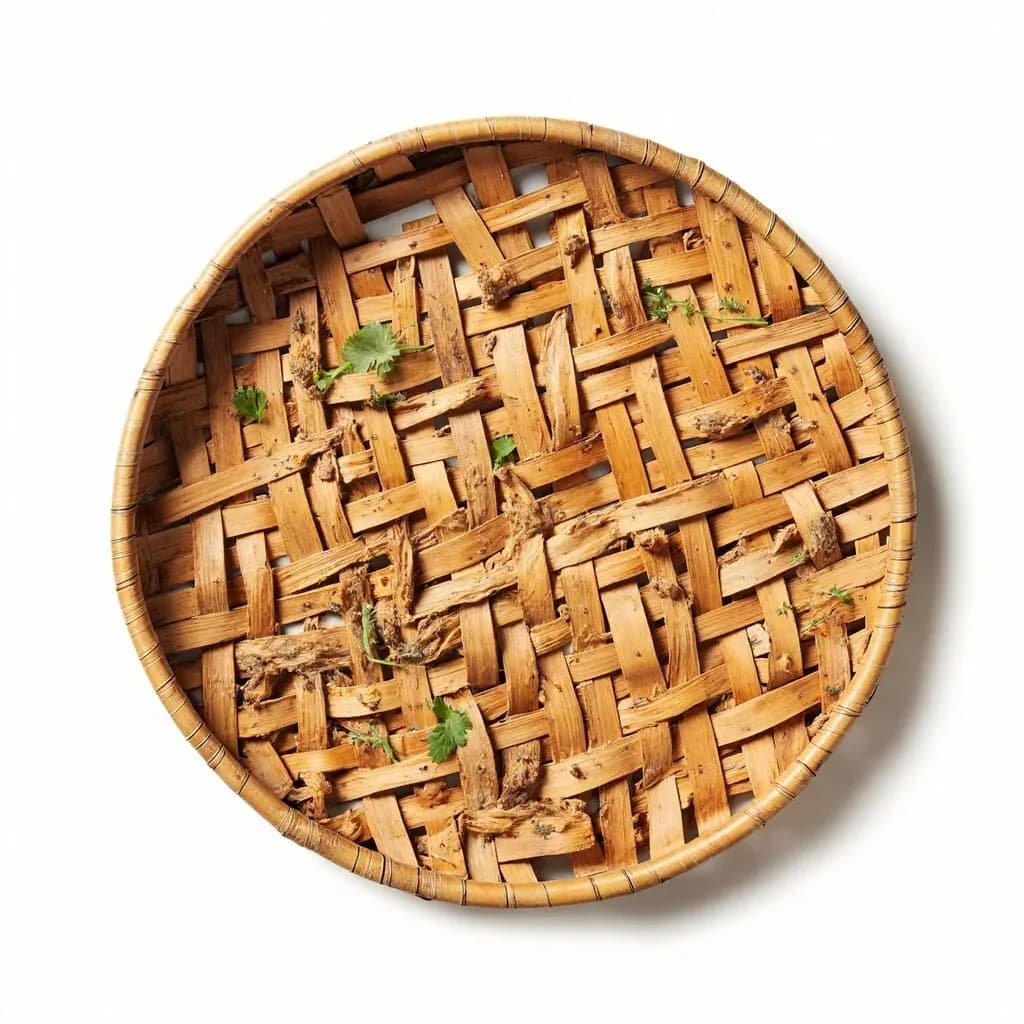
Round flat woven bamboo tray used for winnowing, drying and serving Filipino food.
A bilao is a flat, round tray woven from bamboo or rattan, a staple in Filipino kitchens. Traditionally it is used to winnow rice and dry foods, but it is widely used today to serve communal dishes like pancit and lined with banana leaf for a kamayan feast. Its light, breathable weave makes it ideal for both prep and presentation.
The bilao is a round, flat tray woven from bamboo or buri palm strips that has been a fixture of Filipino kitchens for generations. Its defining feature is the open, lattice-style weave — usually a hexagonal or checker pattern — that lets air move freely through the bottom. That airflow is the entire reason the tray exists: a bilao is a tool for separating grains from chaff, drying fish, fruit, and coffee under the sun, and letting fried foods release steam so they stay crisp. Without the gaps, it would just be a plate.
In the rural kitchen the bilao is genuinely dual-purpose. In the morning it is winnowing gear — two hands, a tossing rhythm, a breeze that carries chaff away while heavier grain falls back to the tray. By afternoon it may be set out with a layer of daing or tuyo drying in the sun, and by merienda it is on the table holding suman, puto, or sliced mango with bagoong. That shift from working tool to serving piece is what separates the bilao from a purely decorative rattan tray or a Western bread basket.
For cooks outside the Philippines, the closest functional analog is a Japanese sushi-zaru, but the shape, scale, and winnowing tradition are distinctly Filipino. Buy one for the table and you will quickly find a use for it at the prep counter, the frying station, and the drying rack.
Alternatives
Types & varieties
The standard workhorse; thicker, sturdier splits with a slightly rough hand-feel, used for winnowing and drying.
Woven from young buri palm strips; finer, more uniform weave, often used for serving kakanin and for display.
Made from lauan (Shorea) or similar hardwood splits for a smoother, more decorative finish; less common.
Tabletop size for rice cakes, dried fish, and sliced fruit — the size you actually want for merienda.
Functional farm-kitchen size for tossing palay, drying whole fish flat, and sun-drying coffee or cacao.
Coated finish for display; not food-functional and not ideal for drying because the seal blocks airflow.
Tighter weave with a minimal rim, used more for presentation than for winnowing.
Buying and sizing
Match the tray to the job. A small 10–14 inch bilao is the right call for most home cooks — it holds a bundle of suman, a plate of dried fish, or a pile of fried snacks without dominating the table. A 22–28 inch bilao is what you want if you plan to winnow grain, dry whole daing flat in the sun, or lay out a kilo of sliced mango for drying. Buy one size up rather than one size down for drying whole fish; they need room to lie flat without overlap, or the centers will never cure.
Care and longevity
A well-kept bilao lasts years; a poorly kept one molds within a season. The two rules are simple: never soak it, and never store it damp. A quick wipe with a barely damp cloth after use, followed by full air-drying in a ventilated spot, is all the maintenance it needs. A light rub of food-grade coconut or mineral oil every few months keeps the splits from drying out and cracking, especially in air-conditioned kitchens. Hang it on a wall hook or stand it on edge rather than stacking flat; flat stacks trap moisture and slowly deform the weave.
Winnowing technique
Winnowing on a bilao is a learned rhythm, not a shake. Hold the tray with both hands at the rim, load it with a few handfuls of threshed grain, and toss the contents upward in a smooth, repeated arc so heavier kernels fall back to the weave while chaff and empty husks drift away on the breeze. Tilt the tray slightly into the wind; the chaff will travel farther than the grain. Work in small batches — overloading the tray is the most common mistake and just sends everything flying together. The same motion works for sorting dried beans and for cleaning toasted coffee before grinding.
Common uses
Tips & pitfalls
- Dry the bilao fully before storing; trapped moisture is what causes mold and a musty smell in the weave.
- Never submerge the tray or run it under a tap — a wipe with a barely damp cloth is all it needs.
- Keep it out of prolonged direct sunlight; bamboo and buri dry, warp, and crack over time, even on a windowsill.
- Rub the splits occasionally with a light coat of food-safe coconut or mineral oil to keep them supple and slow cracking.
- Line the tray with a banana leaf, parchment, or a smaller plate when serving wet or saucy foods — the open weave will leak.
- Hang on a wall hook or store standing on edge so air circulates and the weave keeps its shape.
- For winnowing, hold with two hands, work in small batches, and tilt toward the breeze; overloading sends grain and chaff flying together.
- Avoid placing very hot pans directly on the tray — heat can scorch or shrink the weave, especially on buri versions.
Good to know
- Material
- Bamboo (kauayan) splits, or finer strips of buri palm (Corypha utan) fronds; some decorative versions use lauan hardwood.
- Origin
- Philippines; a traditional craft across Luzon, the Visayas, and Mindanao, with strong production in Bulacan, Pampanga, Laguna, and Quezon.
- Shape
- Round and flat, with a low raised rim.
- Typical diameter
- About 12 to 28 inches (30–70 cm); tabletop serving bilao run 10–14 in, winnowing and drying bilao run 22–28 in.
- Weave
- Open hexagonal or checker lattice; gaps are intentional to allow airflow and chaff to fall through.
- Primary traditional use
- Winnowing palay (unhusked rice) and other grains to separate chaff and light debris.
- Care
- Wipe with a dry or barely damp cloth; never soak; air-dry fully before storage to prevent mold.
- Storage
- Stacked upright or hung in a dry, ventilated space away from direct sun.
- Lifespan
- Years with proper care; can dry out, crack, or mold if mistreated.
- Food safety
- Best for dry or low-moisture foods; line with banana leaf, parchment, or a plate when serving moist dishes.
Also called
Bilao · woven bamboo tray · winnowing tray · nigo
Related

Peeler
Swift blade for stripping skin off fruit and vegetables

Grater
Sharp-toothed surface for shredding cheese and vegetables

Microplane
Ultra-fine rasp for citrus zest, garlic, and hard cheese

Mixing Bowl
All-purpose bowl for combining, whisking, and tossing

Whisk
Looped wires that beat air into eggs, cream, and sauces

Spatula
Flat blade for flipping, lifting, and scraping

Slotted Spoon
Pierced spoon that lifts solids and drains the liquid behind

Wooden Spoon
Gentle, heat-friendly spoon for stirring anything