Prep Tools
Bombilla
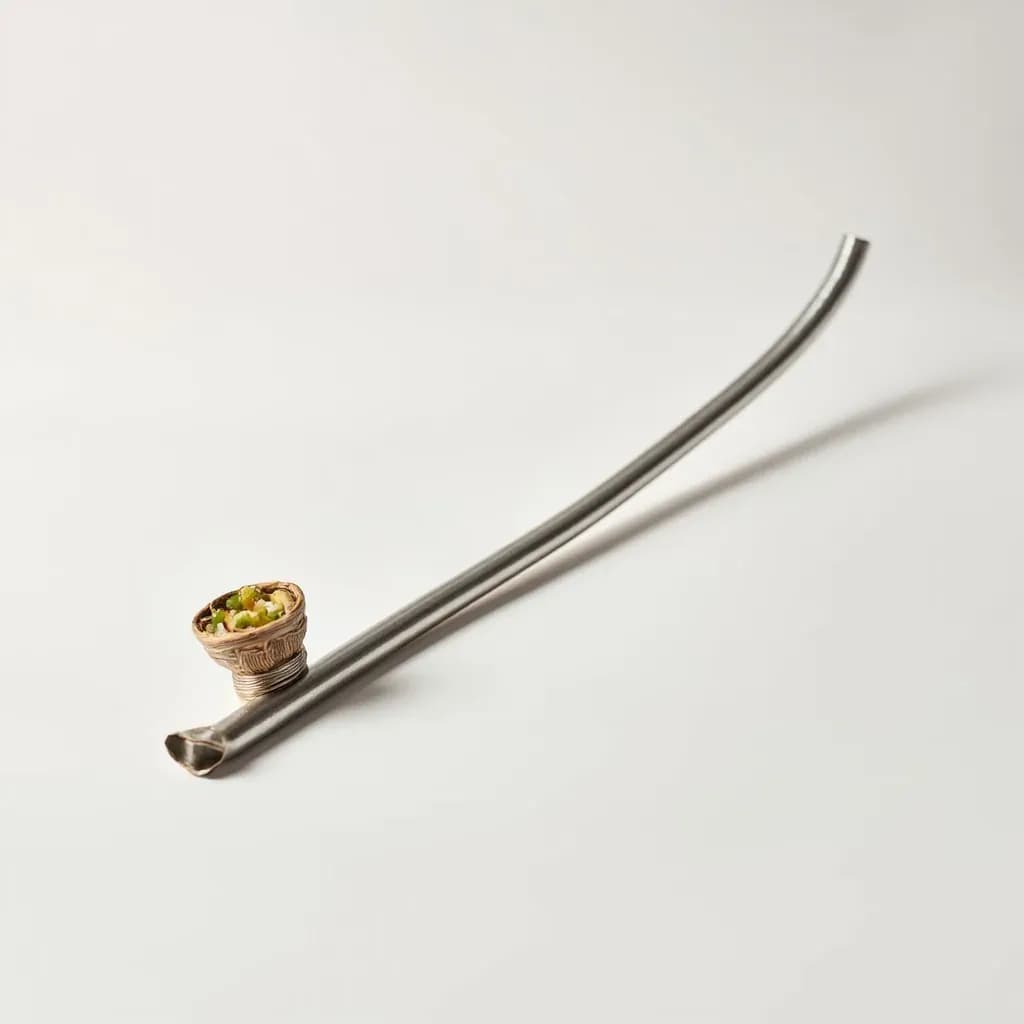
A metal drinking straw with a filtered bulb tip for sipping yerba mate without the leaves.
A bombilla is a metal straw, traditionally silver or stainless, with a perforated, spoon-shaped filter at the bottom that strains out the loose yerba mate leaves as you sip. It is the standard implement for drinking mate from a hollowed gourd across Argentina, Uruguay, Paraguay, and southern Brazil. The filter end is removable on many models so it can be cleaned of trapped leaf sediment.
A bombilla is a filtered drinking straw built specifically for yerba mate, the infusion of dried leaves of Ilex paraguariensis that anchors daily life across the Southern Cone. The shaft, usually 15–20 cm of stainless steel, alpaca silver, or sterling, ends in a perforated strainer that sits down inside the loose leaf while the drinker sips from the mouthpiece above. The genius of the tool is mechanical: a single piece of metal separates the hot water from the floating, dusty, often stem-filled leaf bed without the cloudiness of an open pour or the paper-filter flatness of a teabag.
The bombilla is inseparable from the gourd it serves. Tradition calls for a calabaza (a dried calabash gourd), or alternatively a carved wood, horn, or ceramic cup, packed with yerba, primed with a little cool water, then filled with hot water at 70–80 °C — never boiling, which scalds the leaf and turns the infusion sharply bitter. The bombilla is seated against the dampened wall of leaves, the drinker sips, the gourd is refilled and passed. In mate compartido, the shared round, every participant owns their own bombilla, but only one is in use at a time: the gourd circulates, the straw stays with its owner.
Pick the right filter and the tool disappears into the ritual. Spring-coil filters are forgiving and easy to clean; spoon-end alpaca filters give the cleanest, most traditional sip; flat-disc filters are simple and pair well with short straws. Most of the skill lies not in the metal but in the cebado — the priming pour that wets the leaf and positions the bombilla so the holes don't clog on the first sip.
Alternatives
Types & varieties
Coiled stainless-steel spring filter at the tip; the most common modern style — durable, easy to clean, lets some fine dust through while stopping leaf.
Spoon- or parrot-beak-shaped end with fine perforations; traditional alpaca-silver construction, considered the cleanest sip and the classic Argentine/Uruguayan choice.
Flat perforated disc set at an angle; simple, inexpensive, often paired with shorter straws or travel gourd kits.
A straw-within-a-straw design that insulates the sip from the hot liquid; a modern, niche variant without traditional precedent.
Pre-industrial forms made from hollowed gourd, bamboo, or carved bone; folk-craft and collector's pieces, still made in craft regions of the Argentine northwest.
The classic South American material — bright, conducts heat, develops a patina with use; not suitable for drinkers with nickel sensitivity.
Choosing the right filter style
The filter dictates the entire drinking experience. Spring-coil bombillas are the practical default: they clear easily with a rinse, tolerate the dustier commercial yerbas, and survive heavy daily use. Spoon-end bombillas, especially in alpaca, give a noticeably cleaner sip because the perforations are finer and the geometry holds back more particulate — but they clog faster with very fine or stem-heavy leaf. Flat-disc filters sit between the two and are the easiest to back-flush with a syringe. Match the bombilla to the leaf: a coarse, traditional Argentine yerba pairs well with a spoon or disc filter, while a Brazilian-cut, dustier mate is more forgiving with a spring.
- Spring/coil: best all-rounder, easiest to clean, forgiving of fine dust.
- Spoon/paddle: cleanest traditional sip, but clogs faster on stem-heavy leaf.
- Flat disc: simple, easy to back-flush, often found on shorter straws.
- Double-walled: insulates the sip; a modern convenience, not a tradition.
Cultural role and etiquette
The bombilla is not just a tool but a marker of social ritual. In mate compartido, the cebador — the designated pourer — prepares the gourd, drinks the first serving themselves (a courtesy that tests the strength of the brew), then passes the gourd to the next person. Each drinker uses their own bombilla; the straw never leaves its owner's hand between rounds. The gourd is returned to the cebador, who refills it with hot water and hands it back. This loop, sometimes lasting an entire afternoon, is the structural unit of mate culture. Bombillas are often passed down through families, and a finely made alpaca or sterling straw from a recognized craft region — Salta, Jujuy, Córdoba, or the Paraguayan missions — carries real heirloom weight.
- The cebador drinks the first serving before passing the gourd.
- In shared rounds, every drinker uses their own bombilla; the gourd circulates, the straw does not.
- Bombillas are commonly inherited; antique alpaca and sterling pieces are heirlooms.
- Craft regions include the Argentine northwest (Salta, Jujuy), Córdoba, southern Brazil, and the Paraguayan Jesuit missions.
Cleaning and care
The single most common mistake is leaving dried yerba in the filter. Once the leaf hardens inside the perforations, it is nearly impossible to clear without aggressive soaking. A thorough rinse under running water the moment you finish drinking, with a quick back-flush by covering the mouthpiece and tapping the filter end against your palm, is enough for daily care. For periodic deep cleaning, soak the filter end in warm water with a pinch of baking soda for 15–30 minutes, then back-flush. Avoid dish detergent — even trace residue ruins the next mate, because hot water lifts soap off the metal and carries it into the first sip. Some cebadores keep a small syringe on hand to push water backward through the filter for stubborn cases.
- Rinse under running water immediately after finishing; back-flush by covering the mouthpiece and tapping the filter end into your palm.
- Deep-clean weekly with warm water and a pinch of baking soda; back-flush with a syringe for stubborn clogs.
- Never use dish detergent — residue taints the next round.
- Store dry in a cloth roll or pouch; many drinkers keep a dedicated bombilla per leaf type.
Common uses
Tips & pitfalls
- Wet the yerba mate and tilt the gourd so the dampest leaves form a wall along one side; rest the bombilla against that wall with the filter end in the empty side — this is the key to a clog-resistant cebado.
- Pour the first water (70–80 °C, never boiling) slowly onto the leaves opposite the bombilla tip, not directly over the filter — boiling water scalds the leaf and pulls bitterness into the straw.
- Never stir the mate with the bombilla. Stir with a spoon or by swirling the gourd; stirring with the filter packs fines into the holes and clogs the straw within sips.
- Keep the bombilla stationary once seated. Move the gourd, not the straw, between sips — this is traditional etiquette and prevents disturbing the leaf bed that keeps the filter clear.
- Rinse immediately after finishing. Dried yerba hardens inside the filter and is nearly impossible to remove once it sets.
- For deep cleaning, soak the filter end in warm water with a pinch of baking soda, then push water backward through the holes with a syringe or by covering the mouthpiece and tapping the filter end against your palm.
- In mate compartido, each drinker uses their own bombilla — the gourd circulates, the straw stays with its owner; this is the rule, not a suggestion.
- Don't use the same bombilla for flavored or commercial mate (citrus, mint, blends) and for traditional unsweetened mate — flavor residues carry over; keep a dedicated bombilla per style if you drink both.
Good to know
- Origin
- Indigenous South America; the Guaraní of the Río de la Plata basin (Paraguay, northeastern Argentina, Uruguay, southern Brazil) drank yerba mate through hollow cane or bone tubes. The metal perforated version was adopted by Spanish colonial settlers after the Jesuits commercialized yerba mate in the 17th–18th centuries and was standardized through 18th–19th-century metalwork.
- Primary beverage
- Yerba mate (Ilex paraguariensis), brewed in a calabaza gourd or similar vessel.
- Typical length
- 15–20 cm standard; ceremonial versions run to 25 cm or longer; compact 'para mate chico' styles are shorter than standard.
- Filter types
- Spring/coil (resorte or ballesta), spoon/paddle (cuchara, also 'pico de loro'), and flat perforated disc (criba plana).
- Common materials
- Stainless steel (modern), alpaca silver (nickel-copper-zinc alloy, traditional), sterling silver (high-end), gold plate (luxury), and traditional bone, bamboo, or hollowed gourd.
- Outer diameter
- Roughly 6–8 mm at the shaft, slightly bulbous at the filter end.
- Cleaning
- Rinse after every use; deep-clean periodically by back-flushing or soaking in warm water with baking soda — never leave detergent residue, which taints the next round.
- Storage
- Dry storage after rinsing; many cebadores keep a dedicated bombilla in a cloth roll or pouch.
Also called
Mate Straw · Bombilla Mate Straw
Related

Peeler
Swift blade for stripping skin off fruit and vegetables

Grater
Sharp-toothed surface for shredding cheese and vegetables

Microplane
Ultra-fine rasp for citrus zest, garlic, and hard cheese

Mixing Bowl
All-purpose bowl for combining, whisking, and tossing

Whisk
Looped wires that beat air into eggs, cream, and sauces

Spatula
Flat blade for flipping, lifting, and scraping

Slotted Spoon
Pierced spoon that lifts solids and drains the liquid behind

Wooden Spoon
Gentle, heat-friendly spoon for stirring anything