Baking & Pastry
Bread Loaf Tin
A rectangular pan that gives a baked loaf its tall, even shape and soft sandwich-style sides.
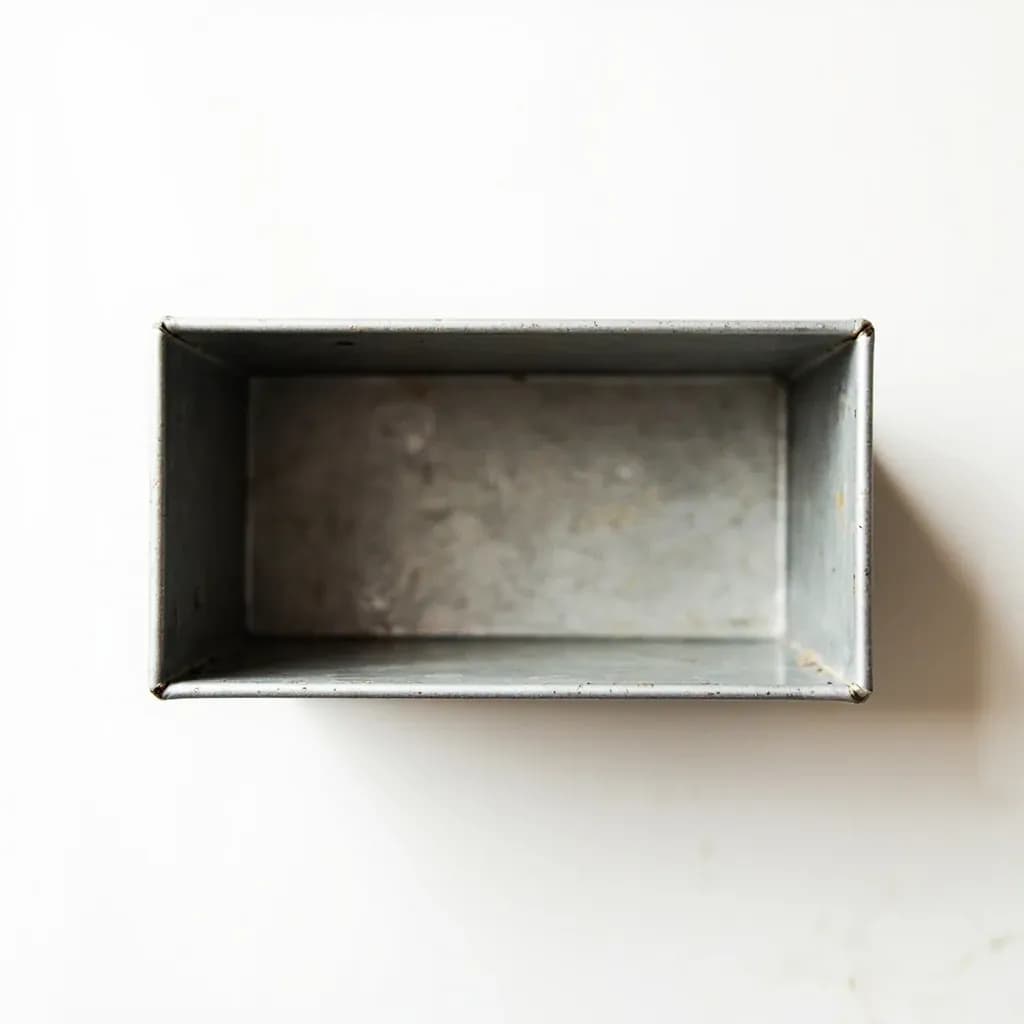
A bread loaf tin is a deep rectangular pan that contains rising and baking dough so it sets into a uniform loaf with a flat bottom and straight sides. It is the standard mold for sandwich bread, banana bread, meatloaf, and pound cake. Tins come in metal, often non-stick, and the proportions shape whether you get a low pan loaf or a tall sandwich loaf.
A bread loaf tin is the workhorse vessel for any bread that needs structural support while it rises and sets. Its straight, vertical walls do real work: they constrain the dough's expansion and force it upward, producing the tight, even crumb and tall, squared-off profile of a sandwich loaf. The enclosed pan also traps the bread's own steam, which keeps the crust soft and pale — the opposite of what you want from a free-form boule or baguette.
The pan you choose changes the bread you bake. Heavy-gauge aluminized steel, around 0.8–1.0 mm thick, is the benchmark: it heats evenly, resists warping, and browns reliably. Dark non-stick pans run hot and tend to scorch the edges and bottom unless you lower the oven temperature by about 25°F (15°C). Glass and stoneware are slow to heat but retain heat well, giving a deeper-colored, thicker crust on enriched doughs. Silicone is flexible and easy to unmold, but it transmits heat less efficiently than metal, so loaves bake paler and softer — fine for a quick bread, less ideal for a sandwich loaf with real crust.
Used well, a loaf tin takes the guesswork out of pan bread. The classic 9 × 5 × 3 in (23 × 13 × 7.5 cm) American pan, or the 1 lb (450 g) and 2 lb (900 g) British tins, will produce a standard sandwich loaf from roughly 800–1,000 g of dough at full working fill. Weighing the dough rather than estimating volume is the single most reliable way to get a consistent shape, because pan-bread ratios are unforgiving — a 100 g difference visibly changes the crumb. The Pullman, or pain de mie, tin with its sliding lid is the defining tool for square-crumbed milk bread and Japanese shokupan, and earns its keep if you bake those often.
Alternatives
Types & varieties
Open-top rectangular pan, 9 × 5 or 8.5 × 4.5 in; the everyday sandwich-loaf and quick-bread pan.
Tall, narrow pan with a sliding lid that produces a perfectly square, flat-topped crumb; the lid can be left off for a gently domed top.
About 5.75 × 3.25 in; for individual quick breads, small brioches, and gift loaves.
Holes or ridges that mimic a steam-injected oven; for crusty European-style breads baked in a pan rather than on a stone.
Fluted or straight-sided tin, often tapered with feet; the traditional shape for loaf-form brioche and enriched breads.
Heavy, heat-retaining, deep-browning; requires preheating and thorough greasing.
Flexible for easy unmolding; bakes paler because silicone transmits heat less efficiently than metal.
Thin, single-use pans for gifting, potlucks, and small batches; little structural support.
Slow to heat but retains heat well; useful for terrines, meatloaf, and breads where carryover cooking matters.
Choosing a pan: material and gauge
A loaf tin is one of the few pieces of bakeware where gauge matters as much as material. Thin aluminum warps in a hot oven, and a warped pan bakes unevenly, with the batter pooling to one side. Look for heavy-gauge aluminized steel (0.8–1.0 mm) or hard-anodized aluminum from a recognized commercial brand; these conduct heat evenly and hold their shape for years. Dark non-stick coatings are convenient but run hot — they bake roughly 25% faster than shiny pans, so reduce oven temperature by 25°F (15°C) to avoid scorched edges and a raw center.
- Heavy-gauge aluminized steel — the everyday workhorse, browns evenly, releases well with a butter-and-flour prep.
- Anodized aluminum — durable, non-reactive, and a good upgrade from a basic pan.
- Dark non-stick — convenient release, but edges brown fast; drop the oven temperature and consider lowering the rack.
- Cast iron — superb for deep, dark crusts on dense loaves; must be preheated and generously greased.
- Silicone — easy release with no greasing, but the crust stays pale and soft; best for quick breads and terrines.
- Glass or stoneware — slow to heat, retains heat long; ideal for meatloaf, pâté, and terrines where carryover cooking matters.
Fill ratios and dough weight
The single most useful number in pan-bread baking is the weight of dough going into the tin. Volume estimates mislead, because flour compacts differently with humidity and how you scoop. A 9 × 5 in pan typically wants 450–500 g of dough for a tidy, even-crumb sandwich loaf. Heavier fills — pushing toward the 800–1,000 g working capacity — produce a taller, crowned loaf that rises well above the rim, but you have less margin for oven spring and a greater risk of spillover. Quick breads and batters, which have no second rise, should fill ½ to ⅔ of the pan so the batter has somewhere to climb.
- Yeast sandwich loaf (9 × 5 in): about 450–500 g of dough for an even crumb; up toward 800–1,000 g for a tall, full-crowned loaf (mind the oven spring).
- Pullman pan (about 13 × 4 × 4 in): 450–500 g for a classic square pain de mie; around 600 g for a fuller loaf.
- Quick bread or pound cake: fill ½ to ⅔ of the pan's depth.
- Mini loaf pan: roughly 250–300 g of batter for an even crown.
Releasing and cooling
Timing the unmolding is the small craft that separates a tidy loaf from a torn one. Bread that sits in the tin too long continues to steam, and the trapped moisture softens the crust and can make the crumb gummy. Bread that comes out too early, before the crumb has set, tears at the bottom and collapses. Ten to fifteen minutes is the right window for most yeasted loaves and quick breads; the loaf should feel firm at the sides and pull away from the tin on its own.
- Line the pan with a parchment sling — a strip that overhangs the long sides — for a clean, no-tear release on enriched doughs.
- If the loaf resists, run a thin knife or offset spatula around the long edges before turning it out.
- Cool the loaf on a wire rack, not a flat surface, so air can circulate and the bottom crust stays dry.
- Invert a Pullman loaf onto a flat board, not a wire rack, so the squared top does not imprint with rack lines.
Common uses
Tips & pitfalls
- Weigh your dough or batter: aim for roughly 450–500 g of dough per 9 × 5 in pan for an even-crumb sandwich loaf. Too little produces a holey, sunken top; too much overflows.
- Grease with softened butter and dust with flour, or line the pan with a parchment sling that overhangs the long sides. Either method gives a clean, no-tear release.
- Light aluminum pans are forgiving for novices; dark non-stick pans demand a 25°F (15°C) reduction in oven temperature to avoid burnt edges and a raw middle.
- Skip the butter-and-flour method on a non-stick pan — a thin film of oil or baking spray is enough. Over-greasing causes the loaf to slide down and dome unevenly.
- Wait 10–15 minutes before unmolding. Bread that stays in the pan too long steams and gets a gummy crust; bread turned out too early tears at the bottom.
- For a domed sandwich loaf, fill the pan about ⅓ to ½ full and bake uncovered. For a flat Pullman-style top, fill ½–⅔ full and bake with the lid on.
- If your loaf pulls away from the sides early in the bake, the pan is too thin or the oven too hot. Switch to a heavier gauge tin and check oven temperature with a separate thermometer.
- Rotate the pan 180° at the halfway mark if your oven has hot spots. Loaf tins are deep, and the back of the pan almost always browns faster than the front.
Good to know
- Also called
- Loaf pan, bread pan
- Standard US size
- 9 × 5 × 3 in (23 × 13 × 7.5 cm); 8.5 × 4.5 in is also common
- UK metric size
- 1 lb (450 g) and 2 lb (900 g) tins
- Capacity (9 × 5 in)
- Roughly 800–1,000 g of dough for a sandwich loaf at full working fill
- Common materials
- Aluminum, aluminized steel, non-stick coated steel, cast iron, silicone, glass, stoneware
- Dark vs light pans
- Dark finishes bake ~25% faster — reduce oven temperature by 25°F (15°C) when substituting
- Fill guideline
- Yeast doughs ⅓ to ½ full; quick breads and batters ½ to ⅔ full
- Rest before unmolding
- 10–15 minutes in the pan so residual steam can finish setting the crumb
Also called
bread-tin · loaf tin · loaf pan · bread pan
Related

Muffin Pan
Multi-cup pan for muffins, cupcakes, and egg bites

Bundt Pan
Fluted ring mold for showstopping cakes with a center hole

Springform Pan
Latch-release pan that frees delicate cakes without flipping

Pie Dish
Sloped round dish for crisp-bottomed pies and quiches

Tart Pan
Fluted pan with a pop-out base for clean-edged tarts

Rolling Pin
Rolls dough into even sheets for pastry and bread

Pastry Brush
Brushes on egg wash, glaze, butter, and marinades

Bench Scraper
Flat blade that divides dough and clears your work surface