Prep Tools
Brine Injector
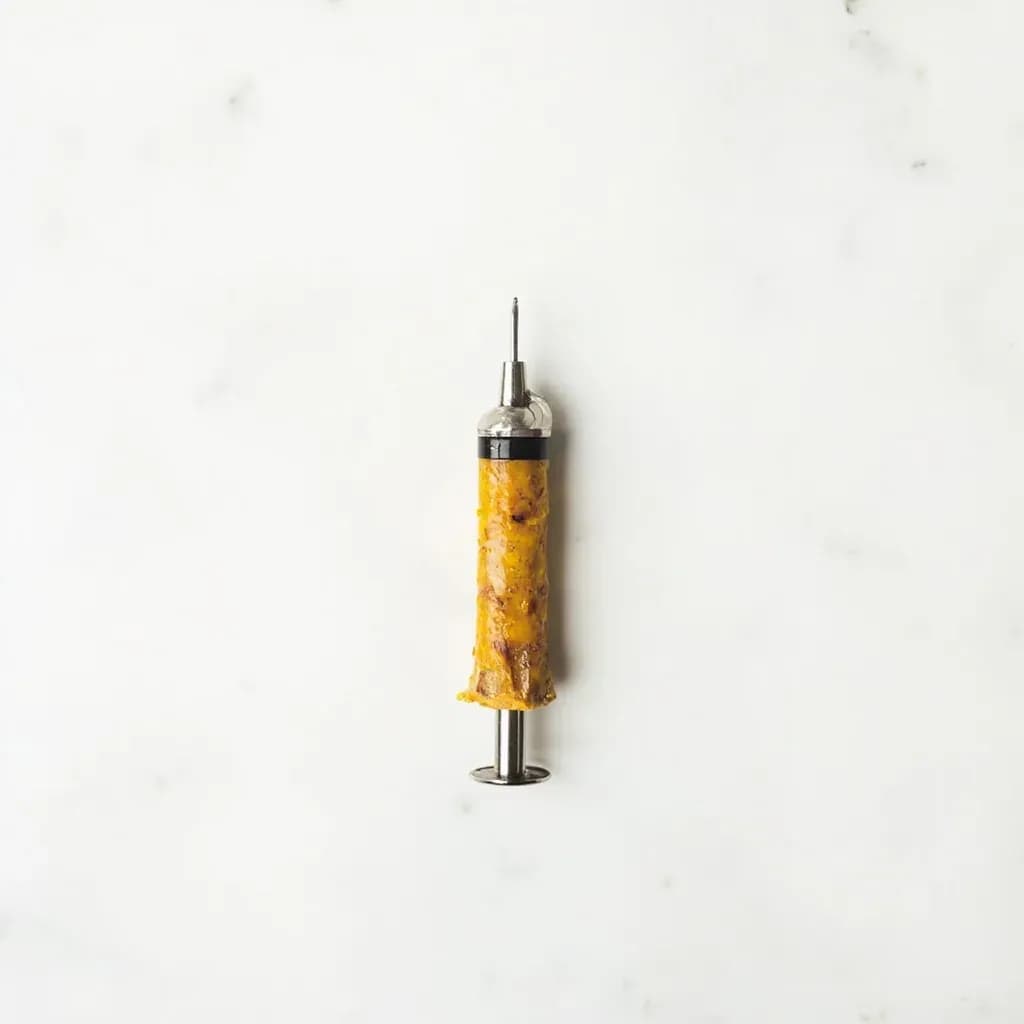
A large syringe with a perforated needle that pumps brine or marinade deep into meat.
A brine injector is an oversized syringe fitted with a thick, perforated needle used to push seasoned liquid directly into the interior of roasts, poultry, and pork. Injecting saves the long wait of surface brining and seasons meat all the way through, keeping it juicy during long roasts and smokes. Side-ported needles distribute the liquid evenly instead of forcing it all out one tip.
A brine injector is a hand-pumped syringe fitted with a long, hollow needle perforated along its shaft — and those side holes are the whole point. A single-tip needle would deliver liquid in one narrow tunnel; multiple lateral openings fan the brine outward as the plunger is pressed, so salt and flavor disperse through the muscle instead of pooling in a pocket. The home cook's version is a direct descendant of the industrial "enhancement" systems meat processors have used for decades, scaled down to a 1–2 ounce barrel and a 3–6 inch needle you can operate with one hand. It earns its place in the kitchen whenever you are cooking a cut too large or too thick for surface brining or marinating to reach the center in time — whole poultry, brisket, pork shoulder, and big roasts are its natural territory. On small cuts like steaks or pork chops, where a short soak does the job, it is unnecessary; on delicate fish, the needle holes will shred the flesh.
Alternatives
Types & varieties
The classic home model: one perforated needle, 1–2 oz barrel, plastic or stainless body. The most widely sold type and all most cooks need.
3–4 oz barrel for whole turkeys, briskets, or pork shoulders so you refill less often.
Two or three needles on a single barrel for faster, wider coverage on very large cuts.
More durable and dishwasher-safe than plastic; favored in restaurant and competition use.
Lighter and cheaper; gaskets and barrel can wear out or crack with heavy use.
A marketing name, not a different tool — usually a long-needle, moderate-capacity single injector sold around the holidays.
Heavier-duty, all-metal construction with reinforced plungers for high-volume kitchen use.
Why side holes matter
A needle that only opens at the tip deposits liquid in one channel, which the meat then slowly reabsorbs — and a good deal of which runs back out the entry wound. A perforated needle with multiple side holes distributes the same volume across a wider column of muscle, so salt, fat, and aromatics reach more fibers before they migrate or leak. It is the single design choice that separates a useful injector from a frustrating one.
- Look for needles with at least three side holes; six or more is better for thick cuts.
- Holes should be deburred and smooth — rough edges tear muscle and leave visible tunnels.
- A clogged or bent tip is the most common failure, so a sturdy, easy-to-clean needle design matters more than fancy features.
How much to inject
There is a ceiling, and crossing it is the most common home mistake. Commercial processors often pump in up to about 15% of the raw weight; for home cooking, 10% is plenty, and anything past roughly 15% starts to read as wet, spongy, and faintly ham-like. The meat should still feel like meat after the liquid goes in, not like a saturated sponge.
- 10% of raw weight is a reliable target for most poultry and pork shoulder.
- 10–12% is right for lean brisket; fattier cuts can take a little less.
- Weigh the cut, weigh the liquid you draw into the barrel, and keep a rough tally as you go so you do not overshoot.
Common uses
Tips & pitfalls
- Always strain your brine or injection liquid through a fine-mesh sieve — solids clog the needle and side holes, and a single stuck fleck of garlic can ruin the flow mid-pump.
- Warm the liquid slightly so salt and sugars are fully dissolved and it moves freely; cold brine with undissolved sugar will jam the barrel.
- Inject in a grid pattern across the cut, spacing punctures about 1–1.5 inches apart, so the fanned liquid overlaps and the whole piece seasons evenly.
- Pull the needle out slowly while still pressing the plunger — this lets the liquid fill the channel as it withdraws and prevents a single pocket that leaks back out the entry hole.
- Stop about half an inch before the surface; injecting too close to the edge causes puddles under the skin and visible wet spots when you slice.
- For a whole turkey or chicken, target the thickest parts of the breast, thighs, and drumsticks — wings and back are too thin and thin-skinned to absorb much.
- Rest the meat 30–60 minutes after injecting so the liquid can diffuse through the surrounding muscle before it hits the heat; cooking immediately wastes much of the work.
- Don't over-inject: stick to roughly 10% of the meat's weight in added liquid. Past 15% the texture turns soft, wet, and reads as a mistake.
- Wipe the needle between insertions and rinse it if you have been in a fatty or sugary liquid — residue builds up fast and slows the flow.
- Disassemble and wash thoroughly after every use; salt is corrosive and will pit stainless steel if it sits in the barrel overnight.
- Lubricate rubber gaskets with a drop of food-grade oil periodically so the plunger does not stiffen and start squirting brine sideways.
- Avoid driving the needle straight into bone — angle alongside it into the meat, or you will blunt the tip and dent the needle.
Good to know
- Also called
- Meat injector, marinade injector, flavor injector, turkey injector
- Form factor
- Hand-held syringe with a hollow, perforated needle
- Typical home capacity
- 1–2 oz (30–60 ml); larger models run 3–4 oz
- Needle length
- Roughly 3–6 inches (7.5–15 cm), with multiple side perforations
- Common materials
- Stainless steel needle; barrel of food-grade plastic or stainless steel; rubber or silicone plunger seal
- How it works
- Side holes along the needle shaft, not just at the tip, fan liquid laterally through the muscle
- Power source
- Manual hand-pumped; no standard electric kitchen models
- Cleaning
- Disassembles for washing; needles must be cleared of salt to prevent corrosion and clogging
Also called
meat injector · marinade injector · flavor injector
Related

Peeler
Swift blade for stripping skin off fruit and vegetables

Grater
Sharp-toothed surface for shredding cheese and vegetables

Microplane
Ultra-fine rasp for citrus zest, garlic, and hard cheese

Mixing Bowl
All-purpose bowl for combining, whisking, and tossing

Whisk
Looped wires that beat air into eggs, cream, and sauces

Spatula
Flat blade for flipping, lifting, and scraping

Slotted Spoon
Pierced spoon that lifts solids and drains the liquid behind

Wooden Spoon
Gentle, heat-friendly spoon for stirring anything