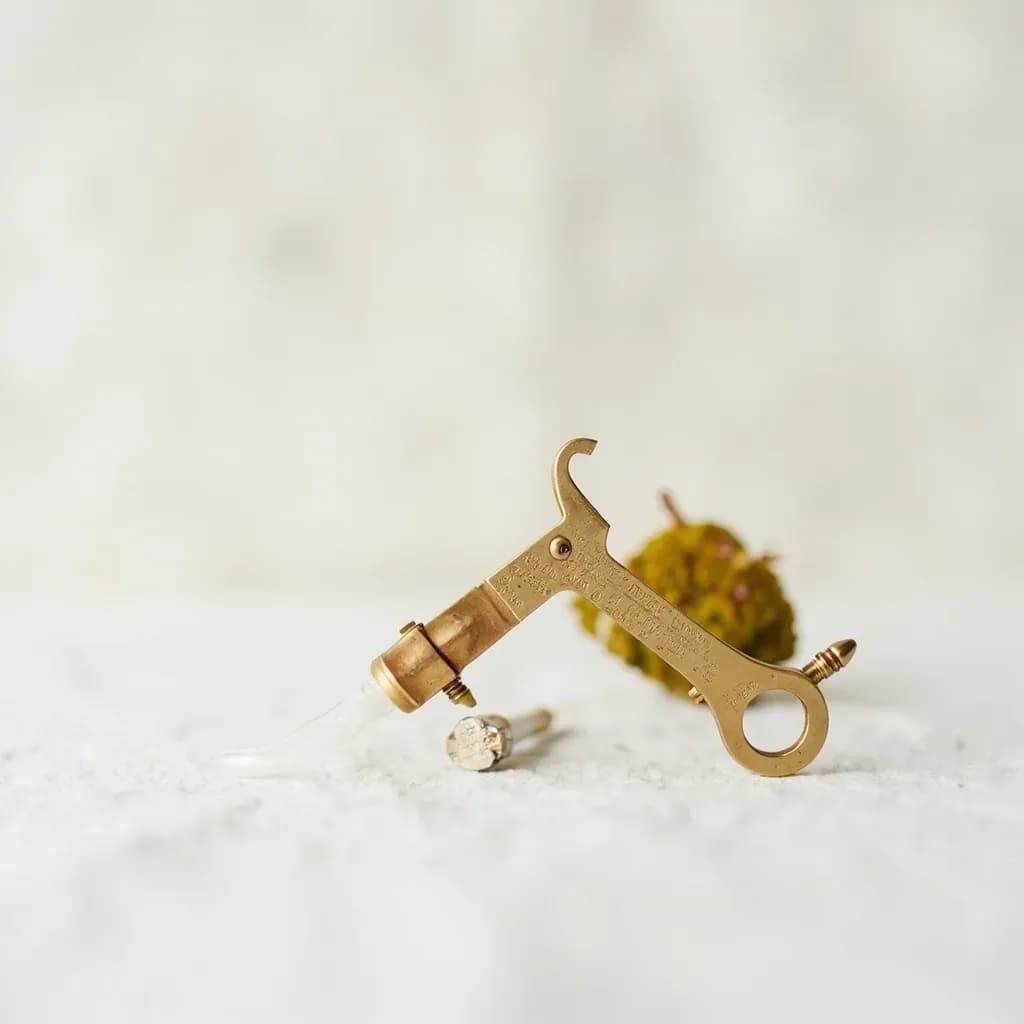
Prep Tools
Brix Refractometer
A handheld optical meter that reads sugar concentration in juice, syrup, or wort by light refraction.
A Brix refractometer measures dissolved sugar content by how much a few drops of liquid bend light, reading out on a degrees-Brix scale. Cooks, brewers, winemakers, and jam and honey producers use it to gauge ripeness, sweetness, and fermentable sugars before processing. A couple of drops on the prism and a glance toward light give an instant reading, and the included pipette or 'thief' draws samples cleanly.
A Brix refractometer is a small optical instrument that measures the concentration of dissolved solids — essentially sugar — in a liquid by how much the liquid bends light. A drop of juice, syrup, wort, or honey is placed on a glass prism, the cover plate is closed, and the user looks through an eyepiece toward a light source. The boundary between the bright and dark fields of the view corresponds to a scale calibrated in degrees Brix (°Bx), where 1°Bx equals 1 gram of sucrose per 100 grams of solution. It is, in practical terms, the fastest way a cook or producer can answer the question 'how sweet is this, really?'
What makes the refractometer uniquely useful in the kitchen is that it reads soluble solids directly, from a single drop, in seconds, with no sample preparation. A hydrometer can tell you the sugar of wort or must, but only if you have a large enough sample, a temperature-corrected reading, and a still vessel to float it in. A refractometer needs two or three drops on a plate and a glance. That same property — tracking dissolved solids in real time — is exactly what a jam cook needs to know when the pot reaches gel, what a beekeeper uses to confirm honey hasn't been watered down, and what a vintner watches as grapes approach ripeness.
The scale is calibrated against pure sucrose, so readings on fructose- and glucose-rich liquids (honey, very ripe fruit, invert sugar) are best read as comparative values rather than absolute sugar weights. Acids and salts contribute a small amount too, which is why a sour lemon juice will read a degree or two above its true sugar content. None of that matters much in day-to-day cooking; what matters is that the same instrument, used the same way, gives you a reliable trend from sample to sample.
Alternatives
Types & varieties
Handheld eyepiece type powered by ambient daylight; the everyday kitchen and farm-stand workhorse
Electronic sensor with LCD readout; faster, often ATC, easier to read in dim light, more expensive
Built-in Automatic Temperature Compensation; the practical choice for kitchens without controlled-temp conditions
Common in home brewing; converts °Bx to SG for wort using Brix-to-SG conversion tables (the Plato and Brix scales are nearly identical, so the same tables serve both)
Suited to honey, concentrated juices, maple syrup, condensed milk
Best for fruit juice, soft drinks, wine, and other low-sugar liquids — gives the sharpest resolution
Reads specific gravity of urine or nD (refractive index); sometimes mis-sold for food use but not interchangeable with °Bx
Mounted in a pipe or kettle wall for continuous Brix monitoring in commercial production
Reading the Boundary
When you look through the eyepiece, you see a circular field divided into a bright upper half and a darker lower half, with a scale running through the middle. The reading is taken at the exact line where the boundary crosses the scale. If the boundary looks fuzzy or is surrounded by colored fringes, the sample is streaky, the plate is not flat, or the prism and liquid are not at the same temperature. Closing the cover plate firmly, waiting about thirty seconds, and aiming the daylight plate at a steady light source (a window or a phone torch) will sharpen the line considerably. Do not read where the colors appear; read the sharp edge of the transition.
- Aim the daylight plate at a window or a steady lamp — ambient room light alone often gives a washed-out field
- The reading is taken at the boundary line, not at the colored fringe above it
- If the line won't sharpen, the most common causes are bubbles, an under-filled plate, or a prism/sample temperature mismatch
The Jam Gel Check
The single most useful application in a home kitchen is confirming the gel point of jam, jelly, or marmalade. A finished cooked fruit preserve lands at roughly 65°Bx — about 65 g of sugar per 100 g of finished mixture, which is the concentration at which pectin sets into a firm gel. The traditional cold-plate wrinkle test works, but it tells you only that you have crossed a threshold, not how far. A refractometer tells you exactly where you are. Spoon a small amount of the boiling mixture onto a cold saucer, let it cool to room temperature (hot samples read artificially high and can damage the prism seal), and put two or three drops on the plate. Read against 65°Bx as your target.
- Target: 65–67°Bx in the cooled finished preserve for a classic set
- Always cool the sample first — hot jam can read several degrees too high and may stress the prism seal
- Below 62°Bx and the preserve will not gel; above 68°Bx it will set very stiff and taste oversweet
Brix vs. Specific Gravity
Brewers, vintners, and cidermakers often need Specific Gravity (SG) rather than Brix. A dual-scale refractometer displays both, but if you have a Brix-only instrument, a workable approximation is SG ≈ 1 + (0.004 × °Bx). A wort at 12°Bx therefore reads roughly SG 1.048. The conversion is approximate because °Bx is a weight/weight measure of sugar, while SG is a density measure of the whole liquid — they only line up cleanly for plain sucrose solutions. For most home-brewing purposes the approximation is close enough; for competition brewing, use a hydrometer on the cooled wort as a check.
- Approximation: SG ≈ 1 + (0.004 × °Bx)
- Best used for plain sucrose worts and musts; honey and fruit juices deviate slightly
- Always confirm critical readings with a hydrometer when the recipe is sensitive to gravity
Common uses
Tips & pitfalls
- Calibrate with distilled water at room temperature every time the unit changes temperature or has sat unused for a day — tap water is mineralized and will not read exactly 0.0°Bx
- Take at least three drops and average them; sugars in fruit vary drop to drop, especially in pulpy or fibrous samples like crushed tomatoes or stone fruit
- Press the cover plate down before reading so the liquid spreads as a thin, even film — bubbles and streaks give a fuzzy, unusable boundary
- Wait about thirty seconds for the sample and prism to equilibrate so ATC settles on the correct value
- Use the 0–90°Bx scale for honey and concentrated syrups; the 0–32°Bx scale gives sharper resolution on fruit juice and wort
- Clean the prism with a soft lens tissue — paper towels and kitchen cloths will scratch the glass and permanently ruin the boundary line
- Rinse and dry the instrument before moving from a high-Brix sample to a low one to avoid carryover skewing the next reading
- For cooked sugar work, read cooled samples; hot liquids read artificially high and the heat can damage the prism seal over time
- Avoid 'clinical' refractometers sold on general marketplaces — their scale (urine specific gravity or nD) is not interchangeable with °Bx and will give nonsense readings on food
Good to know
- Inventor of the Brix scale
- Adolf Brix, a German mathematician, who refined the scale in 1854 for brewing use (building on Carl Balling's earlier work)
- Principle
- Measures the refractive index of a liquid; the index rises predictably with dissolved sugar concentration
- Unit
- °Bx (degrees Brix); 1°Bx equals 1 g sucrose per 100 g of solution, by weight
- Typical range
- Handheld kitchen models span 0–32°Bx for fruit/juice or 0–90°Bx for honey and concentrates; dual-scale units exist
- Resolution
- Analog units read in 0.2°Bx steps; digital units typically resolve to 0.1°Bx
- Calibration standard
- Distilled water at 20°C reads 0.0°Bx
- Temperature sensitivity
- Refractive index shifts ~0.1°Bx per 5°C; ATC (Automatic Temperature Compensation) units self-correct in roughly 10–30°C or 10–40°C
- Sample size
- 2–3 drops of liquid on the daylight plate
- Typical jam gel point
- About 65°Bx (65–67% sugar by weight) in the cooled finished preserve
- Honey reference range
- Genuine honey reads roughly 80–85°Bx; below ~70°Bx suggests water adulteration or under-ripe harvest
Also called
Sample Pipette / Thief · Sugar Refractometer · Brix Meter
Related

Peeler
Swift blade for stripping skin off fruit and vegetables

Grater
Sharp-toothed surface for shredding cheese and vegetables

Microplane
Ultra-fine rasp for citrus zest, garlic, and hard cheese

Mixing Bowl
All-purpose bowl for combining, whisking, and tossing

Whisk
Looped wires that beat air into eggs, cream, and sauces

Spatula
Flat blade for flipping, lifting, and scraping

Slotted Spoon
Pierced spoon that lifts solids and drains the liquid behind

Wooden Spoon
Gentle, heat-friendly spoon for stirring anything