Prep Tools
Bubble Remover / Headspace Tool
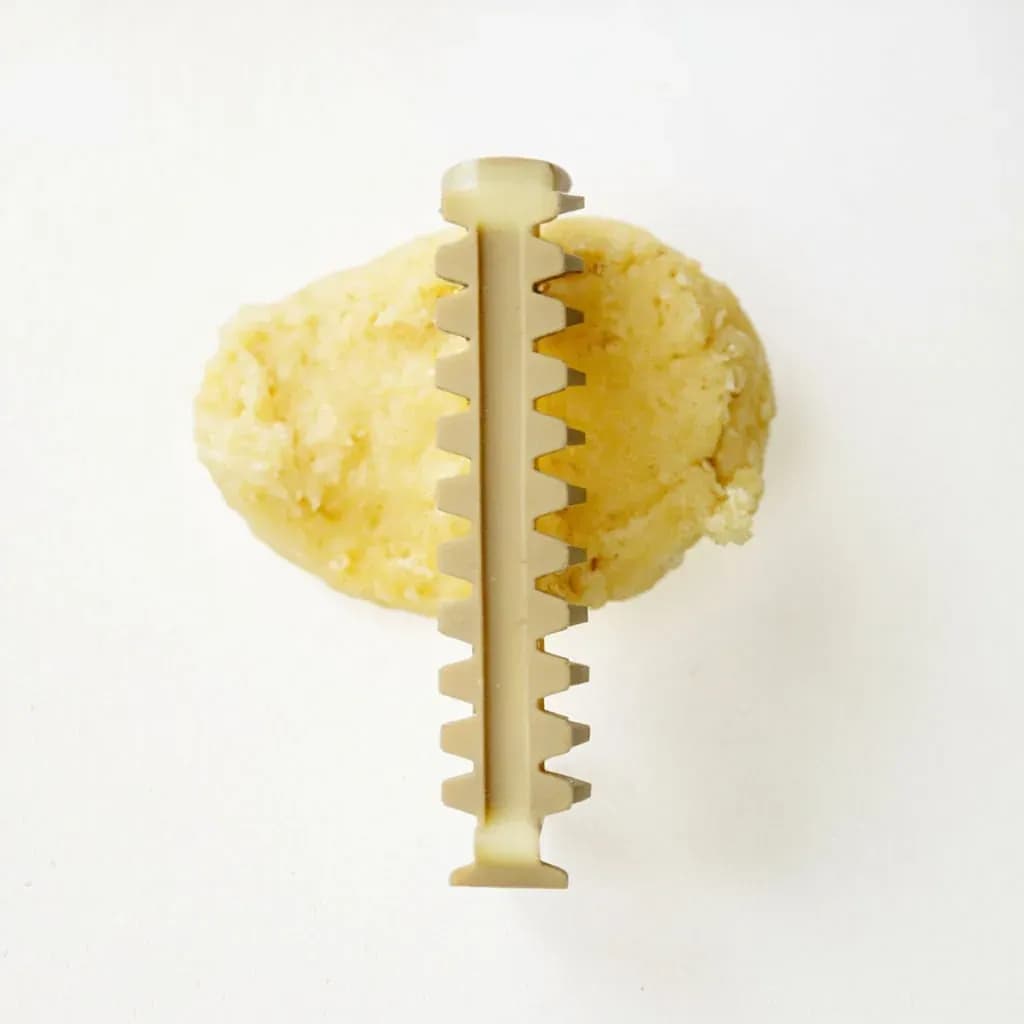
A slim plastic tool that releases trapped air bubbles and measures headspace when filling canning jars.
A bubble remover is a thin, often notched plastic stick slid down the inside of a packed canning jar to pop air pockets that could spoil a seal. One end usually has graduated steps to measure the headspace left between food and the lid. Removing bubbles and setting correct headspace are both critical for a reliable vacuum seal during canning.
A bubble remover—also called a bubble freer, headspace tool, or canning wand—is a slim, rigid plastic blade roughly 8 to 9 inches long, etched with inch and centimeter graduations. It serves two related jobs at once: sliding down the inside wall of a filled canning jar to release trapped air pockets before the lid goes on, and acting as a small ruler so the canner can verify the gap between the food surface and the jar rim against the recipe's specification. Most wands have a squared flat end for bubble work and a slightly tapered or pointed end for working around the jar's circumference.
The tool matters because trapped air is one of the most common, preventable reasons home-canned food spoils or seals fail. Bubbles pocketed in jams, pickles, and chunks of fruit interfere with heat penetration during boiling-water-bath or pressure processing, can lift solids up out of the liquid (the floating-fruit problem), and may cause liquid to siphon out of the jar mid-process. The same tool addresses the other half of the equation—headspace. Too little headspace lets food push under the lid and break the seal; too much leaves residual oxygen that encourages spoilage organisms, and in pressure canning it can prevent the vacuum from forming properly.
Plastic is a deliberate choice. A metal knife or fork can scratch glass and, worse, can cause thermal shock when plunged into a hot jar. Wooden chopsticks—the most common improvised substitute—will splinter with repeated hot-jar use and carry no headspace scale. Food-safe polypropylene is rigid enough to work between food and glass without bending, inert against acidic foods like tomatoes and citrus, and stays comfortable to hold across a long canning session.
Alternatives
Types & varieties
Plain flat plastic wand with measurement markings; the most common style.
Marked explicitly at 1/4, 1/2, and 1 in so headspace can be read directly against the jar rim.
One flat edge for bubble work, the other narrower or rounded for working around the jar's circumference.
Multi-tools that combine a bubble wand with a magnetic lid lifter; the bubble-remover portion is identical in function.
Common home-canning stand-in that works in a pinch but has no headspace scale and can splinter with repeated use against hot glass.
Why headspace is not a suggestion
Tested canning recipes give a specific headspace range for a reason: it controls how much air remains in the jar after the lid seals, which in turn controls how the vacuum forms and how heat moves through the food during processing. The bubble remover's printed scale exists because eyeballing this distance is one of the most reliable ways to get inconsistent results across a batch, and the difference between a safe jar and a failed one often comes down to fractions of an inch.
- Too little headspace (under-filled): food expands during processing and is forced up under the lid, breaking the seal or leaving residue on the rim that prevents it from forming in the first place.
- Too much headspace (over-filled): extra oxygen remains in the jar, which encourages mold and yeast growth in high-acid foods and prevents a proper vacuum from forming, leaving the lid loose or buckled.
- Pressure canning is the least forgiving case: the 1-inch standard for low-acid vegetables, meats, and soups is calibrated for safe siphoning behavior and seal formation. Being off by 1/8 inch here is more consequential than the same margin of error in a high-acid water-bath batch.
- High-acid water-bath canning (jams, pickles, fruit): the 1/4 to 1/2 inch tolerances are tighter in number but more forgiving in outcome—slight errors usually show up as cosmetic discoloration or a weaker vacuum rather than a safety failure.
Common uses
Tips & pitfalls
- Always remove bubbles before wiping the rim and applying the lid; bubbles rise up as you work and the headspace will shift.
- Insert the tool down the inside wall and move it in a slow circle around the perimeter rather than stabbing the center, which crushes soft fruit and pushes solids up.
- After de-bubbling, recheck headspace—the food level almost always drops—and top up with hot liquid to bring it back to the recipe's specification.
- Use plastic, not a metal knife or fork: metal can cause thermal shock against hot glass and can nick the jar, increasing breakage risk in the canner.
- For thick jams and preserves, tap the filled jar gently on a folded towel before using the wand; the impact releases large pockets that the tool then catches around the sides.
- Hold the tool vertically so its etched markings read cleanly against the rim—headspace is measured from the flat top of the food to the top of the jar, not the threads.
- If liquid weeps up around the tool as you work, slow down; you are agitating too vigorously and may be incorporating new air rather than removing it.
- Rinse and dry the wand between batches when switching between acidic and low-acid foods to avoid cross-contamination.
- Replace the wand once the printed markings wear off; without a readable scale, its main function is gone, even if the plastic itself is still sound.
- A wooden chopstick works in a pinch but has no graduations and can develop splinters—keep a proper plastic wand in your canning kit.
Good to know
- Also called
- Bubble freer, bubble popper, headspace tool, canning wand
- Material
- Food-safe rigid plastic, typically polypropylene
- Length
- Roughly 8–9 in (20–23 cm)
- Markings
- Inch and centimeter graduations in 1/4 in (≈0.5 cm) increments
- Headspace standards (US)
- 1/4 in for jams, jellies, preserves; 1/2 in for fruits, pickles, tomatoes, and most sauces; 1 in for low-acid pressure-canned vegetables, meats, and soups
- Trapped air effects
- False seals, liquid siphoning, uneven heat penetration, and floating or sifted fruit
- Care
- Hand wash in warm soapy water; not typically dishwasher safe; replace if markings fade or plastic clouds or cracks
- Notable brands
- Ball, Kerr, Bernardin, Norpro, Tattler
Also called
bubble popper · headspace tool · bubble freer
Related

Peeler
Swift blade for stripping skin off fruit and vegetables

Grater
Sharp-toothed surface for shredding cheese and vegetables

Microplane
Ultra-fine rasp for citrus zest, garlic, and hard cheese

Mixing Bowl
All-purpose bowl for combining, whisking, and tossing

Whisk
Looped wires that beat air into eggs, cream, and sauces

Spatula
Flat blade for flipping, lifting, and scraping

Slotted Spoon
Pierced spoon that lifts solids and drains the liquid behind

Wooden Spoon
Gentle, heat-friendly spoon for stirring anything