Prep Tools
Butcher's Scale
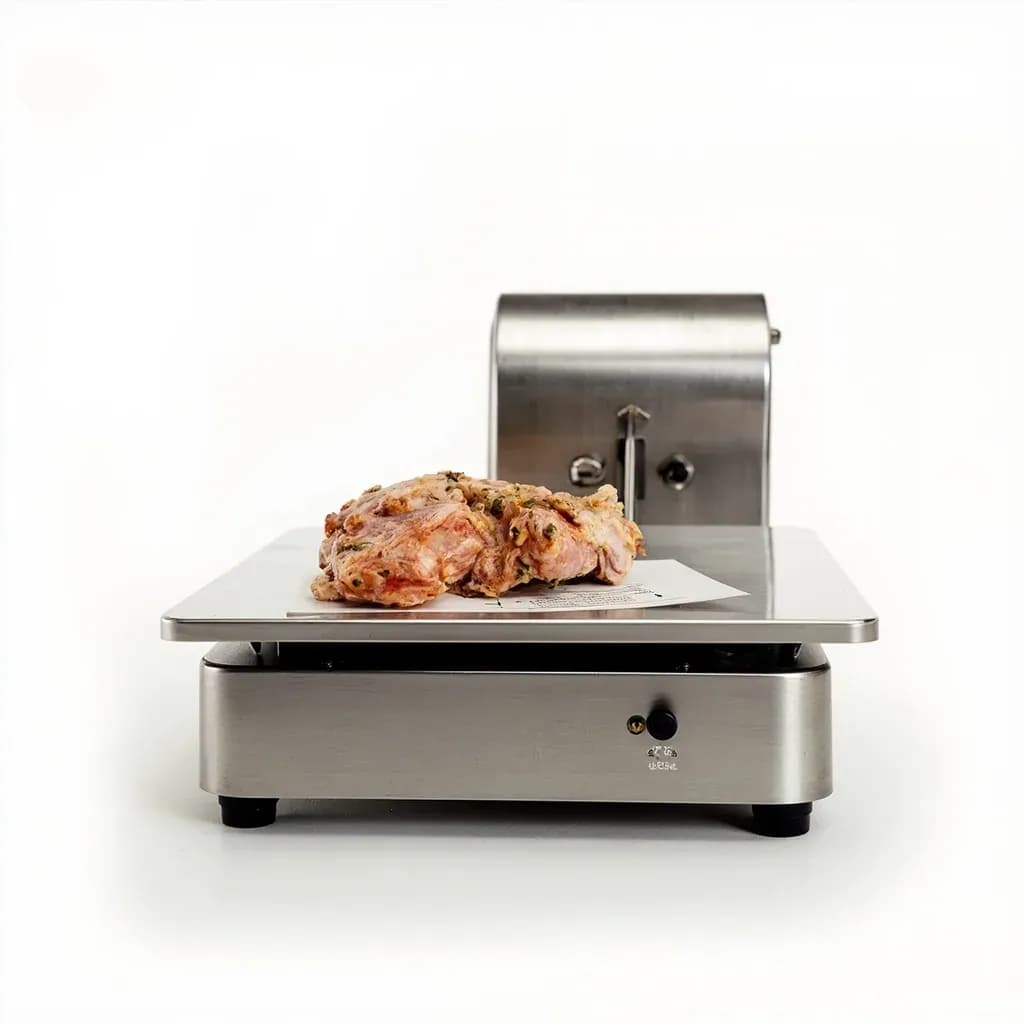
A counter scale that weighs meat and prints a priced, weighted label for the case.
A butcher's scale is a heavy-duty digital counter scale, often with a built-in printer, that weighs cuts of meat and produces a label showing weight, price per unit, and total cost. Butchers and deli counters use it to portion and price product accurately for sale. Many integrate with a register or inventory system and print barcoded labels for the display case.
A butcher's scale is a legal-for-trade weighing instrument that pairs a precision load cell with an integrated price computer and a direct-thermal label printer, turning raw weight into a priced, barcoded, dated retail label in a single motion. On a typical supermarket meat counter the butcher sets a tray on the platform, taps the PLU for, say, a boneless ribeye, lays the cut on the tray, and the scale prints a label showing net weight, price per pound, total price, sell-by date, country of origin, PLU number, and a scannable barcode — the whole transaction captured without a calculator or a second device. The same family of scales also shows up at the receiving dock for invoice checking, in the prep room for portioning steaks and patties to a target weight, and at customer-facing bulk and seafood stations.
The modern electronic price-computing scale replaced the swinging beam and overhead dial that defined butcher shops for most of the 20th century. That older Toledo- and Detecto-style equipment was purely mechanical, requiring the operator to slide poises along a calibrated beam to read weight; today's units digitize the process, store thousands of price look-up codes, and network into POS and back-office systems so price changes and ingredient statements can be pushed from a central computer. In a regulated retail setting — anywhere meat is sold by weight in the U.S. or Canada — the scale itself must be certified (NTEP or Measurement Canada, typically Class III), and that legal status is what separates a butcher's scale from a kitchen portion scale on a home prep table.
Alternatives
Types & varieties
The classic counter unit: flat stainless platform, triple display, integrated thermal label printer — the workhorse of the retail meat case.
Old-school overhead scale with a hook and large rotating dial, once ubiquitous in butcher shops and now mostly decorative or used in very small shops.
Customer-facing scale in produce, bulk, or seafood sections; usually no printer on the unit, label printed from a separate dispenser on a keypress.
Heavy-capacity floor or bench scale (60–600+ lb) at the back dock to verify incoming subprimals, primals, and case weights against the invoice.
Compact, higher-resolution unit (often 0.1 oz / 2 g) used in prep to standardize cut sizes, burger patties, sausage links, and recipe batches.
Light-tree or color-bar display that shows at a glance whether a portion is under, over, or on target weight; used for QC and yield tracking.
Connects to PLU management and labeling software so price and name changes are pushed from a central computer; standard in chain supermarkets.
Sealed stainless scale built to be hosed down; the default in fresh meat rooms and seafood counters where blood, brine, and ice are constant.
From beam to barcode
For most of the 20th century a butcher's scale was a piece of cast iron: a flat platform, a vertical column, and a horizontal beam with sliding poises that the operator moved by hand until the beam balanced, then read the weight off engraved markings. The iconic round Toledo and Detecto dial scales that hung from the ceiling of every neighborhood shop worked the same way mechanically, just with a spring and a geared face. Those scales were elegant, but they had no memory, no PLU file, and no way to print a price sticker.
The shift to electronic scales happened through the 1980s and 1990s. Load cells replaced beams, microprocessors replaced mental arithmetic, and direct-thermal printers replaced hand-written stickers. Once the scale became a networked device — first via RS-232, later USB, Ethernet, and Wi-Fi — it stopped being a scale in the old sense and became a hybrid weighing, pricing, labeling, and inventory terminal. A modern chain can change the price of organic boneless chicken thigh across hundreds of stores from a single PLU update pushed overnight.
Choosing the right scale for the job
Picking a butcher's scale is less about brand and more about matching capacity, resolution, and features to the work. A few rules of thumb cover most situations:
- Pick capacity at least 25% above your heaviest typical item; running near the top of a load cell's range hurts accuracy and shortens its life.
- Match resolution to the task — 0.01 lb is fine for retail pricing a roast, but 0.005 lb (2 g) is worth it if you portion steaks to a target weight for food cost control.
- Choose a washdown (IP65/IP68) housing anywhere blood, brine, or seafood ice is present; standard units will fail at the cable entry and load cell.
- For pre-pack stations, look for a tare-memory PLU so the operator does not retare the tray and film on every pack.
- In a regulated retail setting, confirm NTEP (USA) or Measurement Canada (Canada) certification and Class III designation before purchase — a non-certified scale cannot legally sell by weight.
Common uses
Tips & pitfalls
- Calibrate on a known schedule with certified test weights; drift is the single most common cause of pricing errors and short-weight complaints.
- Use the tare function for every tray, sheet pan, or container — never subtract container weight in your head.
- Place the scale on a level, vibration-free, draft-free surface; air currents from a fan or HVAC vent will make the weight flicker and slow service.
- Keep the load cell and platform clean and dry; meat fat, brine, and blood seeping into the housing is the leading cause of scale failure.
- Use direct-thermal labels rated for refrigerated meat cases — standard paper labels smear and fade under display lighting and condensation.
- Save common tare weights (tray + film, sheet pan + liner) to a PLU key so staff do not retare on every pack.
- Update the PLU file whenever prices, product names, or ingredient statements change; many short-weights trace back to a stale price-per-pound, not a faulty scale.
- Train every counter employee on pre-pack mode versus by-the-piece mode; mis-mode selection is a frequent source of mispriced labels and lost margin.
- Never weigh items above the scale's rated capacity, even briefly — overload can permanently damage a load cell.
- In the U.S., only NTEP-certified units may be used to sell by weight; using a non-certified scale can void a sale legally and trigger fines.
- Back up PLU data and label templates off the scale — power surges and field-service visits are a surprisingly common way to lose programming.
Good to know
- Also called
- Price-computing scale, meat scale, label-printing scale, portion control scale
- Typical construction
- Stainless steel platform and housing, often washdown-rated (IP65/IP68) for hose-down cleaning
- Common capacities
- Dual range, commonly 0–15 lb × 0.005 lb / 0–30 lb × 0.01 lb at the counter; 60–600+ lb at receiving
- Readability
- 0.01 lb (≈5 g) for retail pricing; 0.005 lb (≈2 g) for portioning; 0.1 oz (≈3 g) for recipe and patty work
- Display
- Triple LCD showing weight, unit price ($/lb), and total price simultaneously, readable from both operator and customer sides
- Label printer
- Direct-thermal print head, 2–3 in wide, printing weight, $/lb, total, PLU, sell-by, barcode, country of origin, ingredients, and allergens
- Legal-for-trade
- Must be NTEP-certified (USA) or Measurement Canada–approved (Class III typical) to be used for selling by weight
- Origin
- Mechanical counter-and-beam and overhead dial scales (Toledo, Detecto) were the U.S. meat-market standard from the early 20th century; electronic models took over from the 1980s onward
Also called
Label-Printing Scale · Label Scale · Deli Scale
Related

Peeler
Swift blade for stripping skin off fruit and vegetables

Grater
Sharp-toothed surface for shredding cheese and vegetables

Microplane
Ultra-fine rasp for citrus zest, garlic, and hard cheese

Mixing Bowl
All-purpose bowl for combining, whisking, and tossing

Whisk
Looped wires that beat air into eggs, cream, and sauces

Spatula
Flat blade for flipping, lifting, and scraping

Slotted Spoon
Pierced spoon that lifts solids and drains the liquid behind

Wooden Spoon
Gentle, heat-friendly spoon for stirring anything