Prep Tools
Butter Tea Churn
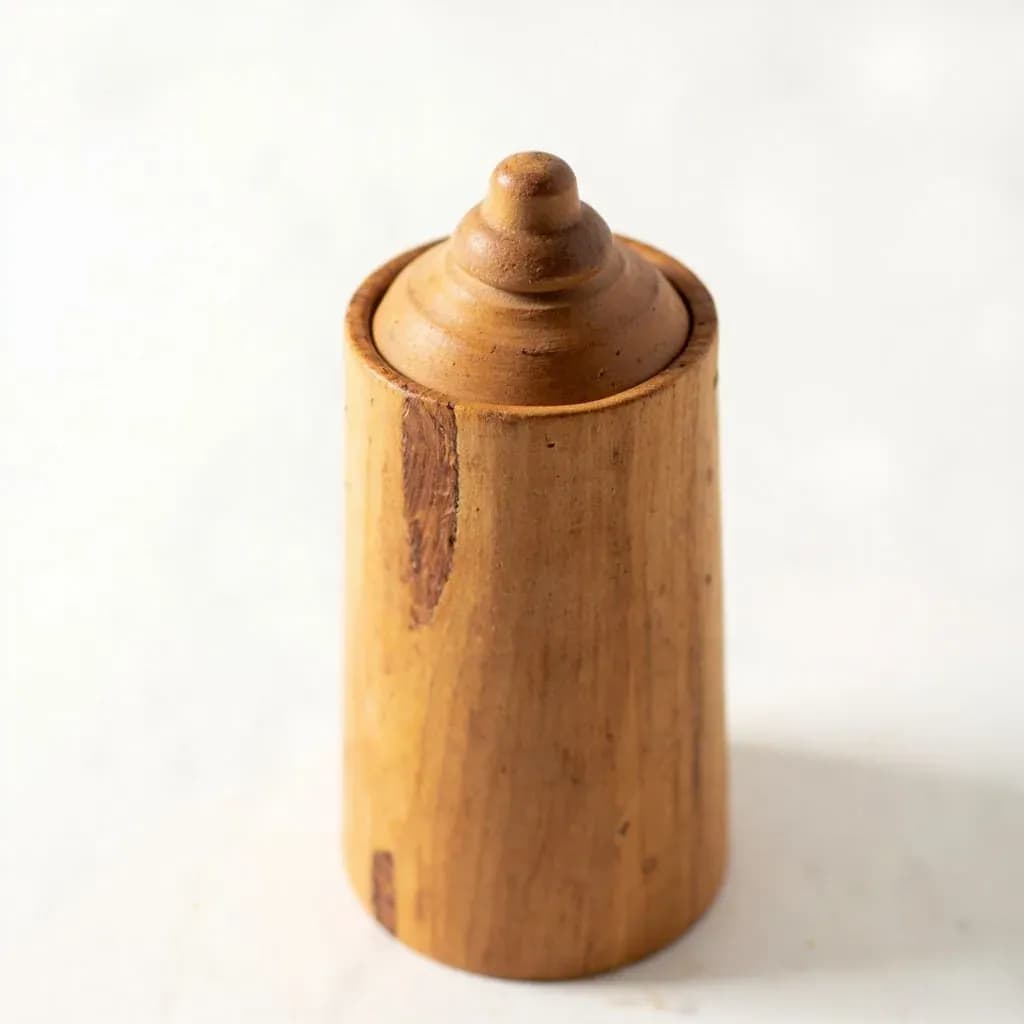
A tall wooden cylinder used in the Himalayas to blend tea, yak butter and salt into butter tea.
A butter tea churn, called a dongmo in Tibet, is a tall narrow wooden cylinder with a plunger used to emulsify brewed tea, yak butter and salt into the rich drink po cha. The cook pumps the plunger up and down until the mixture becomes smooth and frothy. It is a daily fixture in Tibetan, Bhutanese and Himalayan households.
The butter tea churn, known in Tibetan as the chandong (ཆང་དོང་), is a tall open cylinder of wood — traditionally pine or another locally available softwood, sometimes bamboo — fitted with a wooden plunger whose base is a perforated disc. It is the defining tool of the Tibetan Plateau and the greater Himalayan region (Tibet, Bhutan, Nepal, Ladakh, Sikkim, Arunachal Pradesh), where it is used several times a day to make po cha, the salty yak-butter tea that fuels life at altitude. The same vessel is also used to churn cultured cream into yak butter, which is then added to the tea or kept for cooking.
What looks like a simple plunger-and-tube arrangement is, in fact, a precision emulsifier. As the plunger is pumped up and down, liquid is forced repeatedly through the small holes of the disc, which shears the molten fat into droplets fine enough to remain suspended in the watery tea. A whisk simply smears butter across the surface; a blender aerates too aggressively and produces a foamy, unstable drink. The chandong produces the dense, creamy, almost opaque body of authentic butter tea — and, as a side benefit, a layer of fine froth on top that is considered a sign of a well-made cup.
Over years of daily use, a wooden chandong develops a deep tea-and-butter patina that seasoned Himalayan cooks prize rather than scrub away. Modern stainless-steel versions have entered urban Tibetan restaurants and diaspora kitchens, but the wooden churn remains the standard in households, monasteries, and tea houses across the region. For cooks outside the Himalayas, a chandong is the closest one can come to the real article; an immersion blender comes second, a French press a distant third.
Alternatives
Types & varieties
The canonical tall wooden churn with a perforated plunger disc; standard in Lhasa, Shigatse, and Amdo households.
Similar tall wooden construction used for suja (Bhutanese butter tea); often slightly more decoratively carved.
Used in Ladakh and Zanskar; sometimes made with a narrower body suited to small household yields of gurgur cha.
A shorter, wider wooden vessel used to agitate cultured yak cream into butter; distinct from the tea churn, though the same household often owns both.
Contemporary factory-made version with a metal perforated plunger; easier to clean, doesn't absorb flavor, common in urban Tibetan restaurants.
How the perforated disc works
The disc is the engineering heart of the chandong. As the plunger is depressed, tea and molten butter are pushed through the small holes; as it is pulled up, liquid is drawn back through them. That back-and-forth shearing repeatedly divides fat globules into smaller and smaller droplets. Once the droplets are below a certain size, they remain suspended in the aqueous tea rather than coalescing and floating to the top, which is what gives butter tea its signature uniform, creamy body. Holes that are too large leave visible fat droplets; holes that are too fine clog easily. A well-made disc is drilled with smoothly bored holes of roughly 3–6 mm — a detail worth checking when sourcing a churn, because it makes a noticeable difference in the quality of the emulsion.
Seasoning and care of a wooden churn
A new wooden chandong should be seasoned before first use, and a used one should be cleaned with respect for the patina it has built up. Soap is the enemy: it lodges in the grain and re-emerges in future batches as a faint, unpleasant note. Hot water, air drying, and time are all the care a wooden churn needs.
- Season a new churn by plunging 2–3 batches of weak tea with a spoonful of butter through it; discard each batch. This conditions the wood and reduces leaching of woody notes.
- Rinse with hot water only. Never use soap, detergent, or bleach on a wooden chandong.
- Stand the cylinder and plunger open and exposed to air after washing; trapped moisture is what causes splitting and off-flavors.
- Store out of direct sunlight, which can crack the staves as the wood dries unevenly.
- Expect a working wooden churn to darken to a deep amber-brown over months of use — this patina is flavor, not grime, and should not be scrubbed off.
Common uses
Tips & pitfalls
- Use tea at or near boiling. Cold or lukewarm tea will not fully melt the butter, and the emulsion will break within minutes of plunging.
- Plunge straight up and down — do not stir or angle the disc. The plunger must travel the full length of the column to push fat through the holes.
- Fill no more than two-thirds full. The churn needs headspace above the liquid for the plunger to draw liquid back up through the disc.
- Add a pinch of salt. Salt helps stabilize the emulsion; without it the butter separates again almost immediately.
- Shave the butter thinly or melt it briefly before adding. Large cold chunks will not emulsify and will leave greasy streaks.
- Skip a wire whisk if you want authentic texture. A whisk leaves visible fat droplets; a standard blender aerates too aggressively and produces foam rather than the dense, creamy body of real po cha.
- Do not wash a wooden chandong with soap. Rinse with hot water only and let it air dry open — soap flavor will permanently haunt future batches.
- If the butter clumps rather than emulsifying, the tea is too cool or the butter was added in pieces too large; reheat the tea, melt the butter, and start the plunge again.
Good to know
- Tibetan name
- Chandong (ཆང་དོང་)
- Origin region
- Tibetan Plateau and surrounding Himalayas — Tibet, Bhutan, Nepal, Ladakh, Sikkim, Arunachal Pradesh
- Primary material
- Wood (traditionally pine or other softwoods); sometimes bamboo; modern versions in stainless steel
- Construction
- Tall open cylinder with a fitted plunger whose base is a perforated wooden or metal disc
- Typical height
- Roughly 30–60 cm, depending on region and capacity
- Typical diameter
- Around 10–18 cm at the body
- Typical capacity
- 1–3 liters for domestic churns; larger communal versions in monasteries and tea houses
- Mechanism
- Vertical pumping action forces liquid repeatedly through the perforated disc, emulsifying fat into tea
- What it makes
- Butter tea (po cha, ja shog, gur gur), and it doubles as a churn for cultured yak butter
- Replacements in modern kitchens
- Blender, immersion blender, or French press (improvised)
Also called
Dongmo · Chandong
Related

Peeler
Swift blade for stripping skin off fruit and vegetables

Grater
Sharp-toothed surface for shredding cheese and vegetables

Microplane
Ultra-fine rasp for citrus zest, garlic, and hard cheese

Mixing Bowl
All-purpose bowl for combining, whisking, and tossing

Whisk
Looped wires that beat air into eggs, cream, and sauces

Spatula
Flat blade for flipping, lifting, and scraping

Slotted Spoon
Pierced spoon that lifts solids and drains the liquid behind

Wooden Spoon
Gentle, heat-friendly spoon for stirring anything